EXPERIMENTAL: AN INVESTIGATION INTO THE EFFECT OF pH ON THE GERMINATION
OF SEEDS

Introduction
The development, dispersal, and germination of seeds represents part of
the complex structures and mechanisms by which flowering plants ensure
successful reproduction; this is important, because the only purpose of
these living organisms is to ensure that some or all of their genes are
passed onto future generations.  Furthermore, as producers, flowering
plants provide - via photosynthesis - the chemical energy required by
consumers and decomposers:
              Light / Chlorophylls / Enzymes
6CO2(g) + 6H2O(l) 覧覧覧覧覧覧覧覧覧覧覧�ョ C6H12O6(aq) + 6O2(g)     +DE

Seeds vary enormously in size and internal structure. Nevertheless, the
structure of a typical seed is as follows: an embryo, consisting of a
young shoot (the plumule), a young root (the radicle), and one or more
seed leaves (the cotyledons), surrounded by a seed coat (the testa).

Careful experiments have established that, for successful germination,
seeds have three requirements: water (to allow diffusion); dioxygen (to
ensure that enough energy, in the form of ATP, is released via aerobic
respiration); and a suitable temperature (to promote enzyme activity).
                            Enzymes
C6H12O6(aq) + 6O2(g) 覧覧覧覧覧覧覧覧覧覧�ョ 6CO2(g) + 6H2O(l)       -DE

Less well established, however, are the effects of other independent
variables; in view of the increasing levels of acidic pollution, pH
might reasonably be considered one of these.
In this investigation, you are required to examine the effect of pH
on the success and/or rate of seed germination. |
Notes
1.  Germination is considered to be complete when the seedling has
formed its first green leaves; these allow it, via the process of
photosynthesis, to synthesize its own chemical energy by transducing
light energy.
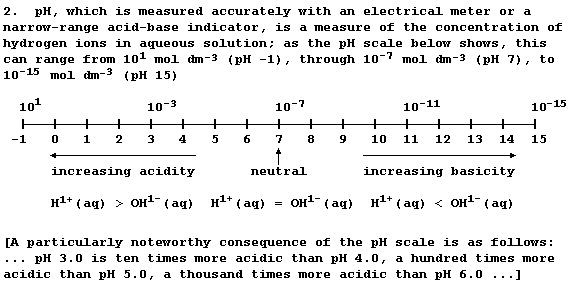
3.  Depending on the weather conditions and location, 'acid rain' can
have a pH of between 2.2 and 5.5: whereas unpolluted rainwater, which
is effectively a dilute solution of carbonic acid, has a pH of 5.6.

4.  You are provided with solutions of varying pH, a variety of seeds,
and growth substrates (including tissue and compost).  In addition, you
will need to use - within reason - other suitable apparatus.

5.  The proposed plan of your investigation should be presented in
detail; this plan may be modified as the investigation proceeds.

Dr. R. Peters                  Next                      Contents' List