APPENDIX: HAT WISSENSDRANG DIE KATZE GETÖTET? (I)
{C. Hinshelwood, who was awarded the Nobel prize for Chemistry in 1956, wrote in The Structure of Physical Chemistry, Oxford, 1951: "Science is not the mere collection of facts, which are infinitely numerous and mostly uninteresting, but the attempt by the human mind to order these facts into satisfying patterns. ..."}
Despite the specter of examinations, there is time, surely, for the conscientious student to stretch his or her abilities in an unorthodox manner. So, in this appendix are ten fragmentary points of discussion which could be mulled over when the «mental batteries need recharging».
Also included here, to leaven these fragments, are extracts of dialog between Dr. Alec D. Stuart and Ms. Alice K. Lidell-Lonsdale at Narkover College (Borst.). [... The Headmaster of this less than august establishment is Mr. Mervyn B. Pond, Phil.; both parents and pupils assume implicitly that the abbreviation «Phil.» is a contraction of Master of Philosophy; the staff, on the other hand, have observed that «Phil.» could be taken to mean philatelist or philistine: Mr. Pond, an otherwise voluble chap, is uncharacteristically reticent on this point. Alice, herself, was the first female pupil at Narkover; her two previous schools were Nutbourne College and St. Swithin's. Dr. Stuart, who is a spiritual descendant of Pooh-Bah, and who took a First in Classics, teaches Science; he wears half-moon spectacles; and is the only staff member with two nicknames: Barbydol (... Barbastella barbastellus) and Desdemona (... Desmodus rotundus). Narkover's mascot, named Stuffet, is a pet canary bird which neither moves nor sings; perhaps coincidentally, Fleabit, the school's moggy, has recently been sent to a new home (owned by a violin maker) ...]
PLAYLET 1: Von Ankunft bis Abschied
Ankunft The winter term is three days old; in a laboratory, Dr. Stuart takes a roll-call for his first lesson with the 4th-Remove (Year 10) ...
Dr. STUART.
Brown.
BROWN.
Present, Sir.
Dr. STUART.
East.
EAST.
Present, Sir.
Dr. STUART.
Flashman.
FLASHMAN.
Here, Sir. (Dr. S. frowns.)
Dr. STUART.
Ms. Lidell-Lonsdale. (Muffled laughs from the rest of the class.) Favete linguis! (Silence follows.)
ALICE.
Present, Sir.
Dr. STUART.
May I extend a warm welcome to you on behalf of the class, or, considering their faux pas, the «sans-culottes»? ... Would you prefer to work with Jack or with Ralph?
ALICE.
Can I work with Jack, please? (She smiles at Merridew.)
Dr. STUART.
Certainly. Errare est humanum. McKechnie.
McKECHNIE.
Present, Sir.
Dr. STUART.
Merridew.
MERRIDEW.
Present, Sir.
Dr. STUART.
Mumford.
MUMFORD.
Present, Sir.
Dr. STUART.
Pattullo.
PATTULLO.
Present, Sir.
Dr. STUART.
Piggy. (No reply.) Piggy! (Still no reply.) Wittering, do you know where Piggy is?
WITTERING.
No, Sir. (He glances fleetingly at both Unman and Zigo.)
Dr. STUART.
Unman.
UNMAN.
Present, Sir.
Dr. STUART.
Wittering.
WITTERING.
Present, Sir.
Dr. STUART.
Zigo.
ZIGO.
Present, Sir.
Dr. STUART.
Now, ladies and gentlemen ...
________________________________________________________________________________________
1. The following has been abstracted from a syllabus: "Setting up and manipulating apparatus with sufficient skill and safety needed ..."
________________________________________________________________________________________
The 4th-Remove are busy in the laboratory identifying unknown compounds using standard anion and cation tests; Dr. S., a pipe-smoker when not on duty, is hovering about in a passable imitation of a Vultur gryphus ...
Dr. STUART.
In flagrante delicto! (He addresses Alice and Merridew.)
MERRIDEW.
But, Sir, our relationship is strictly platonic. (Muffled comments from the other sans-culottes.)
Dr. STUART.
I was not alluding to the birds and the bees. No, rather to the fact that both of you are eating! Those chocolate bars may indeed help you work, rest, and play: ... but, should you absorb a toxic substance, your rest will be permanent — mort, without so much as a tricoteuse in sight. (The entire class look baffled but intrigued by this dead metaphor.) Be that as it may, to eat in the laboratory is a serious infraction of the safety rules. (Dr. S. addresses the class.) Whose purpose, may I remind you all, is homeostasis: ... ensuring that each of you maintains a constant internal environment despite changes in your external environment! (Flashman pretends to whisper something to Brown.) Brown, were you listening? (Brown nods.) And you, Flashman?
FLASHMAN.
Hanging on your every word, Sir. (His tone is breezy.)
Dr. STUART.
100 lines from the pair of you by the start of prep.
BROWN.
But, Sir, that «lettre de cachet» isn't fair!
Dr. STUART.
Fair? Hmph! Brown, life is not fair! Now, ... where was I? Ah, ... Alice and Merridew, your Bunsen is on a yellow flame. (Merridew, but not Alice, looks contrite.)
ALICE.
But, Sir, at my last school, we always had the Bunsen on a yellow flame when on standby.
Dr. STUART.
In my laboratory, ... the only thing that stands is you. Present yourselves in my study after high-tea, complete with three reasons why a yellow flame is not appropriate. ...
Later that day ... Alice and Merridew are standing outside his study (A. looks apprehensive, M. has an assumed air of nonchalance); they can hear violin music which sounds uncannily like a cat miaowing ...
ALICE.
Do you think Barbydol will have a paroxy because we've only got one reason?
MERRIDEW.
J'sais pas ... san-ne-fairy-an. Go on, knock.
ALICE.
No, you knock!
MERRIDEW.
Scaredy-cat! (He knocks on the study door.)
Dr. STUART.
Veni! (The music stops as Alice and Merridew enter. On a coffee table is a weighty Latin tome opened at page ...)
ALICE.
I'm afraid we've only got one reason, ... that burning gas unnecessarily would be a waste of a non-renewable resource?
Dr. STUART.
Splendid! Excellent, ... as far it goes, ... but there are at least two more. First, there is incomplete combustion of methane in a yellow flame: so the concentration of carbon monoxide increases. In turn, this leads to the formation of carboxyhaemoglobin, ... which can have mortal consequences. (There is the merest twinkle in Dr. S.'s eyes.) And, to be honest, I don't think the Remove need help on this subject. (Merridew is a picture of studied innocence, whereas Alice is one of naiveté.) Second, a yellow flame tends to wander, because it is very susceptible to convection currents, and this increases the fire hazard. (Alice and Merridew nod in agreement.) Certainly, with your flowing trestles, Alice, there is a distinct possibility of you being a Cinder-élève.
MERRIDEW.
Oh good, Sir. Very droll indeed, if I may say so, Sir.
ALICE.
Er, ... Oh I agree, Sir. (Alice and Merridew glance at each other, slightly raise their eyes, and sigh very gently.) ...
________________________________________________________________________________________
2. The following has been abstracted from a syllabus: "Communicates the scientific information and ideas gained from an investigation using appropriate nomenclature and specialist terminology with precision and uses the rules of grammar with almost faultless accuracy."
________________________________________________________________________________________
The 4th-Remove enter the library as quiet as mice (sans cheveux?); they expect their marks for the term's first essay: "Lead Chemistry" ...
ALICE.
Sir, you appear to be wincing in pain. Is your prostrate gland troubling you? (Her tone is compassionate.)
Dr. STUART.
I bow to no one! (Alice looks confused.) The word is prostate, without that R. Though a shade indelicate, your concern is appreciated. No, the cause of my anguish is your essay: stated bluntly, it is quite beyond the pale. Let us consider your opening sentences: "Lead is a dead element: as dead as dead can be. It killed the bloody Romans, and now it's killing me." First, the use of the expletive "bloody" is not becoming of a young lady. (Dr. S. averts his gaze; Alice looks suitably demure.) Second, they are, presumably, a parody of a 'witticism' commonly present on the fly-leaves of Latin textbooks. (Alice nods in agreement.) However, examiners are decidedly humourless individuals; indeed their idea of high comedy is chortling over «schoolboy howlers» ever-present on examination scripts. And third, on a purely technical point, ... the element lead, itself, is not toxic. You have almost got the right answer: but the wrong reason! Covalent or ionic compounds of lead are toxic; they have several adverse biological effects ... as, indeed, you note later in your «masterpiece». (Alice looks glum.) Dear me! Pull yourself together! Let us consider your orthography.
ALICE.
Orthography? Please, Sir, what does that word mean?
Dr. STUART.
Spelling. You have made most of the common errors. (Points to: 'burrete' 'definate' 'flourine' 'neccesary' 'pippette' 'seperate' and 'temprature'.) This is woeful, with one L! Don't they teach you to spell in your English lessons?
ALICE.
But we're doing Shakespeare.
Dr. STUART.
Doing? As in, ... say, ... doing to death? And the play?
ALICE.
Something, ... I think ... er, ... it's meant to be a comedy.
Dr. STUART.
Of Errors? (Alice nods.) Just so, Alice. (Alice looks puzzled.) Hmph! Let us change tack slightly. Alice, have you been on a sailing trip recently, to the Scottish islands of Rhum, Muck, and Eigg?
ALICE.
No, Sir! (Her tone is surprised.) Why do you ask?
Dr. STUART.
Your essay is awash with these drunken ugly ducklings ... (He writes on the blackboard: ie eg)
ALICE.
Those are abbreviations for "that is," and "for example,"!
Dr. STUART.
Bôf! Absolument pas! The correct abbreviations are ... (He writes on the blackboard: i.e., e.g.,) I will leave you to consider why variants are not acceptable. And now, let us turn to your omission of the periodicity in Group 14.
ALICE.
But, Sir, when you were wittering on about Mendeleev... (Dr. S. interrupts.)
Dr. STUART.
My apologies for interrupting, Alice. I may warble, I may purr, and I do wax lyrical: but I certainly do not witter.
ALICE.
As I was saying, when you were waxing on about Mendeleev, ... The word was wax? (Dr. S. winces.) ... you said that he designed his Periodic Table on the basis of atomic masses.
Dr. STUART.
I did indeed.
ALICE.
Well he got the right answer: but the wrong reason! As the Table is based on atomic numbers. (Her tone is petulant.)
Dr. STUART.
Hmph! Hoist with my own petard, Alice? (His face beams.)
ALICE.
Just so, Sir! (Dr. S. frowns.) ...
________________________________________________________________________________________
3. The following question, or minor variants thereof, often appears on examination papers: "Write the equation for the reaction between ethene and bromine, and describe the observations you would expect to make."
[C2H4 + Br2(aq) —————® C2H4Br2(l/aq) Orange solution decolorizes and energy change.]
However, the question is specious, for at least three reasons. One, few pupils will have observed this reaction, simply because the preparation of ethene is quite tedious. Two, even fewer (and possibly none) will have executed this reaction, because 1,2-dibromoethane is carcinogenic. And three, it is doubtful whether any chemist, in the last thirty or so years, would have have seriously contemplated using bromine water to test for the presence of an alkene functional group, because there are more sensitive methods available that are non-destructive.
________________________________________________________________________________________
The 4th-Remove are in the laboratory, looking positively angelic; they expect their results for the half-term test on "Organic Chemistry" ...
Dr. STUART.
Heu quam horrendum visu! Cherubic faces. Hmph! La crème de la crème? Absolument pas! The test was an unmitigated disaster! (He sighs deeply.) Zigo was top with 65.2% ... (He observes Zigo blowing on the back of his right fist and then rubbing it on his jacket's left lapel.) No! Not in the least impressive, ... particularly as Mr. Thompson says you are a dab hand at the old dee-y by dee-x! (Zigo looks crushed.) And, as for you, Alice, a meagre 15.1%. You are clearly destined for high office... (She smiles.) There is absolutely nothing to smile about, I can assure you! A little knowledge is not just dangerous: it is useless!
ALICE.
But, Sir? (Her tone is conciliatory.)
Dr. STUART.
Speak now, or forever hold your peace!
ALICE.
You've never explained why we need to know about dibromo ... what's-its-name.
Dr. STUART.
1,2-Dibromoethane. You need it for the public examination!
ALICE.
Are you saying, Sir, ... we just need to know it, just so we can use it in an exam? For a purely utilitarian purpose?
Dr. STUART.
You have been at that dictionary again, Alice. (He smiles.)
ALICE.
No, Sir! My theasaurus! (Her tone is mildly triumphant.)
Dr. STUART.
The word is thesaurus, without that A. It is derived from the... (Alice interrupts.)
ALICE.
Please, Sir, stop being so fussy! Why do we need to know about that 1,2-dibromoethane?
Dr. STUART.
Pedantic, ... moi? Well, ... the compound has been used as a petrol-additive ... (He is reading the textbook, below the level of the dais.) um, ... because it acts as a scavenger for variously formed lead compounds in combustion engines.
ALICE.
And, Sir? (Her tone is disinterested.)
Dr. STUART.
That particular bromination reaction with ethene typifies the addition reactions of alkenes. (He has speed read the paragraph ahead, so his tone is much more authoritative.)
ALICE.
So why can't we do some of those? (Her tone is eager.)
Dr. STUART.
The simplest reactions, that are also safe, are outside the syllabus. And, judging from the results of your half-term test, to do so would be courting disaster. (His tone is pompous.) Class! (The sans-culottes, who have not been paying even the slightest attention to this dialog, are suddenly all agog.) I had forgotten, but Alice's hectoring has reminded me that there should be prep. (Groans from the rest of class.) So, ... I want a minimum of ... two hundred words on this title. (Dr. S. writes on the blackboard: "The simplest alkene homologues that can be studied safely.") Individual work. No cheating! (Dr. S. peers over the top of his glasses, and focuses on Flashman.)
FLASHMAN.
Moi? Absolument pas, Monsieur! (Dr. S. frowns.) ...
________________________________________________________________________________________
4. Stated provocatively, scientists differ from non-scientists in only one fundamental respect: those who can interpret chemical line formulae (see below), and those who cannot. Since time immemorial, the perceived wisdom has been that acquiring the skill in interpreting such formulae is less important than knowing a seemingly endless number of arbitrary facts. However, the acquisition of this skill does allow the scientist, putative or otherwise, to make a reasonable attempt at understanding a significant proportion of topics published in both learned and popular
journals (e.g., Nature, New Scientist, and Scientific American).
Setting aside the anomalies and the finer details, the basic «rules» of line formulae are as follows. Each carbon of the skeleton is shown as a vertex; each full line connecting the vertices represents one localized covalent bond; each hydrogen bonded to the skeletal carbons is omitted; and all other functional groups are shown explicitly.
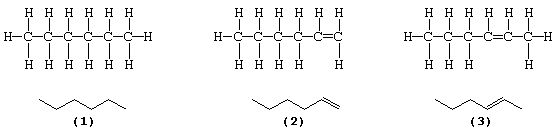
The structural and line formulae of hexane (1), hex-1-ene (2), and hex-2-ene (3) are:
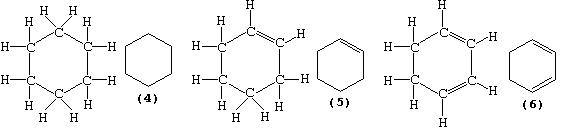
The structural and line formulae of cyclohexane (4), cyclohexene (5), and cyclohexa-1,3-diene (6) are:
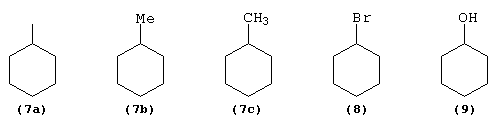
Personal preference, guided by the context, very often determines which carbons are designated skeletal; e.g., methylcyclohexane might be shown as 7a, 7b, or 7c — either of the latter two would probably be used when an author wished to emphasize this compound's topological similarities and/or differences to other substituted cyclohexanes (such as 8 and 9).
[Most of the pupils at Narkover have departed for the half-term «hols». Alice has gone to stay with the Duchess (one of her favorite aunts); confidently expecting «tea and sympathy» on arrival at the noble lady's mausoleum, she is a shade disheartened when greeted with the following growl: "If everybody minded their own business ..." Noblesse oblige?]
5. The merit of line formulae becomes particularly self-evident when large molecules are displayed, as exemplified below; each of these is
topologically related to each other and to chlorophyll-a, hemoglobin, and vitamin-B12. [Incidentally, and stated anthropomorphically, these molecules provide remarkable testimony of Nature's capacity to modify a basic structure in order to realize diverse biological functions.]
Bacteriophytin-a (10) is but one of at least six chlorophylls involved in the transduction of light to chemical energy in photosynthetic bacteria (e.g., Rhodospirillum rubrum). Bonellin (11) is the hormone responsible for masculinization in the marine worm Bonella viridis.

Uroporphyrin (12) is the pigment responsible for the red colouring of the head feathers of the African bird Musophaga rossae. Cytochrome-c (13), which evolved into its present form some 1.5 billion years ago, and which appears to be present in all living organisms (i.e., bacteria, protoctistans, fungi, plants, and animals), is but one of several cytochromes involved in the redox processes of both cellular respiration and photosynthesis.
[Most of the sans-culottes have stayed at school; rather surprisingly, they have been swotting in the library. Wittering has determined that more than one permutation of carbon monoxide, cyanide, cytochrome-a, and hemoglobin has ... well ... sanguinary possibilities.]
6. The most important compound omitted from introductory courses is benzene (14a ... or ... 14b). This omission is perfectly reasonable, because a thorough understanding of its structure and reactivity does require a fairly advanced knowledge of the theories of atomic structure and chemical bonding. Nevertheless, «where angels fear to tread» ...

At first sight, benzene (14a) would appear to be a cyclic analog of hexa-1,3,5-triene (15). However, many pieces of evidence indicate that benzene is not a cyclic hydrocarbon with localized double bonds; just two of these are as follows. First, in contrast to the triene, bromine reacts with benzene by substitution rather than by addition; i.e.,

And second, as determined by a technique called X-ray crystallography, the carbon-carbon bond lengths are all equal: whereas, in the triene there is alternation of bond lengths. Overall, the evidence supports a bonding model for benzene as follows: each carbon atom uses three of its valence electrons to form three localized single bonds (i.e., one with a hydrogen atom, and one each with its adjacent carbon atoms), and contributes its fourth one to the formation of three delocalized bonds.
Scientists accept, as second nature, so to speak, that benzene is not cyclohexa-1,3,5-triene: so formula 14a is not interpreted literally, but automatically generates a mental image better described by 14b; i.e., three delocalized covalent bonds represented by a circle.
In the scientific literature, although the vast majority of compounds containing the «benzenoid fragment» are shown as in 14a, a significant minority are shown as in 14b. However, researchers in the late 1970s, who were developing a technique called stereo-electronic structural analysis, established that for certain compounds both the localized and delocalized descriptions were unexpectedly misleading; as the following
example illustrates spectacularly. Line formulae 16a and 16b represent, respectively, the localized and the delocalized description of the same compound: but the structural analysis showed that 16c was its «best» description (i.e., two «delocalized» rings and one «localized» ring).

[Meanwhile, back at Narkover, the attractions of the library have begun to wane; several of the sans-culottes have started to take an unhealthy interest in both handicraft and Fortune-Tellers.]
7. A line formula merely shows a compound's topology (i.e., the types of atoms, and their connectivity): it does not show topography (i.e.,
the spatial relationships between the atoms). So, line formulae can be (unwittingly) misleading; e.g., at first sight, both benzene (14a) and cyclohexane (4) might appear to be planar: however, whereas benzene is indeed planar, cyclohexane is non-planar. No attempt will be made here to expound upon the important details of the rather complex topography of cyclohexane; on the other hand, one should certainly be aware that molecular models show that the six carbon atoms can arrange themselves into boat (4a) and chair (4b) forms.

Generally speaking, topographical information is conveyed by the use of stereo-chemical line formulae — whose «rules», in part, are as follows. A thick wedge denotes a bond projecting forwards from the plane of the paper (i.e., towards the observer); a broken wedge denotes a bond projecting behind the paper (i.e., away from the observer); and a normal line denotes a bond in the plane of the paper.
As an illustration of the above rules, shown below are stereo-chemical line formulae for three compounds: ammonia (17), tetramethyllead (18), and xenon tetrafluoride (19).

Finally, to conclude this brief introduction to stereo-chemistry, and with mischief (but not malice) aforethought, a chemical puzzle. ... Line formula 20 is absolutely correct for both 20+ and 20-: but, 20+ and 20- are definitely not the same compound. Below are four «cluettes» which might allow the resolution of the fundamental difference between these two compounds: one, a pair of molecular models ask the question "Mirror mirror, on the wall, which camphor ball is the fairest one of all?"; two, mité testes; three, Tineola bisselliella; four, lateral inversion is the apparent left-to-right reversal of an image behind a mirror.

[Mumford, a patient soul, has spent the entire half-term watching his crystal of hydrated copper(II) sulfate grow; he is dismayed to find out that the rigorously correct name for his biocidal pride and joy is: tetraaquocopper(II) tetraoxosulfate(VI)-water(1/1). "What's the use of you having that name," Mumford muttered absentmindedly, "if you won't answer to it?" "No use to me!" retorted the Crystal, out of the blue. "But it must be useful to most people, sometime, I suppose. If not, why do things have correct names at all?" ... "J'ai pas tellement d'idée," Mumford replied indifferently, "mais ... tu es ... vachement joli!" ... The blue Crystal was embarrassed: but it was difficult, so so difficult ... no, impossible to blush.]
________________________________________________________________________________________
8. The following has been abstracted from a syllabus: "... Historical origins of the Periodic Table, especially the work of ..."
________________________________________________________________________________________
The half-term at Narkover sees an influx of girls: a trio from Eire (Lolli, Popsy, and Shandy), who have been placed in the Third form (Year 9); and triplets from Australia (Holly, Molly, and Polly), who have entered the Second (Year 8). The Headmaster, otherwise occupied with his stamp collection, has asked Alice to show the seniors round the school. These four girls arrive outside Dr. S.'s study; inside, he is attaching colored stars to pupils' work whilst listening to music by Heinichen ...
ALICE.
Quiet! (She whispers to her charges, who are twittering.) Barbydol may be roosting. (She knocks, gently.)
Dr. STUART.
Veni! (The girls enter.) Dear me! I do believe I am the rose between four thorns. (The new girls look bewildered.)
ALICE.
Sir, why were you listening to that cacophony?
Dr. STUART.
It refreshes the parts that other music doesn't reach. Now, how can this humble servant assist the pinafore brigade?
ALICE.
No way really, Sir. I'm just showing these new girls round the school. But, ... I ... er, ... do have a problem. ...
Dr. STUART.
Should I hear this? Perhaps, ... Mlle Gossâge or Matron?
ALICE.
No, Sir! Me and Merridew ... I mean, Merridew and me ... I mean ... Oh never mind! We've finished. It's Mendeleev. You said that he predicted the properties of some unknown elements by averaging those known above and below the gaps.
Dr. STUART.
I did indeed.
ALICE.
Well, ... he predicted the melting point of eka-silicon by sort-of-averaging those of silicon and tin? (Dr. S. nods.) And so, ... if had done the same thing for eka-aluminium, by averaging those of aluminium and indium, then he would have got a value of about 400°C. Instead, he predicted that the melting point would be "low". And gallium's is! 30°C! A bit like that monk Mendel, I think that he had discov... (Dr. S. interrupts.)
Dr. STUART.
Alice! Perish that thought! It is a poisoned chalice. ...
ALICE.
But... (Dr. S. interrupts again.)
Dr. STUART.
No! I cannot countenance the notion that there was another Bayesian Affair in that century. Off you go girls! Shoo! Back to cooking, ... or whatever it is called these days.
The girls file out of Dr. S.'s study, crocodile fashion. Alice closes the door, and then the three younger girls start to chatter excitedly.
LOLLI.
Golly gosh, Alice, what is an affair? (Popsy interjects.)
POPSY.
The old goat probably had a mistress. (Her tone is rather patronizing.) What was all that about eka?
ALICE.
I wouldn't worry about it, Popsy. You'll soon realize that old Barbydol trots out the same stuff, year in, year out.
SHANDY.
Oh super! But, Alice, why was he wearing a black gown?
ALICE.
He probably suffers from hypothermia. He is certainly old: thirty-five at least. Or, it may be the tribal instinct ...
LOLLI.
Yes, but, gosh, didn't you notice? He had another hanging on the back of the door. That one had fur on the collar!
ALICE.
Yes, I know. Apparently, he wears that on Speech Day ... to impress our parents. (Curiously, her tone is one of pride.)
POPSY.
Ugh! It smelt of moth balls.
ALICE.
We don't say that word here! It's not becoming of a young lady. (She states primly, but continues pompously ...) As I am Head Girl, I will ensure you are la crème de la crème.
The girls turn left at the end of the corridor. Alice shrieks. Arranged within a scale model of a prison are seven dolls: one is large; three are medium-sized; and another three are small, but identical. Each doll contains pins, shaped like hockey-sticks, pierced through its body. A few of the sans-culottes are watching this jolly scene from a balcony.
________________________________________________________________________________________
9. The following forms part of a typical syllabus: "... Students should recognize the position and general properties of the transition
elements; such properties should include variable oxidation states, catalytic behavior, and the formation of colored compounds." Whether this fragment should be taken at face value is a moot point ... or two.
First, even though over half of all the known elements are transition metals, the (broadest) definition of a transition metal — 'An element which has partially filled d or f shells in any of its common oxidation states' — is well beyond the scope of the syllabus. Contrastingly, many textbooks and examination papers designate both cadmium and zinc as transition metals: despite the fact that neither of them observe the theoretical requirement, much less show the typical properties.
Second, because these characteristic properties are often not alluded to in discussing other elements, one might reasonably assume that they are perhaps irrelevant: but, ... Most elements form compounds in more than one oxidation state; e.g., indium [(I) and (III)], lead [(II) and (IV)], phosphorus [(III) and (V)], and sulfur [(II), (IV), and (VI)]. Catalytic behavior is shown by the widest variety of elements, ions, and compounds; e.g., trioxygen (ozone), iodide ions, and enzymes.
And finally, most non-transition elements form some colored compounds; e.g., lead(II) iodide is yellow, nitrogen dioxide is brown, and sodium nitrite is pale-yellow. Moreover, in everyday-life, almost all of the coloration observed — naturally or synthetically — is attributable to organic compounds; the colors of those shown below should prove to be enlightening.

________________________________________________________________________________________
The sans-culottes are close to succumbing to rigor mortis, because they have been hearing, though not listening to, Dr. S. droning on about the iron-catalyzed synthesis of ammonia; outside, the clouds promise snow; inside, Zigo has finger-traced the word Gossâge on a steamed-up window: but Alice, sanguine as usual, has her looking-glass at the ready ...
ALICE.
Please, Sir, I think I've grasped the facts about transition metals. But why do they behave as they do?
Dr. STUART.
Alice, have you ever come across the words "disingenuous", "dissemble", or "dissimulate"? (Alice shakes her head.) Class! Alice has, indirectly, reminded me about prep. You are to find out the meanings of those words, and the phrase «écriture de chat», by next term. Class dismissed! ...
The class leave the room in ghostly silence. Alice's attempts to engage in conversation with the sans-culottes are received with sang-froid.
________________________________________________________________________________________
10. Those with a whimsical turn of mind might consider that bonellin (11), the hormone responsible for masculinization in the marine worm
Bonella viridis, is not particularly efficacious; ... after all, the female is several thousand times heavier than the male of the species. In Homo sapiens, chauvinism is of graver concern ...
________________________________________________________________________________________
The first snows of winter have fallen at Narkover, so the young are at play. The 4th-Remove have constructed a four-seater motorized toboggan. East and Flashman, who have abducted Alice, hold a modest lead in this vehicle over the rest of the sans-culottes pursuing on foot ...
FLASHMAN.
Faster, Scud, faster. We're leaving 'em!
EAST.
What was that!? (He shouts.) What did you throw out?
FLASHMAN.
Useless baggage! Pas de problème! Step on the gas!
EAST.
What baggage? We had none! Merde! You ... you ... no, Flashy you couldn't have ...
Abschied The winter term is almost over; in a laboratory, Dr. Stuart takes a roll-call for his last lesson with the 4th-Remove ...
Dr. STUART.
Brown.
BROWN.
Present, Sir.
Dr. STUART.
East.
EAST.
Present, Sir.
Dr. STUART.
Flashman.
FLASHMAN.
Here,... (Dr. S. looks up sharply.) Er, ... Present, Sir.
Dr. STUART.
Ms. Lidell-Lonsdale. (No reply.) Alice! (Still no reply.) Wittering, do you know where Alice is?
WITTERING.
No, Sir. (He glances fleetingly at both Unman and Zigo.)
Dr. STUART.
Wittering, ... sans-culottes ... ou ... sans sens?
WITTERING.
Monsieur, qu'est-ce que vous entendez par sens?
Dr. STUART.
Cela veut dire ... mais non! Regardez votre dictionnaire! (He looks down again at the register.) Merridew.
MERRIDEW.
Present, Sir.
Dr. STUART.
McKechnie.
McKECHNIE.
Present, Sir.
Dr. STUART.
Eh bien, sans-culottes ou ... sanglantes culottes? (He waits as the class hunt through their dictionaries.) Mumford!?
MUMFORD.
Present, Sir. Um, I mean, er, ... blood-stained, Sir.
Dr. STUART.
Oui, c'est ça. Peut-être, ... sans-culottes ... sans sens avec sanglantes culottes? Hmph! Que je souffre. Pattullo.
PATTULLO.
Present, Sir.
Dr. STUART.
Piggy. (No reply.)
PATTULLO.
Please, Sir. Piggy is no longer with us.
Dr. STUART.
Thank you, Pattullo. I do remember. I am not senile, yet. Did you go to his memorial service with your Housemaster?
PATTULLO.
Yes, Sir. Mr. Gowers took a whole group of us. They played some achingly beautiful music.
Dr. STUART.
Splendid, Pattullo, splendid! Two House points. Unman.
UNMAN.
Present, Sir.
Dr. STUART.
Wittering.
WITTERING.
Present, Sir.
Dr. STUART.
Zigo.
ZIGO.
Present, Sir.
Dr. STUART.
Now, ladies and gentlemen ... (He peers over the top of his glasses to survey the class.) ... Oh dear, just gentlemen — and I use that word advisedly. As this is the end of term, I thought a smattering of culture might not go amiss. Zigo, I think the class will appreciate my choice of music.
ZIGO.
Really, Sir?
Dr. STUART.
Yes. At its first performance, the musicians blew out their candles as they left one by one during the final movement. (He plays a CD of Joseph Haydn's Farewell Symphony.) ...
HAT WISSENSDRANG DIE KATZE GETÖTET? (II)
{P.W. Atkins, a distinguished author and scientist, wrote in Molecules, Scientific American Library, New York, 1987: "... chemists achieve evil as well as good, sometimes by accident but sometimes by intention. It would be improper to conceal this dark face of their activity, to show their benevolent creations but not their malevolent, so a few of their pernicious contrivances are [included within Molecules] ..."}
Presented here, for the conscientious student wishing to stretch his or her abilities in an unorthodox manner, are seven fragmentary points of
discussion which could be mulled over at leisure.
Also included here, to leaven these fragments, are selected scenes from the second term of Narkover College's inaugural year as a co-educational establishment. [... This boarding school ostensibly evinces several sensuous images at the breaking of a new day: the sun's rays, streaming thru the pristine windows of the Headmaster's bedroom, reflect from an academic gown; the playing fields echo the resonant sound of leather on willow; and the unadulterated tones of a boy soprano's voice float ethereally through the beautiful chapel. But, mirroring what may be a universal truth, precious little at Narkover is quite what it seems ...]
PLAYLET 2: Ein Musikalischer Spass, In Memoriam Papa (28.5.1787)
7.45 a.m. To the opening strains of the Intrada from Leopold Mozart's Musikalische Schlittenfarht, Dr. Alec Stuart — with barely a proverbial fig-leaf to cover his modesty — lights a candle, walks over to his study's windows, and draws open the curtains; the playing fields are carpeted in thick snow, and a solitary raven is perched on the roof of the school's cricket pavilion.
7.45 a.m. In the pavilion — strictly out-of-bounds — the sans-culottes of Narkover's 4th-Remove (Year 10) are assembled; each is wearing a red bobble-hat in the manner of a late C18th French bonnet rouge ...
McKECHNIE.
To order, gentlemen. Flashy, knock it off. (Flashman stops idly bouncing a cricket ball on a bat.) Ziggy, Witters, any repercussions from last term?
ZIGO.
I'm not sure, Duncan. Witters and I went down to the lake yesterday evening; there is no sign of either the baggage or the red cloak.
McKECHNIE.
Mmm ... We'll have to keep a weather eye there. Moving on, ... as all of you must have noticed, towards the back end of last term the trogs in the lower school had started to refer to us as «sans-culottes». What... (Flashman interrupts.)
FLASHMAN.
Les enfants s'amusent! (His tone is dismissive.)
McKECHNIE.
That may be so, Flashy: but, as Barbydol would doubtless say in his tedious Latin spiel, it's certainly infra dignitatum. What we need is an appellation with style: any suggestions?
FLASHMAN.
«La Jeunesse dorée», peut-être, parce... (East interrupts.)
EAST.
Acré! Both Barbydol and Bassy are up and about.
McKECHNIE.
Zut! We'll reconvene after second prep tonight. ...
7.45 a.m. In the Headmaster's bedroom, his lady wife — the epitome of French chic — is reclining gracefully on the bed; Mr. Mervyn B. Pond is preening himself in front of a full-length mirror (set at 30°) ...
Mrs. POND.
Bassett ?
Mr. POND.
Oui, ma chouette ?
Mrs. POND.
Tu sembles beau et distingué à la fois.
Mr. POND.
Je dois consentir avec toi. (His slightly puffed-up tone then changes to one of affection.) Tu es bien ballotée ; et je t'adore... Ce soir ?
Mrs. POND.
Je suis désolée, pas ce soir. Mes règles... (Her tone is resigned, but changes to one of concern as B.'s face shows both embarrassment and disappointment.) ... T'en fais pas ; on a tout le temps !...
7.45 a.m. In the chapel, the school's organ scholar and its principal chorister are both reading novels; playing in the background is a CD recording of the Benedictus from Leopold Mozart's Missa Solemnis in C.
8.50 a.m. In the chapel, the first assembly of the term is drawing to a close; the Headmaster stays on his feet to deliver the notices ...
Mr. POND.
Good morning, School. (Benevolent smile to the staff and students.) This term, to what has been, hitherto, an almost exclusively male preserve, I have the pleasure of welcoming twenty new young ladies. With such a significant proportion of le beau sexe ... (He smiles ingratiatingly.) ... the school's motto, Homo doctus in se semper divitas habet — A learned man always has wealth in himself — is clearly in need of revision! ... Mlle Gossâge, their Housemistress, in keeping with our traditions, has arranged a hockey match for the end of term with our closest rivals, St. Swithin's. ... And, yes, gentlemen, attendance will be compulsory! (Scowls from the senior boys.) ... Rather disturbingly, and most regrettably, Alice Lidell-Lonsdale, last term's Head Girl, does not appear to have returned. (Dr. Stuart glances at the sans-culottes, who are pictures of studied innocence.) Therefore, I have appointed a new student, Ms. Forthort, to uphold the standards set by her predecessor. Incidentally, Mlle Gossâge, together with Dr. Stuart, will also be
supervising the exchange visit over half-term to the Lycée Villiers in La Rochelle; our putative ambassadors are the 4th-Remove, ... but whether the Entente Cordiale will still flourish is a moot point. (He sighs in a resigned manner; wry smiles from the senior part of the school.) This brings me neatly on to my last... Flashman! (The entire school focus their eyes in F.'s direction.) Would you be so kind
as to share your sense of amusement with the rest of us?
FLASHMAN.
I'm afraid to have to tell you, Sir, but you are wearing odd socks. (Mr. Pond glances towards his feet, which reveal one sock as dark red and the other as dark blue.)
Mr. POND.
Flashman, I do appreciate that the younger generation feel they have a monopoly on fashion, ... the taste, nay, deluded individualism shown by wearers of earrings is perhaps a case in point. However, those of maturer years may well have the surer sense of style: ... I, for one, consider that odd socks are decidedly natty; Burlington Bertie certainly cannot rest on his laurels! (As one, the students look baffled by this
dead metaphor.) And now, to continue with my final notice. ... As our new students should have observed already, apart from the safety regulations, every notice and sign within the school is in French; these changes were introduced last term as a prelude to the introduction of bilingualism at Narkover this coming autumn term. I would like to be able to report that this innovation was an unqualified success: but, periodically throughout last term, many of the signs were either modified or translocated, much to the confusion of the lower part of the school! Naturally, my colleagues and I have our suspicions as to the culprits, ... (He looks pointedly at the 4th-Remove.) ... but we are confident that the threat of suspension will prove an effective deterrent.
Now, whilst most of you would probably like to listen to my dulcet tones indefinitely, ... (He smiles whimsically.) ... or at least until after the start of the first lesson, ... I do believe that having entered the groves of academia, it is incumbent upon you to sample its fruits. Good morning! (He nods to the staff, who follow him from the chapel.) ...
11.00 a.m. In a laboratory, Dr. Stuart takes a roll-call for his first lesson of the term with the 4th-Remove ...
Dr. STUART.
Brown.
BROWN.
Present, Sir.
Dr. STUART.
East.
EAST.
Present, Sir.
Dr. STUART.
Flashman.
FLASHMAN.
Present, Sir.
Dr. STUART.
Ms. Lidell-Lonsdale. (No reply.) Oh dear, Alice appears to be no longer with us. ... Ms. M. A. Forthort.
Ms. FORTHORT.
Present, Sir. (Dr. S. looks up sharply.)
Dr. STUART.
How remarkable! Apart from the colouring of your hair, you look the splitting image of Alice. Indeed, I would go as far as to say you are alike as two... Um, ... Never mind.
Ms. FORTHORT.
Not really surprising, Sir. You must of heard of identical twins who were separated at birth.
Dr. STUART.
Hmph! How extraordinary! And what does the M stand for?
Ms. FORTHORT.
Malice, Sir.
Dr. STUART.
Er, ... Interesting. (He glances fleetingly at both Merridew and Wittering.) Um, ... I mean, splendid! ... McKechnie.
McKECHNIE.
Present, Sir.
Dr. STUART.
Merridew.
MERRIDEW.
Present, Sir.
Dr. STUART.
Mumford.
MUMFORD.
Present, Sir.
Dr. STUART.
Pattullo.
PATTULLO.
Present, Sir.
Dr. STUART.
Piggy. ... C'est triste; il est mort. (He speaks softly, in a sad tone, to no one in particular.) ... Unman.
UNMAN.
Present, Sir.
Dr. STUART.
Wittering.
WITTERING.
Present, Sir.
Dr. STUART.
Zigo.
ZIGO.
Present, Sir.
Dr. STUART.
Now, ladies and gentlemen. This term we must direct some of our attention to the Biology syllabus. So, your project has this title: ... (He writes on the board: "The relationship between The Ozone Layer and Ein Musikalischer Spass."; and, as the class copy down this title, he places a transparency of these structural and line formulae on a projector:

then, after about a minute ...) May I have your attention, please? (He smiles warmly.) Thank you. I have decided to introduce our biological studies by revising and expanding upon several of last term's chemistry topics. ... Many biologically important molecules are based on a repeating five-carbon unit known as isoprene, which is biosynthesized from isopentenol. (He points to their respective formulae.)
First, what would be the toxic gas formed by the incomplete combustion of either molecule and what substance is formed in the human body by this gas? ... Yes, Merridew?
MERRIDEW.
Carbon monoxide ... and it forms carboxyhaemoglobin, Sir.
Dr. STUART.
Splendid! Merridew, well done! This transparency shows the line formulae of both oxyhaemoglobin and carboxyhaemoglobin:
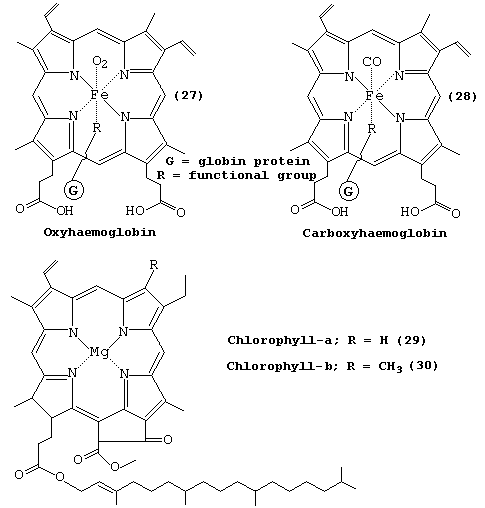
Please note, in passing, their topological relationship to chlorophylls-a and b. ... Unman, you look perplexed!
UNMAN.
Sir, do we really have to know these formulae for the exams?
Dr. STUART.
Absolument pas! As Lord Bountiful, I am merely scattering a few academic acorns in your general direction. (He smiles.) Now, second, how could one distinguish between isoprene and isopentenol, ... Mumford? (As M.'s silence continues, most of the class raise their hands.) ... No! (He addresses the rest of the class.) I am confident Mumford does know the answer. Mumford, let us break down the question. ... What functional group do these two molecules have in common?
MUMFORD.
Carbon-carbon double bond, Sir.
Dr. STUART.
Good, ... and one test for the group is?
MUMFORD.
Um, ... Orange-brown bromine water decolourizes, Sir?
Dr. STUART.
Excellent. Now, ... how do these two molecules differ?
MUMFORD.
Isoprene has two double bonds, ... but isopentenol only has one. ... Oh, I think I see, Sir. Isoprene would require two moles of bromine water, and isopentenol just one?
Dr. STUART.
Splendid! (Mumford looks chuffed.) Yes, Mumford, you have good reason to look pleased with yourself. Your grey cells are always positively champing at the bit to be put through their paces; give them oxyhaemoglobin, so that they can carry out aerobic respiration, and the resulting ATP turns them into thoroughbreds! ... Yes, Flashman? (He sighs.)
FLASHMAN.
That was a rather laboured metaphor, Sir.
Dr. STUART.
True, admittedly, Flashman, ... but I'm just a mere mortal. Moving on! ... Ozone, when produced by a complex series of photochemical reactions involving various nitrogen oxides and unburned hydrocarbons emitted from vehicle exhausts, is a component of photochemical smog. In sharp contrast to its benevolent rôle in the upper atmosphere, protecting the biosphere from harmful u.v. radiation, low level ozone is malevolent: it causes the destruction of a diverse range of synthetic and naturally occurring molecules. For example, the corrosion of rubber — as this transparency summarizes:
![Reaction scheme summarizing the decomposition of rubber [poly(isoprene)] by ozone](media/wis2c.gif)
... Now, Class, after pondering this scheme, are there any comments or questions? ... Yes, Brown?
BROWN.
Does this scheme have any relevance to our project, Sir?
Dr. STUART.
Strictly speaking, no! I would be being disingenuous to say otherwise. However, it is true that some of the biological effects — resulting from, on the one hand, the depletion of the ozone layer, and on the other, the accumulation of low level ozone — are coincidentally the same. ... Now, Class, put those grey cells through their paces! ... ... Yes, Zigo?
ZIGO.
By analogy with bromination, would one classify that first reaction in the scheme as an addition reaction?
Dr. STUART.
Absolutely! Good. Go on, Zigo. ...
ZIGO.
Sorry, Sir, I don't see any implications ... unless ... um, ... rubber is biosynthesized from isopentenol? (Dr. S. nods encouragingly.) Well, ... by extension, any biological molecule which either is biosynthesized from isopentenol ... or contains a double carbon-carbon bond is susceptible to destruction by ozone?
Dr. STUART.
Magnificent! Zigo, well done indeed! Please note in... Yes, Flashman? (He sighs.)
FLASHMAN.
Last term, didn't you mutter something to the effect that, despite some inevitable differences, all living organisms share similar biochemistry?
Dr. STUART.
I would disagree vehemently with your choice of the verb "to mutter". (He smiles.) But, setting aside that infelicity, the point is both astute and very important; and has, albeit indirectly, particular relevance to the project. Now, ...
moving on! Other biological molecules biosynthesized from isopentenol include cholesterol and these sex hormones:
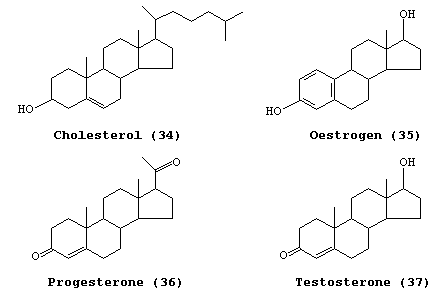
... and this leads me directly on to your prep, which is in two parts. First, I want you to calculate the molar mass of each steroid; you may find it useful to convert each line formula to its structural equivalent. And second, I would like you to do a little background reading on the biological effects of these particular hormones. Mmm, ... With the bell a few minutes away, I'm going to show my usual generosity of spirit and allow you to start prep. (The class haul out their pencils, erasers, and — with the exception of Malice — calculators. Dr. S. waits for a minute or so: and then ...) Class! I spy calculators. (His tone is one of distaste.)
BROWN.
But, Sir, all these steroids have eighteen or more carbons, ... and we only know up to our twelve times table.
Dr. STUART.
Bôf! The relative atomic mass of carbon is ...? Mumford!?
MUMFORD.
Um, ... (He looks at his Periodic Table.) ... 12, Sir.
Dr. STUART.
Twelve twelves are?
MUMFORD.
Um, ... 144, Sir.
Dr. STUART.
And six twelves are?
MUMFORD.
72, Sir.
Dr. STUART.
And so, eighteen twelves must be?
MUMFORD.
Um, ... 216, Sir.
Dr. STUART.
Splendid! As Malice has clearly realized, ... (He gives M. a winning smile.) ... and as Mumford has just demonstrated, a calculator is not de rigueur for all calculations. (His tone is pompous.) Mmm, ... I do believe that, at the end of last term, I set prep... Flashman! Quo vadis? (He addresses F., who has risen on hearing the sound of the bell.)
FLASHMAN.
Nowhere, Sir. I was just, er, ... stretching my legs, Sir.
MALICE.
Please, Sir. Isn't Flashman's feeble excuse an example of dissimulation? (Venomous gasps from the sans-culottes.)
Dr. STUART.
Malice, would you care to expand — perhaps by a definition?
MALICE.
Well, ... to dissimulate is 'to conceal or disguise one's true intentions or opinions under a feigned appearance'.
Dr. STUART.
Just so, Malice. Class dismissed! ...
2.45 p.m. The 4th-Remove arrive in a music classroom for a lesson of General Studies with Signore Arsenio Salieri; the latter sweeps into the room as the bell stops ringing ...
Sig. SALIERI.
Ciao, tutti!
CLASS.
Ciao, Professore. (In slightly patronizing tones.)
Sig. SALIERI.
Mah, ... The entire class on time: ... there must be mischief afoot. (He surveys the room in a circumspect manner.)
WITTERING.
Sir, you do us a grave injustice; we're culture vultures at heart. This morning, Dr. Stuart set us a project involving Ein Musikalischer Spass. Who composed it?
Sig. SALIERI.
Wolfgang Mozart. Would you like to listen to a recording? (No response.) No? Non importa! Perhaps a little revision of scales? (Chorus of "No, Sir, the recording, please."; Sig. Sal. plays a CD and, for the following 20 minutes, the class show varying degrees of amusement, bemusement, and boredom: and then ...) Any comments?
PATTULLO.
Most of it sounded not quite right, ... as if it was some sort of joke.
Sig. SALIERI.
Complimenti! Most perceptive. Indeed, it is gratifying to realize that your constant exposure to popular music has not completely deadened your sensibilities. In point of fact, Wolfgang wrote this composition as a parody of those written by his bungling contemporaries and... Yes, Malice?
MALICE.
Sir, in what way is that a fact?
Sig. SALIERI.
Ecco, ... Since time immemorial, the authors of articles in reference books and recording notes have been in agreement as to Mozart's raison d'être.
MALICE.
That may be so: but, is there any evidence to support their common assertion? For example, are there any documents?
Sig. SALIERI.
Dunque, se non è vero, è ben trovato. (He mutters under his breath.) To be honest, I've no idea ... but, as a starting point for your project, you should find out precisely when Wolfgang wrote this composition. And now, a little more... (The bell rings.) ... La campana, mi dispiace. ... Ciao! ...
3.40 p.m. The senior girls — including Lolli, Popsy, and Shandy from the 3rd-form (Year 9) — arrive at one of the pitches for their first field-hockey practice with Mlle G.; each girl is wearing a canary-yellow blouse and a dark-grey gym skirt. From one touchline, the sans-culottes provide an unceasing tirade of disparaging and indelicate comments; and from the other, several of the younger girls — including the triplets
from Australia (Holly, Molly, and Polly) — provide a cacophony of gushy sounds: then, after about twenty minutes ...
Mlle GOSSÂGE.
Boys! (She shrills.) Your language and general behaviour is upsetting my gals. (Tortured pronunciation of girls.)
FLASHMAN.
Sorry, Miss. Are we putting your gals off their strokes?
Mlle GOSSÂGE.
What impertinence! Young man, I don't care for your tone at all! Report to Dr. Stuart! All of you! Immediately! (She accompanies each shrill phrase with a toss of her head.) ...
4.10 p.m. The sans-culottes arrive outside Dr. S.'s study; inside, he is polishing his violin, which has been restrung recently with catgut strings, whilst listening to Leopold Mozart's Sinfonia burlesca ...
McKECHNIE.
Flashy, no smart comments in there! (He whispers, and then knocks gently on the study door.)
Dr. STUART.
Veni! (The boys enter.) Pauvre de moi! Les bonnets rouges have come to cart me off to Mme Guillotine. (He smiles.)
FLASHMAN.
Your wish is our... (McKechnie kicks F., who winces.) Um, ... No, Sir. Gossypol ... (Dr. S. partially suppresses a smile.) ... I mean, Mlle Gossâge has told us to report, Sir.
Dr. STUART.
Do, please, enlighten me.
FLASHMAN.
Well, ... at the girls' hockey practice ... our conduct may have been unbecoming of gentlemen.
Dr. STUART.
I assume that is a masterful understatement? (Each boy nods his head and shuffles from one foot to another.) From my vantage point, ... (He glances out of his study's windows.) ... you appeared to be indulging in a decidedly juvenile exhibition of callow behaviour. Any dissent ... or excuses? (No response.) Mmm, ... Let me see, ... punishment to fit the crime? (He ponders for about a minute, and then — with his eyes twinkling ever so slightly — he addresses the boys.) Each one of you will «volunteer» to help erect the temporary shower facilities for the girls' hockey match at the end of term. (Each boy mumbles "Yes, Sir.") And, ... Yes, East?
EAST.
Should we apologize to Mlle Gossâge?
Dr. STUART.
I have to presume that question is rhetorical. (His tone is caustic.) Most of you have probably heard the expression «Manners maketh man». Well, as each of you should determine by executing the prep I set this morning, it is definitely «Testosterone which maketh man» — in the biological sense, at least. Be that as it may, ... Yes, Pattullo?
PATTULLO.
Please, Sir, who composed that music you were listening to?
Dr. STUART.
Tempering my displeasure with a judicious digression, eh? (He gives Pattullo a quizzical look.) Leopold Mozart. (He sighs.) Oh, ... go on, ... make yourselves scarce. ...
9.15 p.m. The sans-culottes reassemble in the pavilion, after second prep and before the dormitory roll-call ...
McKECHNIE.
To order, gentlemen. First, Barbydol's punishment; ... any comments?
WITTERING.
What a drag! (General murmur of agreement.)
MERRIDEW.
I'm not so sure. Indeed, I think we may be able to use it to our advantage. ...
McKECHNIE.
Jack, don't keep us in suspense!
MERRIDEW.
Eh bien, ... there's an infamous scene in a film called MASH which involves a temporary shower facility.
McKECHNIE.
And, Jack? ... And!
MERRIDEW.
No, ... no more details. I think everybody should see the movie first — to determine whether the same idea recurs.
McKECHNIE.
D'accord! Flashy, Spats, Ziggy, ... tous? (Expressions of complete agreement.) Moving on, ... does anybody know where Malice disappeared to in first prep?
UNMAN.
She went to the library; apparently she was following up old Arsenic's suggestion as to the date of Mozart's composition.
WITTERING.
Hmph! More fool her! Barbydol's project is probably one of his academic red herrings. Spats, you're the renaissance man amongst us. Qu'est-ce que tu en penses?
PATTULLO.
Je ne sais pas. ... My gut feeling is that Mozart, père et fils, may be part of the conundrum: but don't ask me why.
McKECHNIE.
Mmm, ... Quelle heure? (He looks at his watch.) Oh, zut! We'll have to split; the dorm bell is just about to ring.
________________________________________________________________________________________
1. A population, which is group of individuals in a species that live in a defined habitat, increases exponentially if there is an increase
in birth rate over death rate. However, such exponential growth cannot continue indefinitely because limiting factors determine the carrying capacity of the natural environment for any given population. The human population has increased exponentially for about 10,000 years, because successive revolutions — agricultural, industrial (18th century), and technological (20th century) — have continued to minimize the limiting
effects of two factors in particular: i.e., pathogenic micro-organisms and energy. ... Man also appears to be unique amongst species in its capacity to change, irreversibly, the natural environment by pollution.
2. A pollutant can be precisely defined as any radiation, species, or substance which is above ambient concentration in any given ecosystem as a direct or indirect result of Man's activities. Despite a plethora of published studies which have investigated the effects of various pollutants on diverse organisms, popular attention is almost invariably focused on those most visible to ingestive heterotrophs (particularly vertebrates). However, such effects are most important to autotrophs and to absorptive heterotrophs (i.e., saprotrophs); this is because pollutants either increase the natural mutation rates or decrease the reproductive rates of these organisms, which are indispensable to the recycling of matter within the biosphere.
3. During the twentieth century, in particular, so as to accommodate the life-style requirements — as distinct from the minimum needs — of
the exponentially increasing human population, there have been massive increases in industrialization and in land cultivation; which, in turn, have led to massive increases in the emission of various pollutants which deplete the biosphere's protective ozone layer. From a balanced ecological perspective, the most important effect of this depletion, and the attendant increase in u.v. radiation, is probably the increase in the natural mutation rates of all organisms; which, in turn, will increase the rate of genetic change if mutations occur in reproductive cells. Nevertheless, popular attention is focused on but one effect: the incidence of mutations in the somatic cells of one species (Man).
________________________________________________________________________________________
11.00 p.m. Dr. S.'s second lesson with the 4th-Remove in the 4th week of term ...
Dr. STUART.
Over the past few weeks, we have covered, so to speak, the human female's reproductive system. Now, in my day, ... (He holds up a hand to silence the groans.) ... our practical work on this subject was limited to the observation and drawing of previously dissected specimens of male and female rabbits; indeed, if my failing memory serves me correctly, our theory work was similarly restrictive. (He looks pensive.) ... Be that as it may, ... Yes, Zigo?
ZIGO.
But, Sir, what about contraception?
Dr. STUART.
In different senses of the word, "No" springs to mind. I do recall that rabbit populations were controlled by the Myxoma virus: but the relationship of this fact to the occasional furtive activity in the barber's shop was certainly obscure to me and those of my generation. Now, ... where was I? Ah, ... in these ostensibly enlightened times, one is required to focus on human reproduction. There are clearly multiple opportunities for everybody to breed like rabbits, ... but your practical work must follow safer lines: «safe sex», one might say. ... Yes, Flashman?
FLASHMAN.
Sir, I don't think you have missed your vocation in life, since your «comedic» touches are invariably followed by pregnant pauses.
Dr. STUART.
Flashman, I am going to ignore your display of bad manners, ... for three reasons. First, as the composer Joseph Haydn once said: "Pauses can be as important as the musical notes." Second, "Scientia non habet inimicum nisi ignorantem"; need I translate? (Flashman looks crushed.) Yes, Malice?
MALICE.
Sir, I have never understood why supposedly learned people assume that everybody should be au fait with Latin tags. So, would you translate, please? (Dr. S. looks mortified.)
Dr. STUART.
My deepest apologies, Malice. "Science [or knowledge] has no enemies but the ignorant". Um, ... Pressing on. ... And third, your use of the word "pregnant" is serendipitous. ... Thus, you will recall, I hope, from a previous lesson that progesterone completes the build up of the endometrium, so it is fully prepared to receive the embryo: if there is no fertilized ovum, both oestrogen and progesterone stop being produced; and, as a result, this uterine lining breaks down and menstruation starts. (He peers over the top of his glasses.) You are looking decidedly blank, ... Mumford!
MUMFORD.
Yes, Sir. Um, ... I mean ... er, ... what was the question, Sir? (Audible laughter from the other sans-culottes.)
Dr. STUART.
Favete linguis! (Silence follows.) Mumford's discomfort should not be a source of amusement. Now, Mumford, I do not expect you to remember all of the material covered to date: but, I do expect you to prepare for each lesson by reading through your notes beforehand. (His tone is encouraging.)
MUMFORD.
Yes, Sir. I'll try and remember.
Dr. STUART.
Good lad. Please do. (He then addresses the whole class.) Indeed, each of you should heed the wisdom of this proverb: «A little revision each day keeps this Doctor at bay». (He smiles; several members of the class sigh gently.) Now, let us return to our theme: practical aspects of menstruation. Your final mock practical assessment has this title: (He writes on the blackboard: "An investigation into three or more variables involved in the absorption characteristics of materials which are potentially suitable as female sanitary towels; at least two of these must be quantitative, and at least one must be qualitative.") ... Yes, Brown?
BROWN.
Sir, do we have to do this practical? It's ... um, ... um, ...
Dr. STUART.
Embarrassing, perhaps? (Brown nods.) I must admit that, I too do not feel entirely at ease with the topic; but, aside from the scientific aspects, this assessment will be a rare opportunity for you, as a male of the species, to empathize with one aspect of the female condition. Now, I would like your proposed plans by this time next week; you may start.
11.00 p.m. Dr. S.'s last lesson with the 4th-Remove before half-term ...
Dr. STUART.
I am happy to report that, broadly speaking, each of you has presented satisfactory plans. However, nobody has obtained full marks; albeit for different reasons. Thus, none of the males in this class have considered the importance — either as a constant or as a variable — the shape of the absorbent material or the viscosity of the liquid applied; clearly, in contrast to Malice, none of you have the vaguest idea of either the shape of the uterus or, more surprisingly, the texture of blood.
BROWN.
But, Sir, that criticism is unfair! (His tone is petulant, but changes to one that is dismissive.) Malice is a girl.
Dr. STUART.
Lady is the word you are struggling for. (His face and tone are severe.) I do appreciate that Malice may have several advantages; for example, unlike her, the rest of you would probably be given short shrift by pharmacists if you deigned to ask to view the genuine articles. ... But, I am genuinely puzzled as to the reason why each male of the species should have chosen to use a blue liquid in his experiments.
BROWN.
Sir, blue liquids are always used in TV adverts.
Dr. STUART.
Give me strength! Advertisers are merely showing sensitivity towards the general public, any one of whom could be eating food ... seasoned, perhaps, with tomato ketchup. And, for a similar reason, presumably, advertisers use a blue liquid to demonstrate the absorption properties of nappies: despite the fact that urine is straw-coloured. ... Yes, Malice?
MALICE.
Sir, would you say that common sense was lacking in their plans? (Venomous gasps from the sans-culottes.)
Dr. STUART.
Far be it from me to say so, but a modicum of common sense would certainly not have gone amiss. ... Yes, Zigo?
ZIGO.
Sir, you did say that nobody obtained full marks, ... so, I assume Malice must have made one or more errors.
Dr. STUART.
Your assumption is correct: but, your mean-spiritedness does you no credit whatsoever, Zigo. Malice's error, repeated by everybody else, was the absence of safety considerations in her proposed plans. I did not expect any of you to present an exhaustive appraisal of safety concerns: but, nobody so much as mentioned a pair of safety-glasses in their scripts. I must point out that each person who repeats such an error, in an assessment used for determining external examination grades, will fail. ... And, on that salutary note, we will suspend our scientific endeavours — since I know your minds are drifting towards tomorrow's journey to La Rochelle. ...
Day 1, morning: The 4th-Remove, Mlle G., and Dr. S. travel to La Rochelle by train ... [Their journey is uneventful: Dr. S. listens to music on his personal CD player; Malice reads a novel; and, perhaps ominously, the sans-culottes spend the entire time «brushing up» their French with Mlle G.]
Day 1, afternoon: The aforementioned are greeted in the courtyard of the Lycée Villiers by a welcoming party ... [M. le père Richelieu (Headmaster), Mlle Charlotte Backson (Deputy Headmistress), M. Moisi Rochefort (Senior Teacher), and four students from la deuxième classe (i.e., Year 10)] ...
Fr. RICHELIEU.
Bienvenue! J'ai l'honneur de vous présenter Mlle Backson (Madame le censeur), M. Rochefort (le professeur principal), et de la deuxième classe, Aramis, Athos, Porthos et, pour la jolie femme, ... (He favors Malice with a thin smile.) ... Mlle Bonacieux. ... Mes étudiants vous feront visiter notre école. Et maintenant, est-ce qu'il y a toutes questions !?
FLASHMAN.
Oui, M. le proviseur, où est D'Artagnan ?
Fr. RICHELIEU.
C'est pas drôle !... Ce n'est ni un roman historique ni une colonie de vacances ! (He then turns to Dr. S., and gestures towards the sans-culottes.) Ils onts des têtes !
Dr. STUART.
Oui, malheureusement, c'est juste. Pourtant, ils sont sans malice,... relativement parlant ! (He turns to his class.) Nous vous rappelons que vous êtes invités ici, donc veuillez ne pas se conduire mal ! (Chorus of "Oui, Monsieur, bien entendu !", before the students disperse into four groups.) ...
One group consists of Flashman, McKechnie, Porthos, and Wittering ...
WITTERING.
Quelles matières tu étudies ?
PORTHOS.
J'étudie l'anglais, le français, l'italien, l'histoire, les mathématiques, la biologie, la chimie, et puis la physique.
WITTERING.
Euh, ... As-tu une préférence pour une de ces matières ?
PORTHOS.
Pas particulière, mais j'aime bien l'histoire et l'italien. Qui est-ce que vous apprend le français ?
FLASHMAN.
Mlle Gossâge ; mais nous lui avons donné le sobriquet de «Gossypol».
PORTHOS.
Pourquoi?
FLASHMAN.
C'est un peu compliqué... Alors, Gossypol a été essayé un contraceptif chimique pour homme,... (Porthos interrupts.)
PORTHOS.
Comme une alternative possible pour la capote anglaise ?
FLASHMAN.
Oui, exactement. Eh bien, Mlle Gossâge... pour ce qui de la beauté,... (Porthos starts to smile.) ... à la distribution générale on lui avait filé un billet d'absence ! Tu compris ?
PORTHOS.
J'y suis ! (He and the others burst out laughing; then ...) Mais, c'est un aperçus misogyne ?
McKECHNIE.
C'est vrai ; mais on dit de bonne cœur. Gossypol est un bon professeur, et... (W. interrupts as they turn a corner.)
WITTERING.
C'est magnifique ! Un lac !
PORTHOS.
Et alors ? (He shrugs his shoulders.)
WITTERING.
Tu as lu Les trois Mousquetaires ?
PORTHOS.
Naturellement. Mais,... Mince alors ! Tu pense à la scène d'exécution avec «Milady» ?
WITTERING.
C'est tout à fait exact ! Par analogie, avec Malice et Mlle Bonacieux, si possible ; ... simulée, bien sûr !
PORTHOS.
Avec Malice et Constance : c'est une bonne idée ! M'est avis que nous sommes un peu du même bateau ! (F., M., and W. look puzzled.) Euh, ... En anglais, "similar boats", peut-être ?
FLASHMAN.
Ah,... On dit "We are in the same boat", pour une situation défavorable, et "We are birds of a feather", qui suggère un caractère similaire ; ... ce dernier ? (P. nods and smiles.)
McKECHNIE.
Quand pourrions-nous exécuter cette frasque ?
PORTHOS.
Demain à minuit ? Nous discuterons les détails avec nos amis plus tard. On est d'accord ? (F., M., and W. all nod.) ...
A second group consists of Constance and Malice; and a third consists of Athos, Brown, East, Mumford, and Unman.
The final group consists of Aramis, Merridew, Pattullo, and Zigo ...
ZIGO.
Monsieur le proviseur est assez sévère ?
ARAMIS.
C'est ça. Nous lui avons donné le sobriquet de «Corbeau».
MERRIDEW.
Parce qu'il est un oiseau de mauvais agure ? (A. smiles.)
ARAMIS.
Pas exactement... Mais, c'est une bonne raison, va ! Non, parce qu'il porte toujours une soutane noire. (He turns to Zigo.) Quel genre de musique est-ce que tu préfères ?
ZIGO.
Moi ? (A. nods.) Je préfère la musique pop ; les rock groups Jethro Tull et les Stones sont inégales pour moi.
ARAMIS.
Et toi ? (He turns to Pattullo.)
PATTULLO.
Ah, la musique du dix-huitième siècle, sans aucun doute.
ARAMIS.
C'est un peu surprenant,... mais intéressant, peut-être.
PATTULLO.
Pourquoi ?
ARAMIS.
Ah,... Parce que la fierté et la joie de notre école est un manuscrit musical d'une pièce de clavecin par Armand-Louis Couperin ; ... et, en effet, Constance Bonacieux jouera cette pièce chez la soirée demain.
PATTULLO.
Puis-je voir ce manuscrit, s'il te plaît ?
ARAMIS.
Bien sûr. (The group go to the library, where the said Ms. is in a glass-covered case.) Et voila ! (P. looks closely at the two leaves which are visible for examination.)
PATTULLO.
Jack, regarde les accords du début ! (M. looks closely.)
MERRIDEW.
C'est singulier !
ARAMIS.
Pourquoi donc ?
PATTULLO.
Euh,... Cette pièce de clavecin est similaire au morceau de musique que nous savons. En conséquence, nous pourrions jouer une plaisanterie musicale à la soirée ?
ARAMIS.
C'est une idée géniale !
PATTULLO.
Cependant, ce morceau est écrit pour banjo et guitare ; ainsi, on a besoin de faire une transcription pour le clavecin à quatre mains.
ARAMIS.
Pas de problème ; j'ai le logiciel qui fait une transcription rapidement et correctement. Allons à mon dortoir ! (The group go to A.'s dormitory. Whilst A. and P. are «kittens on the keys», W. and Z. browse thru A.'s books. ...)
ZIGO.
Aramis ?
ARAMIS.
Oui, mon camerade ?
ZIGO.
Tu as lu En attendant Godot ?
ARAMIS.
Oui,... et j'ai vu une représentation.
ZIGO.
Qu'est-ce que se passe à Godot ?
ARAMIS.
Je sais pas. L'auteur dramatique dissimule avec son titre ; on n'est pas sûr même si Godot existe : certainement, il n'arrive jamais !...
Meanwhile, Mlle G. and Dr. S. are shown to their separate rooms. After completing her ablutions, she walks to his room; inside, having bathed, he is standing naked apart from a towel. She knocks on the door ...
Dr. STUART.
Entrez ! (Mlle G. enters; as she closes the door, the towel inadvertently falls from his waist.) Oh, pardonnez-moi, ma chère Agnès. (She looks aghast.) Fichtre alors ! Tu n'as jamais vu quelqu'un en costume d'Adam auparavant ?
Mlle GOSSÂGE.
Peut-être. (Her weak tone changes to one of confidence ...) Mais, jamais un homme d'un certain âge avec un canard... plastique, bien sûr !
Dr. STUART.
Quoi! (He splutters, then observes this embarrassing yellow toy in his hand.) Miel !... Euh,...
Mlle GOSSÂGE.
Non ! Ne pas noyer le poisson ! À tantôt ! (She smiles, then leaves the room.) ...
________________________________________________________________________________________
4. The term 'position of equilibrium' refers to one particular state of a closed system (i.e., one that allows energy but not matter to be
transferred; e.g., a sealed conical flask); and one state, or position, differs from another in the concentrations of substances present in the equilibrium mixture. Concentration, pressure, and temperature are three of the independent variables which affect the position of equilibrium; and the qualitative effect of changing such variables is summarized by Le Chatelier's Principle: 'When a closed system at dynamic equilibrium is subjected to change in an independent variable, the position of equilibrium shifts so as to oppose the effect of the imposed change.'
Thus, at dynamic equilibrium in a closed system: ... an increase in the concentrations of products shifts the position of equilibrium to the left; ... an increase in the concentrations of reactants shifts the position of equilibrium to the right; ... an increase in pressure increases the yield when there are fewer moles of gas on the product side of the equation; ... an increase in pressure decreases the yield when there are more moles of gas on the product side of the equation; ... a change in pressure has no effect on the yield when there are the same number of moles of gas on each side of the equation; ... an increase in temperature increases the yield when the reaction is endothermic (+ DH); ... an increase in temperature decreases the yield when the reaction is exothermic (– DH).
________________________________________________________________________________________
Day 2, morning: The 4th-Remove attend lessons.
Day 2, afternoon: Together with Mlle G. and Dr. S., the 4th-Remove visit Hydragyrum Chapelier Vinaigrette — a small company which, curiously perhaps, specializes in the manufacture of hats and ethanoic acid; the Director's name is M. Oliver R. Scrooge. ... After been shown round the factory, the party is invited to observe a meeting whose focus is the possible methods of increasing both the speed [la vitesse] and the yield [le rendement] of ethanoic acid [l'acide acetique]; on a whiteboard is this chemical equation and energy level diagram:
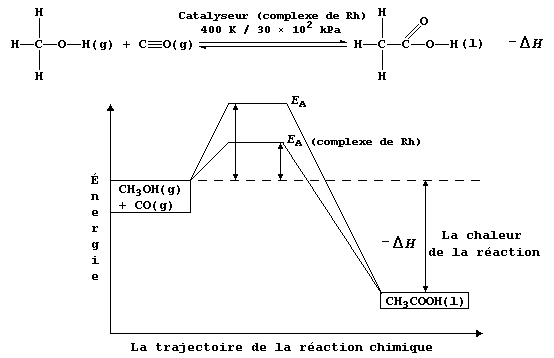
Seated at a boardroom table, containing a sprinkling of the company's latest creations in head-wear, are four elegantly dressed women: Mlle É. Activé, Mlle M. Brulôt, Mlle O. Gonfleur, and Mlle I. Sagesse. M. Scrooge, a slouch in the sartorial stakes, seats himself down ...
M. SCROOGE.
Euh,... (He counts heads.) On est cinq ! Où est Jacob ?
Mlle ACTIVITÉ.
Bôf ! Il n'est pas là. Il est mort !
M. SCROOGE.
Ça ne fait rien... Nous ne pouvons pas se reposer sur nos lauriers du passé ! Alors, je veux plus et je veux cet acide plus rapide ! (No response from the ladies, who are either polishing their finger nails or admiring their creations.) Malheur à vous, si la patience m'échappe ! (With this veiled threat, they are all attention. In succession, each lady uses a pointer to highlight an aspect of the above diagram.)
Mlle ACTIVITÉ.
Eh bien,... ce catalyseur augmenterait la vitesse. Cependant, parce qu'il est une complexe d'un métal très précieux, il y aurait des dépenses d'investissement... Néanmoins, nous le réutiliserions, à condition que nous minimisions la présence des inhibiteurs dans les vaisseaux de réaction.
M. SCROOGE.
Ça augmenterait le rendement aussi ? (His tone is hopeful.)
Mlle ACTIVITÉ.
Bôf ! Certainement pas ! (S. looks glum.) Pas de catalyseur change la position d'équilibre, parce que pas de catalyseur change la chaleur de réaction !... Un catalyseur simplement réduit l'énergie d'activation. (S. looks chastened.) Quoi qu'il en soit, sans ce catalyseur, on devrait utiliser très hautes températures. Par conséquent, ce catalyseur réduirait les dépenses courantes ; indirectement, bien sûr.
Mlle BRULÔT.
C'est juste. Néanmoins, une haute température augmenterait la vitesse.
M. SCROOGE.
C'est bien !... Et, le rendement aussi ?
Mlle BRULÔT.
Certainement pas ; faites attention ! Cette réaction chimique est exothermique. (S. now looks more chastened and glum.)
Mlle GONFLEUR.
Une haute pression augmenterait aussi la vitesse ; ... ainsi qu'une augmentation inévitable des dépenses courantes.
M. SCROOGE.
Oui, oui,... (His tone is weary.) ... mais, est-ce qu'une haute pression augmenterait le rendement ?
Mlle GONFLEUR.
Certainement ! (S. perks up.) Je suis d'accord avec Marie : faites attention à cette équation ! (She points forcibly to same.) Prenez note qu'il y a moins de moles de gaz sur le côté de produit. Eh bien, en réalité, il y a nul !
M. SCROOGE.
Splendide !... Alors, je suggère que nous devrions utiliser une quantité radine de catalyseur et une température assez basse : mais, une pression massive. (His tone is bullish.) On est d'accord ?
Mlle SAGESSE.
Non !... Pas nécessairement. Je dois pousser la prudence ! Les vaisseaux de réaction qui sont assez robustes pour résister très hautes pressions sont très chers ; et un gaz, en particulier, est très toxique (le monoxyde de carbone). La sécurité de nos ouvriers et du grand public est suprême !
M. SCROOGE.
Misère ! Toutes les femmes de l'espèce sont-elles si sages ? (His tone is ambiguous, perhaps even patronizing.)
Mlle SAGESSE.
Certainement !... Eh bien, la plupart du temps. Cependant, nous suspendrons le jugement sur votre futur... (The ladies glance pointedly at the stiletto heels on their shoes.) ... jusqu'au jour où nous recevons nos primes de Noël.
M. SCROOGE.
C'est entre Charybde et Scylla ! Plus je depense, moins j'ai d'argent ! Et puis, la paperasse pour chez petite entreprise... (He sighs deeply.) ... Ah ! (He picks up a telephone.) Bob, c'est Oliver Scrooge ici. Veuillez revenir... (Shortly afterwards, the visitors express their gratitude to M. Scrooge, without him hearing Flashman's most graceless utterance — "C'était l'équivalent scientifique du thé de fou chapelier." — and then return to the Lycée Villiers.
Day 2, 8.00 p.m.: In a magnificent room bedecked with chandeliers, the 4th-Remove, la deuxième classe, Mlle G., and Dr. S. are present at a soirée hosted by Father Richelieu and his senior colleagues. After a modicum of polite conversation, Fr. Richelieu asks courteously for silence, and then Constance Bonacieux seats herself at a harpsichord ...
CONSTANCE.
Bonsoir... Je vais jouer une pièce de clavecin par Armand Couperin qui est appelée L'Enjouée, et qui a été écrite en 1751. (About 6 minutes later, the audience clap, there are a few polite shouts of "Bis !", and Richelieu favors Constance with his warmest smile; then Aramis and Pattullo seat themselves at the harpsichord.) ...
ARAMIS.
Bonsoir. Jean-Baptiste Forqueray est né en 1699, et il est mort en 1782. En 1747 il a publié son «Livre de Clavecin», qui contient La Forqueray. Cette pièce de clavecin, qui a pu être écrite comme hommage à son père, Antoine, qui est mort en 1745, semble parodier les talents extraordinaires d'Antoine. (He nods to P.)
PATTULLO.
Pourtant, plutôt que de jouer cette pièce, nous avons décidé de jouer un morceau qui est appelé Duelling Banjos, et qui nous avons transcrit pour le clavecin à quatre mains. (After about 15 seconds of their rendition, Athos, Porthos, and the sans-culottes are barely suppressing smiles, whereas the English and French staff are looking increasingly vexed; and, after about 45 seconds, a thunderous looking Richelieu
rises to his feet.) ...
Fr. RICHELIEU.
Ça suffit ! (He holds up a hand.) Moi, je n'ai jamais été témoin d'une telle exposition de mauvaises manières !
ARAMIS.
Mais, M. le proviseur, ce n'était pas irrespectueux ; non, c'était seulement une petite plaisanterie musicale.
Fr. RICHELIEU.
Silence ! Je me charge de vous, et les autres, demain ! (He turns to Dr. S., and smiles weakly.) Avec ton accord,... (His tone changes to one that is severe.) ... je suggère que tous les étudiants se couchent de bonne heure.
Dr. STUART.
Certainement. Je me confonds en excuses pour la conduite de mes étudiants. (His tone is contrite, but, as he turns to the 4th-Remove, this changes to one that is fairly severe.) Je veux pas d'agitation et pas d'absurdité... Exécution ! (The sans-culottes barely suppress smiles at his unintended pun.) Allez ! Tout de suite ! ... (He sighs deeply.) ...
Day 2, 8.30 p.m.: The students go to various dormitories; and, after their ablutions, Mlle Backson and M. Rochefort switch off the dorm lights at 9.15 p.m. Malice, Constance, and most of la deuxième classe are asleep by 10.0 p.m. ... Whereas, Aramis, Athos, Porthos, and the sans-culottes are holding various whispered conversations, including this one ...
PORTHOS.
La fin de la soirée... Bôf !... Ce n'est pas une affaire !
McKECHNIE.
C'est juste ; le calme qui précède la tempête ? À propos, tu vas à la colonie de vacances pendant le troisième trimestre ?
PORTHOS.
Où ?
McKECHNIE.
À Sault Sainte Marie.
PORTHOS.
Bien sûr ! Nous attendons avec impatience le plaisir de voir Huck et ses amis. Un instant ! Au Canada ou aux États-Unis ?
McKECHNIE.
Euh,... Je suis pas sûr, peut-être les deux ? On a besoin d'un sobriquet avec style ?
PORTHOS.
J'y penserai... ... Ah, «La Jeunesse dorée» !
McKECHNIE.
Quelle coïncidence ! Notre camerade Flashy a suggéré le même sobriquet plus de bonne heure ce trimestre.
PORTHOS.
Sans aucun doute, nous sommes un peu du même bateau !...
Day 2, 12.00 p.m.: Aramis, Athos, Porthos, and the sans-culottes are assembled in one dormitory; each boy is wearing a red and black bobble-hat ...
ARAMIS.
À la ordre, mes copains. Merci. D'abord et d'une : il fait froid de canard dehors. (He checks everyone is wrapped-up.) Très bien ! Reprenons les détails encore une fois, s'il vous plaît. Le groupe de Porthos procurera les jeunes femmes. (P.'s group all nod.) Le groupe d'Athos se mettra en position, à intervalles, de la cour à l'abri à bateaux. (Athos's group all nod.) Et, ... pour terminer, mon groupe
preparera le bateau. Est-ce qu'il y a toutes questions ?... C'est bien ! Pardonnez-moi le calembour, mais, exécution ! (Nervous, but quiet, laughs as the groups disperse.) ...
PORTHOS.
Allons leur dortoir ! (He whispers; then they tiptoe along to one of the girls' dormitories, and are standing outside.) Je jette un coup d'œil ! (He opens the door and has a quick look.) Bon, elles dorment comme des souches. (All the boys
enter and, ever so carefully, transfer Constance and Malice to camp beds equipped with trolley wheels. Then, they pass from this dorm, down the back stairs, across the courtyard and the gardens, to the boathouse; on their arrival ...)
ARAMIS.
Bravo ! Mais, c'est la partie le plus difficile : Constance et Malice ne doivent pas se réveiller. (With infinite care, each trolley has its wheels removed and then each bed is placed in a boat attached to a long piece of rope; finally, each damsel in distress is covered with a red cloak ...)
ATHOS.
Bon voyage ! (He and three others push the tethered boat gently out into the lake; and when it stops ...)
McKECHNIE.
Porthos, mon ami,... Constance et Malice sont, bel et bien, dans le même bateau ! (Upon which all the boys collapse in uncontrollable laughter. ... At this point, in one of the staff bedrooms with an open window, Mlle Backson and M. Rochefort are in bed together ...)
Mlle BACKSON.
Moisi ?
M. ROCHEFORT.
Encore ?! (His tone is gently ironic.)
Mlle BACKSON.
Bôf ! Une fois suffit ! Non! Écoute ce bruit ! (She goes to the window.) Et, il y a des lumières près du lac... et un bateau sur le lac !
M. ROCHEFORT.
Miel ! L'esprit de «Milady» ? (He mutters under his breath in an enigmatic manner.) ... T'affole pas, ma petite chatte. D'abord, s'habillons, ... et puis découvrons les méfaits des étudiants, selon toute probabilité. (Both dress quickly and then make their way to the lake. ... Almost at the moment of their arrival, East sees them out of the corner of his eye.)
EAST.
Acré ! Mme le censeur et le professeur principal.
Mlle BACKSON.
Que personne ne bouge !... Alors, qui est dans le bateau !?
ATHOS.
Constance et Malice, Mlle Backson.
Mlle BACKSON.
C'est conduite extrêmement dangereuse ! On croit rêver !... Elles peuvent noyer si le bateau a chaviré ou elles peuvent mourir de froid ou... Mais, d'abord, à la rescousse !...
Day 3, morning: Dr. S. and the sans-culottes present their apologies to Father Richelieu; and then they travel back to Narkover — in silence apart from this one early exchange ...
FLASHMAN.
Monsieur ? Euh, ... Nous avons décidé d'appeler nous-mêmes «La Jeunesse dorée». Que pensez-vous de notre sobriquet ?
Dr. STUART.
Bôf ! Lorsque Mme Pond, femme de notre proviseur et sœur de M. Richelieu, apprend parler de votre conduite en France, ce pourrait être un cas de «La Jeunesse hongrée». (Each boy looks both puzzled and distinctly apprehensive.)
FLASHMAN.
Euh,... Monsieur, qu'est que vous entendez par «hongrée» ?
Dr. STUART.
Je suis toujours en vacances ! Regardez votre dictionnaire !
Dr. S.'s first lesson with the 4th-Remove after half-term ...
Dr. STUART.
Good morning. I suspect that most, perhaps all, of you may consider that Dr. Stuart and joie de vivre is a good example of an oxymoron. (Puzzled frowns from the class.) However, such bonhomie I do have will be in absentia, for the simple reason that I spent an uncomfortable hour in the presence of Mrs. Pond, the Headmaster's wife — on the carpet, literally and metaphorically — attempting to defend the indefensible; to wit, your disgraceful behaviour in La Rochelle. The good lady has decided that my penance should be accompanying you and the other students to Sault Sainte Marie next half-term; a chore which I had confidently expected to pass me by. So, woe betide anyone who strains my patience beyond its elastic limit! (He peers over the top of his glasses, surveys the class, and looks pointedly at Flashman.) Yes, Mumford?
MUMFORD.
Sir, um, ... what is an oxymoron?
Dr. STUART.
Good question, Mumford; one, I hope, that was on the lips of everybody else. (His tone is stern but encouraging.) Mmm, ... An oxymoron is 'a figure of speech in which two ideas of opposite meaning are combined to form an expressive phrase'; perhaps the most commonly used example is «bitter-sweet», although there are particularly notable examples in science. Would anybody care to be enlightened? (Chorus of "Oh, yes please, Sir.") Hmph! I wonder whether this newly acquired thirst for knowledge masks a hidden agenda; namely, 'we are in the dog-house, so let's humour this old fogey who is well past his sell-by date'. ... Yes, Pattullo?
PATTULLO.
Sir, perish that cynical thought! ... As I think you might say if you were in better humour.
Dr. STUART.
Touché ! Truly, a splendid case of genuine wit. Pattullo, well done! ... The specific examples I referred to are part of 'acid-base' chemistry; so, as our point of reference, you will need to view the diagram of the pH scale. (The class root out, and then are looking at the following diagram.)
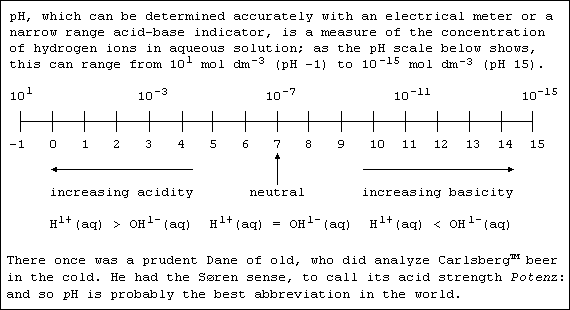
... First and foremost, would anybody care to comment upon this diagram? ... Yes, Zigo?
ZIGO.
The pH scale is linear, Sir.
Dr. STUART.
True. But your description is, perhaps unwittingly, both incomplete and slightly misleading. ... Yes, Malice?
MALICE.
The pH scale is linear, with unit changes, whereas that for the concentration of hydrogen ions changes in powers of ten?
Dr. STUART.
Malice, splendid! This diagram, which is both accurate and acceptable, scientifically, is an effective illustration of how differently a scientist and a layperson may perceive any given scientific topic. Now, moving on... Yes, East?
EAST.
Could you expand on that point, please, Sir?
Dr. STUART.
Yes, my pleasure! A layperson, who does not understand the relationship of pH to the concentration of hydrogen ions, will probably think that pH4 is «only» a bit more acid than pH6. By contrast, a scientist, who does understand the said relationship, would know that pH4 is 100 times more acid than pH6. Does that help, East?
EAST.
I think so, Sir. (His tone is uncertain.)
Dr. STUART.
If would overlook the pun, let me put that to the acid test. ... East, describe the difference between pH8 and pH11: but, so as not to receive a caustic response from me, ... (Groans from the class.) ... do look at the diagram! (East does so.)
EAST.
Um, ... pH11 is 1000 times more alkaline than pH8, Sir?
Dr. STUART.
Splendid! The only unresolved question is ... whether any of you will bear in mind that nugget of understanding beyond the exams! Now, ... some of you may recall that in the very first lesson of term I peddled a couple of metaphors which likened your grey cells to thoroughbred horses. Well,... Yes, Unman?
UNMAN.
I think Flashman described one of them as "laboured", Sir.
Dr. STUART.
Indeed! ... Perhaps it was Flashman's idea of a back-handed compliment. (He gives F. a waspish glance.) Ever one to share a winning streak, I intend to pursue this equine theme by likening our chosen topic to show-jumping. Thus, I will write on the board nine equations: four pairs and one single, ... which could be considered as four «double jumps» and one «water jump», ... and which you can successfully negotiate if — and only if — you concentrate. So, grey cells: on guard!
First up! When hydrogen chloride is dissolved in an organic solvent, the solution formed does not conduct an electric current — which indicates the absence of free-moving ions. By contrast, when this gas is dissolved in water,

the aqueous solution of hydrochloric acid formed conducts an electric current strongly, because this 'strong' acid is completely dissociated; that is, the position of this equilibrium lies completely to the right:

Second up! When ethanoic acid is dissolved in an organic solvent, the solution formed does not conduct an electric current — which indicates the absence of free-moving ions. By contrast, when this liquid is dissolved in water,

the aqueous solution of ethanoic acid formed conducts an electric current weakly, because this 'weak' acid is partially dissociated; that is, the position of this equilibrium lies far to the left:

Third up! Water is often considered to be a purely covalent compound; but, even after extensive purification by repeated distillation, the purest sample of water still electric current very weakly. The usual explanation for this observation is that water undergoes very slight dissociation or ionization; that is, the position of this equilibrium lies almost completely to the left:

Fourth up! When ammonia gas is dissolved in water,

the aqueous solution of ammonia formed conducts an electric current weakly, because this dissociated; that is, the position of this equilibrium lies far to the left:

Last up! When sodium hydroxide is dissolved in water,

the aqueous solution of sodium hydroxide formed conducts an electric current strongly, because this 'strong' base is completely dissociated; that is, the position of this equilibrium lies completely to the right:

Dr. STUART.
Now, Class ... Yes, Mumford?
MUMFORD.
Sir, ... um, ... throughout that sequence you classified the strength of those acids and bases by their dissociation into aqueous ions. Um, ... (Dr. S. nods encouragingly.) ... er, You didn't mention concentration at all. (He frowns.)
Dr. STUART.
Splendid! Well done, Mumford! You have the followed the line of argument precisely. As you, yourself, have grasped, the descriptive terms 'strong' and 'weak', used in reference to acids and bases, are simply a qualitative measure of the extent of ionization or dissociation in water; they do not refer to the concentration of substance. ... Yes, Pattullo?
PATTULLO.
But, Sir, where does the oxymoron come into the picture?
Dr. STUART.
That, ... my thoroughbreds, ... is the subject of your prep this evening! (He gives each student a worksheet.) On this worksheet are the equations I have just written on the board and a table which, I hope, clearly reveals why oxymoronic phrases such as 'concentrated weak acid' and 'dilute strong base' are perfectly logical. (He copies the table on the board.) Now, ... (The bell rings.) ... Yes, Pattullo?

PATTULLO.
Sir, somewhat curiously, this lesson appears to have been well prepared. What topic had you planned to cover today?
Dr. STUART.
Acids and bases, ... naturally. (He smiles.)
PATTULLO.
So, Sir, would it be fair to say that your introduction to today's lesson was just a shade disingenuous?
Dr. STUART.
Bôf! Perish the... (Chorus of "thought", and accompanying laughter, as he sweeps majestically from the room.) ...
The 4th-Remove's lesson with Dr. S. in the penultimate week of term ...
Dr. STUART.
Good morning. Today, I... (Patullo interrupts.)
PATTULLO.
My apologies for interrupting, Sir, but please may we use this lesson to write up our projects?
Dr. STUART.
Certainly. Indeed, you have pre-empted the first part of my introduction. However, before you sharpen your quills, I wish to inform you of two of next term's biology topics; namely, biodiversity and evolution. To whet your appetite, I have prepared a conundrum for you to attempt to solve in the holidays. (He give each student a worksheet containing this diagram,

... and, after a minute or so ...) Now,... (Brown interrupts.)
BROWN.
But, Sir, this is just chemistry. (His tone is petulant.)
Dr. STUART.
Brown, I do not expect your French to be fluent: ... but, I do hope you recognize at least one of the three biological species referred to on this sheet; namely, la canne à sucre? (Brown nods.) Good. (He smiles encouragingly) I would be being disingenuous were I to suggest that you will find it easy to solve this conundrum; but, each of you should accept that, even if you fail to find the complete solution, any conscientious attempt will be rewarding, ... in two senses: expanding the mind and providing a partial platform for next term's studies. ... Now, with the deadline for your project submissions looming, I suggest you disappear to the library, ... that is the room ... (Chorus of "Thank you, Sir, we do know where it is!") ...
________________________________________________________________________________________
5. Metal ions are regarded as pollutants when, as a direct or indirect result of Man's activities, their concentrations in any given ecosystem
increase. Popular attention invariably focuses on the toxic effects of ions which have little or no biological role; e.g., those of aluminum, cadmium, lead, and mercury. However, a correctly balanced perspective of pollution also requires an awareness of the potential toxicity of biologically essential ions; e.g., those of copper, iron, manganese, and zinc. Thus, although each species has evolved mechanisms of using, and adapting to, molecules and ions at their ambient concentrations, adverse effects occur at higher concentrations because such homeostatic mechanisms are overwhelmed.
6. Until relatively recently, biodiversity — the range of biological species in the biosphere — had been determined by natural selection. Now, however, three major artificial selection pressures are occurring: first, Man's unparalleled ability to misuse the environment (e.g., by emission of greenhouse gases, by depletion of the ozone layer, and by causing acid rain); second, in order to obtain more land suitable for crops, there is steady destruction of the (non-renewable) tropical rainforests, which is leading to the extinction of a countless number of naturally evolved species every year; and third, new organisms are being introduced into the biosphere as a result of the advances in both cross-breeding and recombinant DNA technology ... and the medium- to long-term effects of these introductions can only be guesstimated; in this context, albeit indirectly, it is worth reflecting upon the long-term environmental effects of CFCs, DDT, and leaded-gasoline: despite their undoubted short term advantages to one species (Man).
7. "One day, I will metamorphose into a chrysalis and then after that into a beautiful butterfly," said the Caterpillar proudly. "Who, may I
enquire, are you?" He continued in a rather patronizing tone. "Ich bin Frau Neumon," replied the Wasp.
________________________________________________________________________________________
9.02 a.m. On the penultimate day of the term, the 4th-Remove arrive in a music classroom late for their last lesson with Sig. Sal. ...
CLASS.
Ciao, Professore. (In apologetic tones)
Sig. SALIERI.
Ciao, tutti! Mi dispiace, no lesson today. (A chorus of "Oh, Sir, what a shame!", in less than sincere tones.) Le pagella! (He holds aloft a sheaf of school term reports.) So, while I am writing polite fiction, you can either amuse yourselves very quietly or listen to this recording of a wind composition by my much maligned ancestor. (He plays a CD of Antonio Salieri's Serenata in B. And, up to the bell, Brown plays solitaire; Malice, Mumford, and Pattullo read thru their projects; whilst the others talk together in a conspiratorial huddle.) ...
11.00 a.m. The girls' field-hockey match. [In the spirit of those exciting (if far-fetched) novels of yore, one might expect that the star of Narkover's hockey team was rescued from a deep water-well by pluck and derring-do, overcame all manner of obstacles in her efforts to return to — and so uphold the honor of — the school, and arrived just in time to score the winning goal by a piece of individual wizardry with her hockey stick. However, verisimilitude is obligatory. Thus, on the one hand, nothing untoward occurs before the match and the game itself is a disappointment (to wit, despite partisan support from the touchline, St. Swithin's beat Narkover 5-1), and on the other, the sans-culottes are unexpectedly conscientious in their attention to the details of erecting the temporary shower facilities.] The girls of the two teams are in their respective, makeshift locker rooms; in honor of Malice's consolation goal, the Narkover team allow their captain to be first with the hot water in the showers: meanwhile, the sans-culottes have placed themselves in a strategic position. ...
FLASHMAN.
Ready, Scud, ... tous? (Nods from those assembled.) Now is the time to discover whether Malice is a natural brunette: Scud, ... a drum roll, s'il te plâit! (East delivers a drum roll; Flashman tweaks one rope, and every side of the shower facility is exposed to the elements. The mocking taunts of the sans-culottes are short-lived because, contrary to their expectations, Malice makes no cries of modesty — but simply
gives her onlookers an icy stare before covering herself with a towel in a dignified manner; then, after short period of silence ...) Merde! Jack, that was a bit of anticlimax.
MERRIDEW.
D'accord! But, ... who cares? (He shrugs his shoulders; then everybody starts laughing.) Ssh! We'd better scarper?
McKECHNIE.
Absolument pas! That would be an admission of guilt. No, if necessary, we'll bluff this one out. In the meantime, let's put this wretched contraption back together again. ...
2.00 p.m. In a laboratory, Dr. S. takes a roll-call for his last lesson of the term with the 4th-Remove ...
Dr. STUART.
Brown.
BROWN.
Present, Sir.
Dr. STUART.
East.
EAST.
Present, Sir.
Dr. STUART.
Flashman.
FLASHMAN.
Present, Sir.
Dr. STUART.
Ms. Lidell-Lonsdale. ... C'est triste...
ALICE.
Present, Sir! (Malice [Alice?], removes a head scarf to reveal flowing blonde hair. No facial reaction from Dr. S.; gasps of astonishment from the sans-culottes) Yes, Brown?
BROWN.
But, Sir, Alice left! Malice, her twin sister has been with us this term. (There is uncertainty in his voice.)
Dr. STUART.
Listen carefully! At the end of last term, as prep, I set you the task of finding out the meaning of three words: "disingenuous", "dissemble", and "dissimulate". Apart from
Alice, nobody executed that prep: by contrast, Alice not only showed conscientiousness but also provided an exemplar with true style. ... Yes, Brown?
BROWN.
But, Sir, Malice said she was Alice's twin.
Dr. STUART.
Not so! Malice said, and I think I am recalling correctly: "You must of heard of identical twins who were separated at birth." (He glances at Alice [Malice?, who nods.) This is merely a platitude. ... Yes, McKechnie?
McKECHNIE.
Fair enough, Sir. I do agree that her statement does not, necessarily, indicate a relationship between Alice and her alter ego Malice: but, neither you nor Alice have presented any evidence for her true identity, ... after all, identical twins are formed from one fertilized ovum: and so they must have identical genotypes and phenotypes.
Dr. STUART.
As, apparently, you found out this morning in a spectacular display of mischief making. (He peers over the top of his glasses to glance briefly at each boy, each of whom squirms uncomfortably in his seat.) McKechnie, your astute analysis is correct; however, whether this proves to be an invaluable lesson to you, and your confrères, remains to be seen. Be that as it may, for the present at least, the true identity of this young lady will have to remain a mystery. Now, ... where ... (He looks down at the register.) Ah, McKechnie.
McKECHNIE.
Present, Sir. (Polite laughter from the class.)
Dr. STUART.
Merridew.
MERRIDEW.
Present, Sir.
Dr. STUART.
Mumford.
MUMFORD.
Present, Sir.
Dr. STUART.
Pattullo.
PATTULLO.
Present, Sir.
Dr. STUART.
Piggy. Non? Même pas son esprit? (He smiles.) ... Unman.
UNMAN.
Present, Sir.
Dr. STUART.
Wittering.
WITTERING.
Present, Sir.
Dr. STUART.
Zigo.
ZIGO.
Present, Sir.
Dr. STUART.
Now, ladies and gentlemen. Regrettably, I have affairs of state to attend to, ... which, roughly translated, means I have reports to write, ... along the lines of 'Candy Floss has been trying this term'. (Amused expressions from the class.) So, against my better nature, ... (He smiles.) ... I will humour your finer instincts by allowing you to play the customary board and card games. However, before such «merriment» begins, we must attend to two outstanding matters. First, I would like your projects. (Each member of the class places his or her submission on Dr. S.'s desk.) Mmm, ... These are rather on the thin side; perhaps, for once, each of you has sacrificed quantity for quality? (His slightly ironic tone is softened by the hint of a smile.) And second, although I doubt whether you will use these holidays in a profitable manner, I am the eternal optimist: so, here is the title of next term's project. (He writes on the blackboard: "The Relationship between the Tropical Rainforests and Dresden.") ...
7.30 p.m. In the chapel, the students are present for an unscheduled assembly; the Headmaster lights a candle, leads a prayer, and then stays on his feet to deliver a notice ...
Mr. POND.
Good evening, School. (Muted tones.) I have called this assembly so that I may formally report some serious news — although the school's grapevine will probably have rendered my information superfluous. ... Just before high-tea, the Head Girl took an overdose of paracetamol. Thanks in large measure to the common sense shown by Popsy Rice, ... (He gives this girl a brief smile.) ... we were able to get her to Borchester Hospital as fast as possible after what was, one presumes, an accident. However, she's in a light coma and her... Flashman! (The entire school focus their eyes in F.'s direction.) This is most definitely not the time for immature behaviour; a sense of... (F. interrupts.)
FLASHMAN.
But, Sir, the candle flame ... (Mr. P. turns round.)
Mr. POND.
Mmm, ... I think it would be appropriate, at this time, to sing a suitable hymn: so, let us all sing ... Where have all the flowers gone. (He nods to the organist.) ...
8.30 p.m. In the chapel, the school's organ scholar and its principal chorister are both diligently practicing the Benedictus from Leopold Mozart's Missa Solemnis in C.
10.00 p.m. In the Headmaster's bedroom, his lady wife — unaware of the day's events — is reclining in bed; Mr. Pond, who would be generously described as having a fuller figure, is standing in his pajamas ...
Mrs. POND.
Bassett ?
Mr. POND.
Oui, ma chouette ?
Mrs. POND.
Si c'est pas dans la vitrine, voyez dans le magasin !
Mr. POND.
Mais,... tu es enceinte ! (He looks and sounds shocked.)
Mrs. POND.
Oui,... une situation intéressante : tout est là ! Alors, je peux miser sur toi ?
Mr. POND.
Euh !... (He looks flustered.) Désolé, pas ce soir, j'ai la migraine. Je me sens un peu déprimé... (He sighs.) les étudiants... (He gets into bed, then turns out the light.)
10.00 p.m. In the pavilion, on a bitterly cold night, the sans-culottes of the 4th-Remove are assembled; each is wearing a black bobble-hat ...
McKECHNIE.
To order, gentlemen. First, Alice ... or Malice : ... any comments? (No response) Anybody? ... Spats?
PATTULLO.
Mmm, ... Since chapel, I've been wondering whether there are any parallels with that dreary set book by Priestly we did last term. I suspect that, in some way or other, we are all partly responsible because... (Wittering interrupts.)
WITTERING.
That's bollocks! We... (McKechnie interrupts.)
McKECHNIE.
Witters! That's well out of order; you know our cardinal rules are no cutting across the speaker and no swearing in English. Spats, please continue.
PATTULLO.
No. Not now. We don't even know her condition: so, any discussion may be... (East interrupts.)
EAST.
Acré! Both Barbydol and Bassy have put their lights out.
McKECHNIE.
Zut! ... Although, perhaps, that's a blessing in disguise. Well, gentlemen, 'til next term ... and Sault Sainte Marie!
10.00 p.m. To the strains of the final movement from Wolfgang Mozart's Ein Musikalischer Spass, Dr. S. — with barely a proverbial fig-leaf to cover his modesty — extinguishes a candle, walks over to his study's windows, and draws close the curtains; the playing fields are carpeted in snowdrops, and there are three ravens perched on the roof of the pavilion. ...
HAT WISSENSDRANG DIE KATZE GETÖTET? (III)
{Paraphrasing here, R. Dawkins wrote in River Out of Eden, Weidenfeld &
Nicolson, London, 1995: "Francis Crick and James Watson, the joint recipients of the Nobel prize for Medicine in 1962, for unraveling the the molecular structure of DNA, should, I believe, be honored for as many centuries as Plato and Aristotle. Our whole understanding of life will go on being revolutionized again and again as a direct result of the change in thinking that those two men initiated in 1953. ..."}
Presented here, for the conscientious student wishing either to stretch or to enhance his or her abilities in an unorthodox manner, are four
fragmentary points of discussion which could be mulled over at leisure.
Also included here, to leaven these fragments, are selected scenes from the final term of Narkover College's inaugural year as a co-educational establishment. [... An extract from the minutes of one Governors' meeting: "... The introduction of girls at Narkover should promote increased levels of academic attainment and emotional maturity for the boys. ..." Curiously, or otherwise, these minutes not only enshrine what may be an
element of wishful thinking but also omit any reference to the benefits to le beau sexe ... if, indeed, there be any ...]
PLAYLET 3: Il Proteo ò sia Il Mondo al rovescio
11.00 a.m. In a laboratory, Dr. Stuart takes a roll-call for his first lesson of the term with the 4th-Remove (Year 10) ...
Dr. STUART.
Brown.
BROWN.
Present, Sir.
Dr. STUART.
East.
EAST.
Present, Sir.
Dr. STUART.
Flashman.
FLASHMAN.
Present, Sir.
Dr. STUART.
Ms. Malice A. Forthort.
MALICE.
Present, Sir.
Dr. STUART.
Ms. Alice Lidell-Lonsdale.
ALICE.
Present, Sir.
Dr. STUART.
Splendid! I am glad to see that you ladies have recovered from previous trials and tribulations. ... McKechnie.
McKECHNIE.
Present, Sir.
Dr. STUART.
Merridew.
MERRIDEW.
Present, Sir.
Dr. STUART.
Mumford.
MUMFORD.
Present, Sir.
Dr. STUART.
Pattullo.
PATTULLO.
Present, Sir.
Dr. STUART.
Piggy: mort. ... Ms. Chalice Poison.
CHALICE.
Present, Sir.
Dr. STUART.
Welcome to the class, Chalice.
CHALICE.
Thank you, Sir.
Dr. STUART.
Without wishing to appear impertinent, you do remind me of the deceased student Piggy.
CHALICE.
That is to be expected, Sir, because Xavier Piggy was my non-identical twin brother. (Audible intakes of breath by, and furtive glances between, the sans-culottes.) We were separated at birth; I was brought up in France, whereas Xavier was brought up here in England.
Dr. STUART.
On behalf of the class, I express our belated condolences for your personal loss. ... Yes, McKechnie?
McKECHNIE.
Sir, with Alice and Malice being identical twins who were also separated at birth, our class appears to be a grotesque parody of Shakespeare's Comedy of Errors.
Dr. STUART.
I am not sure that "grotesque" is a particularly felicitous choice of adjective. Moreover, being at such a tender age, I have reservations as to the desirability of you accepting the received wisdom of drawing parallels between various facets of contemporary life and Shakespeare's oeuvre. ... On the hand, ... (He looks pensive.) ... ... Yes, McKechnie?
McKECHNIE.
Sir, we're all agog!
Dr. STUART.
No matter, ... I was merely pondering, albeit vaguely, the possibility of your Year 11 projects incorporating selected scientific themes with Shakespeare's life or plays, or both. ... Unman.
UNMAN.
Present, Sir.
Dr. STUART.
Wittering.
WITTERING.
Present, Sir.
Dr. STUART.
Zigo.
ZIGO.
Present, Sir.
Dr. STUART.
Now, ladies and gentlemen. There is a rumour abroad that yours truly peddles the same lessons each academic year. (He observes Flashman whispering to Brown.) You agree, Flashman!?
FLASHMAN.
Oh no, Sir! Perish the thought!
Dr. STUART.
Indeed so! (His tone is severe.) However, in my defence, I would point out that one's teaching programmes are largely circumscribed by the syllabuses — which are, for better or worse, essentially invariant. (His tone is pompous.) Be that as it may, in a probably vain attempt to persuade one and all that I am not quite ready for the knacker's yard, my presentation of this term's work will be de novo. ... In
particular, so to allow you the opportunity of understanding the biochemical basis of evolution and genetics — which are the focus of our studies after half-term — we need to revise and expand upon several of the previous two terms' topics. ... ... You may recall that, in digestion, the final hydrolysis products of fats are fatty acids and glycerol; those of carbohydrates are monosaccharides such as glucose: but what of proteins? (The class look blank.) I appreciate that all of you are environmentally sensitive souls: but, would you please make the noble sacrifice of disturbing the habitats of the moths in your notes? (He waits as the class hunt thru their notes.) Brown!?
BROWN.
They are hydrolyzed to peptides and then to amino acids, Sir.
Dr. STUART.
Just so! Good. ... And, it is this class of compounds which provides our starting point: so, please pay attention to the structural formulae I have drawn on the blackboard.

... As the general structural formula indicates, each amino acid has at least one amino and one carboxylic acid group; and, as perhaps exemplified by the two amino acids shown, the R group — usually known as the side group — may be simple or fairly complex. ... But, and this is an important caveat, amino acids do not belong to a single homologous series. ... Moths!! (The class again hunt thru their notes.) East!?
EAST.
A homologous series is a group of compounds which have the same functional group or groups but different chain lengths or ring sizes, Sir.
Dr. STUART.
Splendid! Now, at the beginning of last term, Flashman — in a rare moment when he was not trying my patience (F. looks mock aggrieved.) — reminded us that, despite some inevitable differences, all living organisms share similar biochemistry. (He gives F. a waspish smile.) For example, almost all living organisms biosynthesize their peptides and proteins from the same twenty amino acids; their structural formulae are given on Reference Sheet 1. (He gives one of same to each student.)
Reference Sheet 1![Reference Sheet 1 [structural formulae of the 20 genetically controlled amino acids]](media/wis3b.gif)
Dr. STUART.
... Unman?
UNMAN.
Yes, Sir?
Dr. STUART.
Like several other members of the class, you have a haunted look. Ne timeas non! You are not required to learn either the names or the formulae of these amino acids. (Audible expressions of relief from the students.) Nevertheless, you will need to refer periodically to this reference sheet, ... starting tonight in prep. (Audible groans from the sans-culottes.) Quills ready? Good! First, name the four pairs
of amino acids which are homologous to one another; second, name the two amino acids which are isomers of one another; third, explain briefly which amino acid you consider to be anomalous; and fourth, construct a molecular model of one
amino acid. ... Yes, Alice?
ALICE.
Sir, won't we end up with twenty models of the simplest one?
Dr. STUART.
Good point! But, pray, which is the simplest amino acid? (Alice studies the sheet.) ...
ALICE.
Glycine, ... abbreviation Gly, Sir.
Dr. STUART.
Correct. To ensure that we have a molecular model of each amino acid, I have allocated one to each student ... and I will construct the remaining seven. Now, gather round, and
I will show how a model of tryptophan is constructed. (The class gather round the dais, and watch Dr. S. constructing the model; then ...) Please be seated. I will leave the model kit in the library. In the meantime, up to the bell, you can exercise your grey cells with the first three parts of prep; I suspect that you will need to disturb those moths yet again. Cave blattae! (He smiles impishly.) ...
2.45 p.m. Signore Salieri's first lesson of General Studies with the 4th-Remove ...
Sig. SALIERI.
Ciao, tutti!
CLASS.
Ciao, Professore. (In slightly patronizing tones.)
Sig. SALIERI.
Ecco, ... Some of you may remember, with varying degrees of warmth, playing the recorder in primary school. (Pained expressions from several members of the class.) However,... Yes, Wittering?
WITTERING.
Sir, at the back end of last term, Dr. Stuart set us a project entitled "The Relationship between the Tropical Rainforests and Dresden".
Sig. SALIERI.
Per me va bene! (He smiles.) And, Wittering?
WITTERING.
Well, Sir, we have been discussing the information gleaned from our background reading, ... and find «destruction» is apparently the only link; that is, the rainforests are being destroyed, ... and Dresden was almost completely destroyed in the Second World War. Any «piccolo» clues, Sir, please?
Sig. SALIERI.
Mah, ... I am not sure that I do. (He looks pensive.) ...
Dresden — often referred to as Florence on the Elbe — was indisputably the artistic capital of Germany, and its museums and libraries contained an unparalleled diversity of cultural treasures. ... Yes, Malice?
MALICE.
The rainforests are the main repositories of the biosphere's gene bank, containing an unparalleled diversity of species.
Sig. SALIERI.
Malice, my knowledge of science is pretty limited, but you do appear to have implied one further link. Complimenti! Now, ... please may we return to the subject of my lesson!?
In the 17th and 18th centuries, many composers — including, incidentally, several who were employed by, or associated with, the Dresden court — wrote compositions featuring
the recorder as a concertante instrument. And, today, I thought you might like to listen to a couple of these: the first is a concerto con molti stromenti by Vivaldi, where I would like you to pay particular attention to the rôle of the four recorders; and the second is a concerto for flute, recorder, and strings by Telemann, who composed this at a period when the flute was starting to be preferred to the recorder. (He plays the CDs; members of the class show varying degrees of genuine and feigned interest.) ...
5.45 p.m. Sig. Sal. arrives outside Dr. S.'s study; inside, he is listening to music by Fasch. Sig. Sal. knocks on his door ...
Dr. STUART.
Veni! (Sig. Sal. enters.) Arsenio, this is a pleasant surprise. Are you seeking sanctuary from your lady wife?
Sig. SALIERI.
Ecco, ... Not this evening; Vespina has banished me from her domain whilst she's making jam. ... I frutti del sua lavora. (He mutters softly in an wistful tone.) ... Sorry. ... No, my dear Alec, I have called because the 4th-Remove sought my help with their project of yours.
Dr. STUART.
Mmm, ... Would you care for a sherry?
Sig. SALIERI.
Yes. Thank you. (Dr. S. pours each of them a dry sherry.)
Dr. STUART.
Please, do sit down. ... Oh, one moment. (He turns off the music.) Now, ... where were we? ... Ah, yes! Were you able to provide the Remove with any useful pointers?
Sig. SALIERI.
Perhaps one. They had established that destruction was one probable link, ... and, after I had drawn their attention to the wealth of cultural treasures in Dresden, Malice implied a second link by informing us that the rainforests contain an unparalleled wealth of living species.
Dr. STUART.
Splendid! Those links should act as veritable springboards for both the finer details and the two further links.
Sig. SALIERI.
And, ... these would be?
Dr. STUART.
Mmm, ... First, neither set of treasures had been completely catalogued prior to their destruction: so unknown amounts of both natural and cultural evolution have been irretrievably lost to future generations. For example, an indeterminate number of unique musical manuscripts were destroyed in the War — before they had been catalogued, much less duplicated. Similarly, an indeterminate number of unique species have been destroyed — before they have been catalogued or samples of their genetic material stored for posterity. And second,... (The bell for high-tea rings.) ... Oh dear! Never mind. Arsenio, another time perhaps? (Sig. Sal. nods.) ...
10.00 p.m. Mlle Gossâge, having completed her inspection of the Year 9 and 10 (three-girl) dormitories, is standing at one end of a corridor ...
Mlle GOSSÂGE.
Girrrls! (She trills. Their high-spirited cacophony ceases immediately.) There can be no doubt that, compared to your male peers, you are the more mature for your age. (Lolli and Shandy, amongst others, surreptitiously move their teddy bears to less conspicuous positions.) However, one cannot rest on one's laurels. ... So, each weekday evening, there will be a reading period, during which time I will play a piece of classical music. Your... (Shandy interjects.)
SHANDY.
Oh super, Miss! Can we read anything we like?
Mlle GOSSÂGE.
Yes, within reason; ... providing it is of the improving variety — which, naturally, excludes those silly school-girl stories involving dormitory feasts, heroine worship of
Dimsie the school's lacrosse captain, spiders in Mam'zelle's bath, ... and similar twaddle! ... Books out! Tonight's music is Vivaldi's violin and cello concerto, RV547. ...
10.30 p.m. In the Headmaster's bedroom, Mr. Pond is browsing thru his stamp collection; his (pregnant) lady wife is lying on the bed reading ...
Mrs. POND.
Bassett ?
Mr. POND.
Oui, ma chouette ?
Mrs. POND.
J'ai besoin de sauce au chocolat.
Mr. POND.
Quelle bonne idée ! (As he reaches the door, he turns round and frowns.) Euh,... Pourquoi ?
Mrs. POND.
Puisque je suis enceinte de trois mois. (She looks up from her book and then starts to smile.) Gros bêta, va ! Tu pense que... Mais non ! Absolument pas !...
10.30 p.m. The sans-culottes are assembled in the pavilion ...
McKECHNIE.
To order, gentlemen. First, Chalice: ... any impressions or comments? ... Spats? Qu'est-ce que tu en penses?
PATTULLO.
Mmm, ... Rien du tout. I do, however, wonder whether Chalice will probe the circumstances surrounding Piggy's death.
WITTERING.
I doubt it; after all, the coroner's verdict was accidental death by drowning.
PATTULLO.
C'est juste, ... but the coroner had no knowledge of the incidental rôle of the school's cat.
WITTERING.
Bôf! And neither should Chalice! Moreover, I doubt whether any student remembers Fleabit, ... at least, consciously.
McKECHNIE.
Mmm, ... Caution must be our modus vivendi: so, I suggest that we steer well clear of Chalice, ... at least until we get to Sault Sainte Marie. On est d'accord? (General
expressions of agreement.) Moving on, ... does anybody know where the three girls disappeared to during second prep?
UNMAN.
The library, presumably, because the rota showed only their models of Barbydol's amino acids required construction.
McKECHNIE.
Mmm ... Quelle heure? (He looks at his watch.) Any other business? ... No? ... À dortoir! ...
________________________________________________________________________________________
1. For decades, science textbooks have often included the incomplete acronym OILRIG (oxidation is loss reduction is gain): however, whether this has proven to be a useful aide-mémoire or an unwitting catalyst for confusion is a moot point. Thus, oxidation can be defined as 'the gain of oxygen', 'the loss of electrons', or 'an increase in oxidation number'; to the beleaguered student, and therefore putative scientist, these definitions are not self-evidently equivalent (and the first two may appear intuitively to be contradictory). One partial solution to this possible source of confusion might well be to use a more complete acronym: OILRIGE (oxidation is loss reduction is gain of electrons). A second, perhaps more attractive, partial solution could the routine (and mischievous) adoption of the word Olé (the acute accent may help remind one that an electron is negatively charged).
2. An(ode) There once was a damsel called Goldilocks, whose hobby was counting odd sox. She sat in her box, and said pox on you fox, because
she always got flummoxed by red and by ox. So along came three bears, who rushed up the stairs, to sort out this mess for a lass in distress. And out of the blue came some bees, if you please, to see if they could help her too. There's no need to fuss, if you want the A plus, because an ode is so easy to suss. Simply feign you're in Spain, we know it's insane, and sing in the rain ... Olé! Honey!
________________________________________________________________________________________
Dr. S.'s second lesson with the 4th-Remove in the 1st week of term; he enters the room with molecular models of the twenty amino acids ...
Dr. STUART.
Good morning. I have here our molecular models for twenty amino acids, ... and, in addition, models of what appears to be farmyard animals. (He holds aloft some exemplars, and peers over the top of his glasses at the sans-culottes; each of whom has an expression of fresh-faced innocence.)
FLASHMAN.
Sir, why have you assumed that we are responsible?
Dr. STUART.
Bôf! Perish the thought! I am not accusing anybody: but, as the Dutch farmer said to his errant daughter, if the cap fits. ... ... For this lesson, you will require rough paper,
Reference Sheet 1, and — to a fanfare of muted trumpets (The class look bemused.) — Reference Sheet 2! Brown, the honours, please. (B. hands out one of same to each student; Dr. S. allows the class a few minutes for perusal: then ...)
Reference Sheet 2![Reference Sheet 2 [including the reaction scheme for condensation, amino acid sequences of four dipeptides and two pentapeptides (enkaphalins), and the line formulae of three opiates]](media/wis3c.gif)
Dr. STUART.
In our last lesson, you exhumed — from your «moth-eaten» notes — the fact that, in digestion, peptides and proteins are hydrolyzed to amino acids. Not surprisingly, therefore, the characteristic reaction of amino acids is the opposite of hydrolysis, which is condensation; and, Sheet 2 shows a general reaction scheme for the condensation of two amino acids. ... Now, Malice, what does the '+ DE' term mean?
MALICE.
The reaction absorbs energy from its surroundings, Sir?
Dr. STUART.
Well done! The reaction is endergonic, ... and the source of the energy is ATP; ... derived from?
MALICE.
Respiration, Sir.
Dr. STUART.
Excellent! Now, ... Mumford, I think. What do you notice about the ends of each amino acid and each dipeptide? (M. studies the sheet carefully.)
MUMFORD.
They are the same, Sir!
Dr. STUART.
True, but be more precise!
MUMFORD.
Um, ... Each contains a free amino and a free carboxylic acid group, Sir?
Dr. STUART.
Good. So, the characteristic reaction of a peptide will be?
MUMFORD.
Er, ... Condensation, Sir?
Dr. STUART.
Just so! Now, as you can see from this sheet, 4 different dipeptides can be obtained from 2 amino acids. ... Would anybody care to guess how many different dipeptides can be
obtained from these 20 amino acids? (Almost immediately, both Chalice and Zigo put up their hands.) Yes, Chalice?
CHALICE.
400, Sir.
Dr. STUART.
You agree, Zigo?
ZIGO.
Yes, Sir. 400 is 20².
Dr. STUART.
Splendid! ... Oh, ... I can that several of you are baffled. Both Chalice and Zigo have used permutation theory, which can probably be better explained by your Maths' teacher, Mr. Thompson. Nevertheless, rather than leave you suspended in a complete haze, I would like you to convince yourselves that 9 ... or 3² ... different dipeptides can be obtained from any three amino acids of your choice. Rough paper will do! (He waits for everybody to complete the task; Mumford is the last to finish.) Finished? Everybody? Mumford?
MUMFORD.
Yes, Sir.
Dr. STUART.
Good! Reel them off, reading from left to right, please.
MUMFORD.
Um, ... Ala-Ala, Arg-Arg, Asn-Asn, Ala-Arg, Arg-Ala, Ala-Asn, Asn-Ala, Arg-Asn, and Asn-Arg, Sir.
Dr. STUART.
Mumford, well done! ... For prep, ... not now, ... I would like you to write down the different linear tripeptides that can be obtained from three different amino acids. ... This number is? (Chalice and Zigo raise their hands immediately,
followed by Alice, Malice, and McKechnie.) Yes, Alice!?
ALICE.
27, Sir, ... which is 3³.
Dr. STUART.
Excellent! ... Yes, Zigo?
ZIGO.
Sir, you used the word "linear"; does that imply that cyclic peptides are possible?
Dr. STUART.
Yes, indeed; ... by intramolecular condensation of the amino and carboxylic acid groups. Cyclic peptides are relatively rare in Nature; ... the only one I can recall off-hand is present in 'ferrichrome', which is involved in the transport of iron into and within bacteria. (He looks at his watch.) Oh dear! We must press on! ... A protein consists of one, two, or several polypeptide chains, where each polypeptide contains between forty and hundreds of amino acid residues. ... And, the biological properties of any given protein are determined by the precise number and order of the amino acid residues in the polypeptide chain or chains. Although,... Yes, Unman?
UNMAN.
Sir, um, ... in a living organism, what determines the number and order of these residues?
Dr. STUART.
What an astute question! These two parameters are dictated by an organism's hereditary material; ... which is, rather serendipitously, the subject of our next lesson! ... Now, where was I? ... Ah, yes! ... I suspect that the admirable, but sadly vanishing, quality of politeness is suppressing your outward displays of either fever-pitched excitement or intense boredom. (He peers over the top of his glasses, and focuses on Flashman with a quizzical glint.)
FLASHMAN.
Oh, Sir. I'm hanging on your every word. (His tone is one of studied civility.)
Dr. STUART.
With good reason, I'm sure! (There is the merest twinkle in his eyes.) Mmm. ... But whether or not you have a thirst for more knowledge about proteins, I feel that expounding upon the details — albeit important details — of their chemistry at this time could well prevent you from acquiring at least a partial understanding of the biochemical basis of evolution and genetics. So, with an apparent disregard for
continuity, we are going to re-focus our attention on the smaller peptides. ... From the mid-1970s onwards, scientists have been directing considerable attention to a group of oligopeptides known as endorphins, and... Yes, East?
EAST.
Sir? Oligopeptides?
Dr. STUART.
Ah! ... Broadly speaking, oligopeptides contain between 5 and 40 amino acid residues, whereas polypeptides contain more than 40 residues. ... These so-called endorphins have been shown to have a broad range of biological rôles: but, only one of these will concern us here. Specifically, two pentapeptide endorphins — commonly known as enkaphalins — have been shown to behave chemically like morphine and related opiates; that is, they act as the body's natural pain killers. ... Yes, Pattullo?
PATTULLO.
Sir, what does the term "endogenous" mean?
Dr. STUART.
Mmm, ... Endogenous means 'grown within'. ... Yes, Flashman? (He partially suppresses a gentle sigh.)
FLASHMAN.
Sir, by analogy, could one refer to morphine, codeine, and thebaine as 'exogenous opiates'?
Dr. STUART.
Yes, ... I suppose one could; though I am fairly sure that they are invariably referred to simply as opiates. ... Now, are there any more questions? ... Yes, Brown?
BROWN.
Sir, plants do not experience pain, do they?
Dr. STUART.
Correct, ... or, strictly speaking, there is no evidence to suggest that they do.
BROWN.
So, why do they need to biosynthesize opiates?
Dr. STUART.
Your question is hardly germane to the focus of our studies.
BROWN.
That may be so. But, with all due respect, aren't you being a shade disingenuous with your comment? (Approving glances from the rest of the class.)
Dr. STUART.
Hmph! ... Hoist with my own petard! (He smiles.) However, rest assured, Class, your «fallen idol» will provide a clear answer to Brown's question next lesson. (The bell rings.) Ah! The sweet concord of music! ... Class dismissed!
Dr. S.'s first lesson with the 4th-Remove in the 2nd week of term ...
Dr. STUART.
Good morning. (He peers over the top of his glasses.) Oh dear! We barely have a quorum! Where are the others?
BROWN.
Flashman, McKechnie, Merridew, Wittering, and Zigo have all been in the sanatorium since the weekend, Sir.
Dr. STUART.
That is unfortunate. I hope they are comfortable.
UNMAN.
No, Sir. The doctor thinks that they may have contracted a rare type of food poisoning: so Matron has been giving them liberal doses of laxative. (Dr. S. partially suppresses a smile.)
Dr. STUART.
There is something piquant about the self-styled jeunesse dorée being tucked up in bed in standard-issue pyjamas.
CHALICE.
Sir, we girls have them sent a spray of flowers.
Dr. STUART.
How solicitous! And the variety?
CHALICE.
Atropa belladonna, Sir.
Dr. STUART.
Mmm! ... No comment! ... ... Disappointingly, the absence of Flashman et al. means I will have to postpone my planned lesson.
ALICE.
But, Sir, what about the answer to Brown's question?
Dr. STUART.
Ah! Yes, indeed. Mmm, ... A partial answer is as follows. ... Plants use glucose, produced by photosynthesis, mainly in two ways: first, as a respiratory substrate to release the ATP required for endergonic processes such as active transport and biosynthesis; and second, as the substrate for the synthesis of all the other compounds required for growth and reproduction; ... examples of these so-called primary metabolites include growth substances, nucleic acids, oils, polysaccharides, and proteins. ... Now, most of the other compounds synthesized by plants are biocides; thus, in order to discourage insect predators, many plants have evolved an ability to biosynthesize their own insecticides; ... examples of these secondary metabolites include atropine, caffeine, codeine, morphine, mustard, and nicotine. ... Yes, Malice?
MALICE.
Sir, you did say "most of the other compounds are biocides". Am I correct in assuming that some are not?
Dr. STUART.
You are, indeed. Well listened! Plants also synthesize a number of nitrogenous excretion products; tannin is but one example. However, these are usually produced in relatively
small quantities because, in contrast to animals, plants as autotrophic organisms do not waste their nutrients. ... Now, are there any other questions? ... No? ... Fair enough. I suggest that you go the library and utilize the rest of this lesson on the project. ...
Dr. S.'s second lesson with the 4th-Remove in the 5th week of term ...
Dr. STUART.
Good morning. Having completed our background work for the field trip to Sault Sainte Marie over half-term, I think we should return to our studies on the biochemical... (Under his breath, Flashman utters "Oh, bloody hell!") Flashman!?
FLASHMAN.
I'm sorry, Sir. I didn't mean to be rude, Sir.
Dr. STUART.
I should hope not! (His tone is severe.) Nevertheless, I suspect that you have probably expressed something akin to your true feelings. Would I be correct in assuming that you find these lessons boring?
FLASHMAN.
Um, ... Sir, would you prefer an honest or a polite answer?
Dr. STUART.
Those adjectives are not, necessarily, mutually exclusive!
FLASHMAN.
Yes, Sir. Well, ... you have already implied that no part of this half-term's topic will be examined, ... and I, for one, have no intention of studying Science after Year 11. So, sorry, Sir, I really don't see the point.
Dr. STUART.
Strictly speaking, there is none, ... (The entire class look flabbergasted.) ... in the sense that these rudiments of biochemistry will probably not help you one jot in answering questions in the public examinations. But, I am reasonably confident that they will provide you with at least a partial understanding of the biochemical basis of evolution.
FLASHMAN.
Fair enough, Sir; I'm prepared to accept your raison d'être. But, surely devoting so much time to this «extra-curricular» material is a bit rough on the majority of us who will not be studying Science further?
Dr. STUART.
Once again, I empathize with your point of view. But, I put forward a caveat for you all to consider: there is anecdotal evidence that, despite glittering successes in the Year 11 public exams, those who do not continue with Science will be scientifically illiterate throughout the rest of their lives; ... and, in so far as mature adults should make reasoned and informed choices in our ever-changing world, one could view
this as a damnable indictment on «education» as it continues to be perceived. ... Yes, Merridew?
MERRIDEW.
Sir, are you suggesting that all of us should study Science beyond Year 11?
Dr. STUART.
Merridew, unwittingly or otherwise, Flashman has introduced a topic of inestimable importance: but, regrettably, this is neither the time nor the place for its discussion. ... So,... (Merridew interrupts.)
MERRIDEW.
But, Sir,... (Dr. S. holds up his hand.)
Dr. STUART.
No! I am sorry, but I would like to make progress. (Frowns from several of the class.) For this lesson, you will need Reference Sheets 1 and 2, and, ... to no fanfare of trumpets, (He smiles.) ... Reference Sheet 3. ... Yes, Wittering?
WITTERING.
Sir, are there any more of these reference sheets to come?
Dr. STUART.
No, I am pleased to say. (As one, the class smiles.) Well, ... (The class emit a mixture of barely audible sighs and groans.) ... no, not this side of half-term. (He smiles.) Merridew, the honours, please. (With a distinct lack of grace, M. hands out one of same to each student.; Dr. S. allows a minute or so for perusal by the class: then, ...)
Reference Sheet 3![Reference Sheet 3 [Line formulae of the components of DNA, diagrammatic representation of double-stranded DNA, and table of The Genetic Code for the genetically controlled amino acids]](media/wis3d.gif)
Dr. STUART.
Aside from recombinant DNA technology, the determination of DNA's structure and the elucidation of the genetic code have been the two most significant advances in the 20th century, not least because they underpinned two of the 19th century's most important: Darwin's theory of evolution and Mendel's laws of heridity. But, regrettably, in order that you can be «monarchs of all you survey», I intend to omit discussing either the topology or topography of DNA. ... Yes, Mumford?
MUMFORD.
Sir? Topology? Topography?
Dr. STUART.
Oh! Have I not introduced these terms before? (As one, the class shake their heads.) Hmph! ... Topology refers to the types of atoms and their connectivity: whereas, topography refers to the spatial relationship between the atoms. ... Now, ... after examining Sheets 2 and 3, can anybody tell me the fundamental difference between peptides and nucleotides in the way the monomers are connected? ... ... Yes, Chalice?
CHALICE.
I think so, Sir. (Her tone is one of doubt.) In an oligo- or polypeptide, the amino acid monomers are bonded together directly, whereas in an oligo- or polynucleotide ... (Dr. S. nods encouragingly.) ... the DNA bases are bonded together
indirectly via ribose-sugar and phosphate?
Dr. STUART.
Magnificent! Chalice, well done, indeed! ... Mmm, ... DNA's topography — particularly its double helix structure — is of crucial importance in cellular division; however, I do feel that a bird's-eye-view of this topic is perhaps best achieved by background reading: should, of course, you wish to do so! (He executes a drum roll.) ... The Genetic Code relates the four letter «language» of the bases to the twenty letter «language» of the genetically controlled amino acids. ... A triplet of adjacent bases, read from left to right, called a codon, codes for an amino acid; for example, valine, Val, is coded by GTT, GTC, GTA, and by CTG. ... Now, East, which triplets code for histidine, His?
EAST.
Um, ... (He studies the sheet.) ... CAT and CAC, Sir?
Dr. STUART.
Good! (East looks chuffed.) And now, Flashman, I think! Which is the only triplet which codes for tryptophan, Try?
FLASHMAN.
Um, ... TGG, Sir. (His tone is rather dismissive.)
Dr. STUART.
Correct, Flashman; though I fail to see why you should adopt such a graceless tone. (He sighs.) There are, in addition to the triplets which code for the amino acids, three which code for the end of a peptide chain; these so-called STOP codons are TAA, TGA, and TAG. ... We are now in position to state the genetic codes, or base sequences, for any peptide! And, I will use an «old friend», the dipeptide Gly-Gly, to exemplify this happy state of affairs; so, please study this diagram I am going to write on the board. (He does so.)

Dr. STUART.
Clearly, this is just one of the codes or base sequences for Gly-Gly; and your first task is to write down an alternative one for Gly-Gly. Rough paper will do! (The class get busy; and Dr. S. walks round to check each student's answer.) ... ... Well done, Class! Everybody appears to have grasped the idea; ... and a couple of you — Flashman and Zigo — have shown a touch of imagination by using different codons for both glycine and the end. Flashman, your example, please!
FLASHMAN.
TAA, GGU, GGC, TGA, Sir. (His tone is one of distinctly forced breeziness.)
Dr. STUART.
Good. ... Your second task, everybody, is to write down one base sequence for each of the other three dipeptides given on Sheet 2; I will come round and check your answers. (The class get busy again; and Dr. S. walks round ...) ... ... Splendid! (The bell rings.) Oh dear! Wait! For prep, I would like you to write down one base sequence for each pentapeptide; that's to say, both enkaphalins! Class dismissed!
Dr. S.'s lesson with the 4th-Remove in the 6th week of term ...
Dr. STUART.
Good morning. I am sure that all of you will be pleased, or relieved, to know that today's lesson is the focal point of our studies. But, before «cutting to the chase», I want to exercise your grey cells with an ostensibly unrelated topic: namely, the prediction of the possible relationships between two variables. ... Yes, Brown?
BROWN.
Sir, I don't really understand ... unless, um, ... you are talking about hypothesis testing. (He shakes his head.)
Dr. STUART.
I am, indeed. Well done, Brown. (B. looks both chuffed and slightly confused.) Class, might a specific example disturb the mothballs? (As one, the class nod their heads.) Listen very carefully! Broadly speaking, there are three possible
relationships between the two variables in this hypothesis: "As the amount of amylase-enzyme, the independent variable, is increased, the rate of hydrolysis of starch, the dependent variable, will ..., or ..., or ..." (The class get busy, and Dr. S. walks round.) Good! Although I have no idea why three of you should choose to spell both "independent" and "dependent" with an A. (He sighs.) Now, Unman, I think; please read your complete sentence, slowly, pausing at each punctuation mark.
UNMAN.
"As the amount of amylase-enzyme, the independent variable, is increased, the rate of hydrolysis of starch, the dependent variable, will increase, or stay the same, or decrease."
Dr. STUART.
Good. We are now in prime fettle for the final canter! ... Class, all of you satisfactorily completed the prep on the base sequences of the two enkaphalins; though it remains one of the minor mysteries of life why most males of the species submit work on paper which has all the appearance of a failed attempt at origami. (He sighs.) ... Please pay the closest attention to the contents of the blackboard. (He uncovers same, to reveal these diagrams:)

Dr. STUART.
The top diagram shows one of the correct base sequences for Leu-enkaphalin; in prep, several of you provided different but equally correct codes for the normal gene: so, do not be miffed by my choice! ... From this reference point, we will consider, first, how mutations can occur, and second, what are the possible effects of any given mutation. ... ... A mutation is the spontaneous but random change in the base sequence of a polynucleotide. As the three lower diagrams indicate, a mutation can occur by deletion, by substitution, or by addition; and the resulting mutant gene codes for the biosynthesis of a different polypeptide. ... ... Now, if the mutation occurs in a reproductive cell, then the mutant gene can be inherited by the organism's offspring, whose chances of surviving to reproductive maturity will ...? Alice!?
ALICE.
Increase, Sir?
Dr. STUART.
Or ...? Chalice!?
CHALICE.
Stay the same, Sir?
Dr. STUART.
Or ...? Malice!?
MALICE.
Decrease, Sir?
Dr. STUART.
Splendid! Let us now consider each mutation in more detail. A «favourable» mutation is one where the mutant gene codes for a peptide or protein which increases the chances of an organism's offspring surviving to reproductive maturity, and so produce offspring which will also inherit this favourable mutation; clearly, over time, the frequency of this mutant gene will ...? Yes, East?
EAST.
Increase, Sir? (Dr. S. nods and smiles warmly.)
Dr. STUART.
A «neutral» mutation is one where the mutant gene codes for a peptide or protein which neither increases nor decreases the chances of an organism's offspring surviving to
reproductive maturity. And, an «unfavourable» mutation is one where the mutant gene codes for a peptide or protein which decreases the chances of the organism's offspring
surviving to reproductive maturity. ... ... Now, put your «thinking caps» on! We have four possibilities: the normal gene; the favourable mutant; the neutral mutant; and, the
unfavourable mutant. Which one do you consider to be the most important for evolution? (Slowly, but surely, all the class put up their hands.) ... No! Write down your answer on rough paper, and I will come round and check. (They do; he does, and then he sighs in gentle but deep satisfaction.) Well done! Absolutely magnificent! The answer is, Class?
CLASS.
The favourable mutant, Sir!! (In near unison.)
Dr. STUART.
Splendid! ... I have, albeit just for now, two caveats. ... First, we have used the two enkaphalins as reference points, partly because they have been extensively studied in Homo sapiens, although they do occur in countless other «simpler»
organisms, ... and partly because of their simple structure. Each living organism typically contains tens of thousands of oligo- and polypeptides, each one of which is coded for by one or more genes or base sequences; and, in turn, each gene can mutate! Second, mutations occur naturally all the time; although their frequencies are increased by certain types of radiation and chemicals. However, in Nature, all mutations are non-directional; that is, they do not occur either as a response to changes in the environment or with the aim of increasing the chances of an organism's offspring surviving to reproductive maturity. (He mops his brow in a theatrical manner.) ... Oh dear! I'm a mere shadow of my former self. (He sighs.) Yes, Flashman?
FLASHMAN.
Sir, am I now «monarch of all I survey»? (Dr. S. smiles.)
Dr. STUART.
Indeed you are, ... though, perhaps, without fully realizing your position. I suspect, and certainly hope, that each one of you has questions; these I will address after half-term. In the meantime, I have prepared a Table which may provide partial answers to some of your questions. McKechnie, the honours, please. (Mc. hands one of same to each student.)
This Table provides a comparative summary of two (of several) possible mechanisms for the development of white coat colour in Ursus maritimus (polar bear) from — as a purely hypothetical example — Ursus arctos (brown bear); 'gradual' evolution (occurring over many generations) and 'punctuated' evolution (occurring within a few generations). |
|
'Gradual' evolution |
'Punctuated' evolution |
1. Consider a population of brown bears which had migrated to the Arctic — so becoming isolated from other brown bears. |
1. Consider a population of brown bears which had migrated to the Arctic — so becoming isolated from other brown bears. |
2. As a results of mutations, followed by the exchange of genetic material via meiosis and random fertilization, there was variation in coat colour within this population — ranging from dark brown through to light brown. |
2. In the ovaries of one bear, a mutation occurred which resulted in a gene or dominant allele whose base sequence coded for white (protein) coat colour. |
3. Carnivorous bears obtain food by hunting prey and, inevitably, there was competition for food. [Bôf! No honey!?] |
3. Carnivorous bears obtain food by hunting prey and, inevitably, there was competition for food. [Bôf! No porridge!?] |
4. Bears with the lightest coat colours were best adapted to the white environment of snow, because they were better camouflaged to prey, and so obtained more food. |
4. Her offspring, with white coat colour, were best adapted to the white environment of snow, because they were better camouflaged to prey, and so obtained more food. |
5. As, here, the agent of natural selection is food, more of their offspring survived to reproductive maturity; and, in turn, their offspring inherited alleles coding for the lightest coat colours. |
5. As, here, the agent of natural selection is food, more of their offspring survived to reproductive maturity; and, in turn, their offspring inherited the allele coding for white coat colour. |
6. Accordingly, the frequency of the alleles coding for the lightest coats have increased within the gene pool of this population. |
6. Accordingly, the frequency of the allele coding for white coats has increased within the gene pool of this population. |
MERRIDEW.
But, Sir, you said there would be no more reference sheets this side of half-term. (His tone is slightly petulant.)
Dr. STUART.
Give me strength! (He sighs deeply, and then takes a deep breath.) ... I accept that this Table could be regarded as another reference sheet: but, I have prepared it merely for your edification or enlightenment or delectation — call it what you will. (He shrugs.) ... Merridew, your mild display of petulance does you no credit whatsoever; after all, you are not lacking grey cells!
MERRIDEW.
Now you're patronizing me, Sir.
Dr. STUART.
Not at all! (He stares hard at M.) You are as aware as I am that all of these sheets can be consigned to the waste-paper basket. Perhaps, like advice, the recipient has the choice of acceptance or rejection, ... preferably after due and careful consideration. ... And, with that salutary note in mind, all of you can now disappear to your dormitories to check that you have packed everything required for our trip to Sault Sainte Marie tomorrow. À bientôt! ...
Day 1: The 4th-Remove, together with Mlle G., Sig. Sal., and Dr. S., travel to Sault Sainte Marie, Ontario, Canada. [Where they meet up with Year 10 counterparts from Gage High School (Boston, Massachusetts, U.S.A.), Lycée Villiers (La Rochelle, Charente-Maritime, France), and Montgomery College (Montréal, Québec, Canada); their peers include Jean-François Porthos, Joseph Boulogne, and Huckleberry Fiennes (from L.V., M.C., and G.H.S., respectively).] ... Mlle Gossâge's geography lesson, delivered in French during the transatlantic flight, is mercifully brief. ["Un petit peu de géographie : La rivière Sainte-Marie sépare le Canada des États-Unis sur une distance de 101 km ; elle prend sa source du lac Supérieur, à l'ouest, et se déverse dans le lac Huron, au sud-est."]

Day 2, morning: The combined party of 60 students and 12 staff cross the 1.6 km international bridge over St. Mary's River to Sault Sainte Marie, Michigan, for a lecture on the Canals presented by Major Franklin (a dapper looking gentleman in his late 50s). ...
MAJOR FRANKLIN.
Good morning! My name is Major B. I. Franklin and, before my retirement, I was in the U.S. Army Corp of Engineers, the servicemen and women who maintain the American side of the Sault Ste. Marie Canals, known hereabouts as the Soo Canals. ... In deference to my splendidly cosmopolitan audience, ... I have modified my standard lecture, to local high school students, so as to give you a little more of the historical background before the construction of the first American locks in 1855. But, before doing so, you must appreciate why the systems of locks are necessary. ... There is roughly a 6 meter drop between Lake Superior, to the west, and Lake Huron, to the south-east: so, systems are in place to ensure cargo ships can travel throughout the Great Lakes waterway. ... And now a little history ... (During the historical part of his lecture, Pattullo and Boulogne, amongst a few others, scribble away furiously.) ... The French explorer Étienne Brulé landed here in 1618, in his search for a Northwest passage. ... ... In 1668, the Jesuits established a mission under Father Jacques Marquette. ... ... ... As a result, in 1787 this part of Sault Sainte Marie was ceded by the French to the U.S. ... ... Surprisingly, perhaps, the first canal was built on the Canadian side in 1797: but was destroyed by American troops in the 1812 War of Independence. ... ... ... (About forty minutes later ...) ... And, that brings us up to the present day. Thank you for being a most attentive audience. (Spontaneous and warm applause by one and all.)
Day 2, afternoon: Following brunch, the combined party fly in a fleet of helicopters to a temporary camp site on the east side of Drummond Island. After refreshments, the students assemble in the communal tent for the formal introduction by Mr. Brummel. ...
Mr. BRUMMEL.
Good afternoon, everyone! ... My name is Mr. James Oliphant Brummel IV, and I am the senior teacher of Biology at Gage High School in Boston. I have been given the honor of being the director of the American phase of our combined ecology study; that is, here on Drummond Island. M. Fouquet, of Montgomery College, ... (He smiles warmly at, and makes a gracious gesture in the direction of, this man.) ... will be directing our affairs when we move to Cockburn Island in a couple of days time. ... ... Each of you has certainly been briefed about the scope of our field study, and I hope each of you has carefully read the information pack; ... superbly produced, if I might say so, by the Canadian staff. Nevertheless, I will hand over to my wife, Mrs. Brummel, to color in a little of the background. (He nods to Mrs. B.)
Mrs. BRUMMEL.
Thank you, Jim. Good afternoon, everyone! Biologists have always found islands to be fruitful places to study; Charles Darwin in the 19th century, and Edward Wilson in the 20th century, are just two of the innumerable distinguished men and women to do so. ... In particular, islands have proven to be ideal natural laboratories for investigating both the colonization and extinction of species. And, it is in this context, that our field study on the two islands is focused primarily. Specifically, we will be looking at the numbers and patterns of distribution of Short-Horned Bugs, which are more correctly known as Homoptera-Auchenorrhyncha. ... This class of insects includes many species of leafhoppers; for example — please look at page 4 of your information pack now — those with binomial names such as Calamovilfa longifolia, Limotettix divaricatus, and Sogata nigridorsum. (She nods to Mr. B.)
Mr. BRUMMEL.
Thank you, Honeybun, ... I mean, Mrs. Brummel. (Ripples of laughter from the student body.) ... Now, I would like to introduce you all to M. Fouquet. (He nods to same.)
M. FOUQUET.
Good afternoon. ... My name is M. Fouquet. In addition to being the senior lecturer in Biology at Montgomery College, Montréal, I am an affiliate of the Ontario Natural Heritage Information Centre. This body, which maintains Ontario's Biological and Conservation Database, has, unsurprisingly, developed close working relationships with several American bodies, including the Nature Conservancy and Michigan State University. ... Although none of the data you students will collect, on either island, will be entered into the above database, we will adopt standard ecological practices, as
outlined in your information packs. ... In particular, you must consider each living organism to be genetically unique. In practice, this is certainly not true because all living species produce, either by accident or by design, biological clones. (He glances briefly at Alice and Malice, which, in turn, has an amusing effect on the students.) Nevertheless, whilst you may use nets to trap organisms temporarily, for
the purposes of identification, I would ask you not to kill any organism. Obviously, should you have difficulty with identification, ... and field work with small insects, in particular, can often be frustrating, ... please either take an instant photo or ask for help from the nearest member of staff. (He nods to Mr. B.)
Mr. BRUMMEL.
Thank you, Sir. ... And now I would like to introduce you to M. Rochefort, who will be organizing each evening's entertainment. (He nods to same.)
M. ROCHEFORT.
Bienvenue! My name is M. Moisi Rochefort, and I'm the Senior Teacher at the Lycée Villiers in La Rochelle; a large town on the western coast, in roughly the middle of France. ... This evening, Pierre Aramis, one of my students, will be presenting a concert of folk music with his friends from each of the other schools. My diary is otherwise blank, so please come forward and volunteer. Merci, et bonne chance! (He nods to Mr. B.)
Mr. BRUMMEL.
Thank you, Sir. ... Lastly, I would like to remind everybody that lights must be out by 2200, ... (He waits for the good-natured groans to subside.) ... because reveille is at 0600! ... (He waits for the less than good-natured groans to subside.) Time and tide waits for no leafhopper! ...
Day 2, early evening: After the evening meal, the staff and students assemble in the central area of the site for a concert given by Aramis [cornemuse (bagpipes) and vielle à roue (hurdy-gurdy)], Boulogne [violin and viola], Fiennes [guitar and mandolin], and Pattullo [flutes and guitar]; these four, who play Breton and Cape Breton folk music for about an hour, conclude their set with a new arrangement of Weissberg's Duelling Banjos and Armand-Louis Couperin's L'Enjouée.
Day 2, late evening: Assembled are Aramis, Athos, Flashman, McKechnie, Merridew, Porthos, Wittering, and Zigo ...
McKECHNIE.
Euh, ... (He looks round.) On est huit. (He addresses the French students.) English ... ou français?
ARAMIS.
English is fine. We need to practise! (He smiles.)
McKECHNIE.
Good. Mmm, ... First of all, where are the others?
PORTHOS.
Spats and Le Chevalier said they wanted to talk about this morning's lecture on the Soo Canals. (He shrugs.)
MERRIDEW.
Huck was rather dismissive; all he said was "You've got to be kiddin! We're gonna check out the chicks."
ATHOS.
Qu'est-ce ... No! Er, ... What does that mean?
MERRIDEW.
Flashy, your province, I believe?
FLASHMAN.
J'y penserai. ... Ah! "Check out the chicks", en français, peut-être, "Prendre un jeton ... ou ticket ... des nanas". Tu compris, Michel?
ATHOS.
Ah, oui! Thank you, Flashy. (He smiles warmly.)
McKECHNIE.
What about Scud and the others?
ZIGO.
Huh! Would you credit this!? ... They said they'd prefer to talk to the Canadians. (He shrugs.)
McKECHNIE.
Oh! Never mind. To business! Has anybody any ideas about the girls?
WITTERING.
Yes, I do! Might I suggest a variation on what we did in La Rochelle; you know, our version of Milady's execution scene in The Three Musketeers. (Nods of approval all round.)
ARAMIS.
Go on, Vitters! (The English students laugh gently.)
WITTERING.
Well, when the girls are asleep, we place them on a raft on the beach; cover them with red cloaks; and, then, wait for the tide to come in! (More nods of approval.)
ZIGO.
That sounds cool to me. But, ... what about a cat?
PORTHOS.
Cat!? Why a cat?
ZIGO.
Ah! Chalice's brother, Piggy, ... now dead, ... was allergic to cats; and I'd guess that Chalice will be also.
PORTHOS.
Euh, ... I see. A nice touch!
McKECHNIE.
Is everybody agreed? (Complete expressions of agreement) We'll leave planning the details until tomorrow evening. One question remains: when shall we carry out this nonsense?
FLASHMAN.
Tomorrow at midnight?
PORTHOS.
No! We should wait until we get to Cockburn Island; this would give the girls — how you say — a false sense of security?
McKECHNIE.
Good point! I agree with Jean-François. ... In the meantime I suggest we circulate within camp site; both Barbydol and Fromage-Rassis keep on giving us suspicious looks. ...
Day 3, morning and afternoon: The students, in 15 multi-national groups, work conscientiously on the ecology project.
Day 3, early evening: After the evening meal, the staff and students assemble in the central area of the site for poetry readings in English and French — with the poet Longfellow given pride of place.
Day 4, early morning: Assembled in the communal tent for breakfast are almost all the students, chattering away in good spirits. A bell rings loudly and persistently; complete silence follows. Dr. S. rises to address everybody ...
Dr. STUART.
Most regrettably, I have some serious news to report. ... At about 5.30 this morning, a Canadian marine vessel found, washed up on the beach of Cockburn Island, the remains of a raft, three red cloaks, and various items of clothing which belonged to three British students: ... namely, Ms. Malice Forthort, Ms. Alice Lidell-Lonsdale, and Ms. Chalice Poison. ... Not surprisingly, my colleagues and I feel that it would be inappropriate for our students and ourselves to continue with this collaborative ecological study. Accordingly, I hope you will accept our most sincere apologies. We will be returning to England immediately. (He motions to the boys to leave the tent and start packing; they do so.)
Day 4, morning: The 4th-Remove, Mlle G., Sig. Sal., and Dr. S., fly from Drummond Island to Sault Ste. Marie, and, from there, travel back to Narkover.
Dr. S.'s first lesson with the 4th-Remove in the 7th week of term; several of the sans-culottes are in a high-spirited mood ...
Dr. STUART.
Silence!! ... ... (Very softly.) Please. I would have hoped that today, at least, you would have shown respect. Without the girls, it is as if three candles have been extinguished from our class. ... Yes, McKechnie?
McKECHNIE.
Sir, we were not responsible for the girls' deaths.
Dr. STUART.
Hmph! I can assure you that you are responsible. The items collected bore your trademarks, with their close parallels to your dangerous escapade in La Rochelle last half-term. (All the class look slightly guilty, with F., Me., Mc., W., and Z. also looking confused.) ... Yes, Zigo!?
ZIGO.
But, Sir, Duncan is telling the truth. I do admit we were planning an escapade, as you put it; and I do accept that it did have elements of danger for the girls: but our plan was to be executed on Cockburn Island. Honest, Sir.
MERRIDEW.
Yes, Sir, Ziggy is right. And, our plan included Constance Bonacieux along with the girls; perhaps, since the tragedy did not involve her, the French students double-crossed us.
Dr. STUART.
Double-crossed!? Heavens above! You are beginning to sound like a character in some third-rate spy novel. ... However, because you are so sure about not being responsible, let us consider that aspect. ... ... I gather you have studied, as a set book, one in which a police inspector investigates the death of a servant? ... Yes, Unman?
UNMAN.
Priestley's An Inspector Calls, Sir?
Dr. STUART.
Correct. ... Now, what does that inspector show about that ghastly family? ... Yes, Pattullo?
PATTULLO.
Um, ... That they were all responsible for her suicide, Sir?
Dr. STUART.
Just so! Regrettably, the author does not go on to explore the consequences of her death on that family; for example, would they have changed for the better? ... Now, you all have studied at least one other set book which has distinct parallels with An Inspector Calls. (As one, the class look blank.) ... ... Yes, Mumford?
MUMFORD.
Um, ... May we have a clue, please, Sir?
Dr. STUART.
Certainly. An island ... boys of your own age ...
CLASS.
Oh, Lord of the Flies, Sir! (In near unison.)
Dr. STUART.
Indeed. Two deaths, neither of them murders, occur within the novel. A third death, which would have been a murder, is forestalled by the providential arrival of whom on the beach? ... Yes, Wittering?
WITTERING.
The naval officer, Sir.
Dr. STUART.
Correct. Now, who is responsible for the deaths of Piggy and Simon? ... Yes, Merridew?
MERRIDEW.
Um, ... All the boys, Sir?
Dr. STUART.
Correct. Regrettably, once again, the author does not go on to explore the consequences of these deaths on the surviving boys; indeed, what happens after the novel ends is surely of at least equal importance to what has occurred within it? (His tone changes from a neutral to a dismissive one.) On the other hand, judging from your response to the events on Drummond Island, perhaps one should assume that the survivors in Lord of the Flies would have been unaffected. ... ... Be that as it may, you have studied a play in which the dramatist does explore the twin themes of responsibility
for and consequences of death. ... Yes, Pattullo?
PATTULLO.
Macbeth, Sir?
Dr. STUART.
Just so! Now,... (Merridew interjects.)
MERRIDEW.
But, Sir, Shakespeare was the better writer.
Dr. STUART.
You are almost certainly correct: but, with respect, you are merely peddling a received opinion. Each work of an author should be considered on its merit, rather than uncritically accepting an author's reputation at large. ... Yes, East?
EAST.
I'm sorry, Sir, I don't understand that last point.
Dr. STUART.
Fair enough. Imagine there was one, and only one, play from two dramatists: Henry VIII, by Shakespeare, and A Man for All Seasons, by Bolt. I would be prepared to stake my life savings, ... pitiful as they are, being an under-paid though over-worked teacher, ... (For the first time in this lesson, he hints at a smile.) ... that the majority of people would consider Bolt to be the better dramatist. ... Certainly, in my opinion, one does need to consider literature critically and comparatively, if only to allow one to be in a position to ask dangerous questions; for example, in contrast to most science — which is, by its very nature, progressive — is literature inherently recursive? ... ... Flashman?
FLASHMAN.
Yes, Sir?
Dr. STUART.
Just before half-term, you posed what could be viewed as a dangerous question — albeit laced with waggish undertones — as to value of our studies on rudimentary biochemistry. Although I did provide an answer, I would accept that it was neither complete nor satisfactory. Nevertheless, I now ask you to answer this question: What is, or was, the point in you studying these set books?
FLASHMAN.
They're compulsory, Sir! One needs to study them for the public exams.
Dr. STUART.
A utilitarian reason, but fair enough. Let us assume that you score a glittering success in the public examinations. As is common knowledge, you plan to study Languages in Year
12 and beyond: ... what would then have been the point in studying those books? ... Would you have merely secured a Pyrrhic success? ... ... (F. looks increasingly flustered.)
FLASHMAN.
Oh, ... I don't know, Sir! This is not fair. Why are you picking on me? (His tone is hurt rather than petulant.)
Dr. STUART.
Don't be foolish, boy! I'm not trying to belittle you, ... much less suggest that you shouldn't study these books. I was, however, hoping to encourage you to think. Yes, Zigo?
ZIGO.
What should we think, Sir?
Dr. STUART.
No. No. No. Zigo, you have misheard what I said. I would be instantly «defrocked» or «degowned» — or whatever it is — were I to tell any of you, at such an impressionable
age, what to think; that, surely, could never be my rôle. ... Yes, Zigo?
ZIGO.
Alright, Sir. So, what is your rôle?
Dr. STUART.
My principal obligation is to ensure that each one of you secures the highest possible, deserved, grade in the public examinations. Beyond that, I'm not wholly sure of my rôle. Perhaps, to encourage you all to think; for example, about the questions I posed to Flashman. ... Yes, Merridew?
MERRIDEW.
Before half-term, I asked you whether we should all study Science beyond Year 11. Are you, in a sort of roundabout way, suggesting that we should? Sir. ... ... (Dr. S. looks completely bemused.)
Dr. STUART.
Merridew, I am sorry, but I'm afraid I don't understand your train of thought. Certainly, I would have hoped that I was not a spiritual descendant of Machiavelli. (He looks pensive.) ... Be that as it may, despite your persistence — which is to your credit — I absolutely refuse to provide an answer, one way or t'other. However, what I will do is attempt to provide each of you with a wider perspective. ... Let us, first, take a step back; specifically, last term's project on "The Relationship between The Ozone Layer and Ein Musikalischer Spass". Pattullo, summarize for us what you found out about Ein Musikalischer Spass, please.
PATTULLO.
Let me think, Sir. ... ... There was no documentary evidence to support the commonly held view that Wolfgang wrote this composition as a parody of his bungling contemporaries. ... And, um, ... this particular composition had musical motifs and witty aspects present in some of his father's «popular» compositions.
Dr. STUART.
Splendid! All the circumstantial evidence would support the hypothesis that Wolfgang wrote Ein Musikalischer Spass as an unusual, uniquely appropriate, and intensely personal lament on the death of his beloved father, Leopold; In Memoriam, so to speak. However, more importantly for you, perhaps, is that it provides an example of how, merely by repetition and the absence of questioning, an originally speculative notion can become the received truth. ... ... Now, East, I think. Please summarize for us what you found out about The Ozone Layer.
EAST.
I'm not sure I can remember it all, Sir.
Dr. STUART.
No matter, East. Just a few facts will do.
EAST.
Um, ... The ozone layer protects the biosphere from harmful u.v. radiation. (Dr. S. nods encouragingly.) ... However, it is being destroyed by, er, ... several gaseous pollutants, like, er, ... CFCs, methane, and ... nitrogen oxides. (Dr. S. nods again.) This destruction means that the biosphere gets more u.v. radiation. ... Oh, and this leads to higher mutation rates. I'm sorry, Sir, that's all I can remember.
Dr. STUART.
No, well done, East, that was fine. ... East's point about higher mutation rates requires elaboration. Such increases affect all organisms and, as you now can better appreciate from our studies before half-term, these will have important genetic consequences if — and only if — they occur in reproductive cells. Nevertheless, popular attention is continually being focused on but one aspect; that is, the mutations in somatic cells, leading to skin cancer, in one species: Homo sapiens! ... Yes, Brown?
BROWN.
Sir, I can understand that: but I don't see how it relates to Ein Musikalischer Spass.
Dr. STUART.
Fair enough. From reading through everybody's projects, it was clear that nobody had established the relationship; and, to be honest, I really didn't expect anybody to do so. ... But, first, let me complete my elaboration. The layperson's attention is being continually focused on one aspect of the destruction of the ozone layer. There is no sinister reason for this focus: but, merely by repetition and the absence of questioning, what is an indisputably minor part of the truth becomes the whole received truth. ... Yes, Flashman?
FLASHMAN.
Sir, may I guess the above relationship, please?
Dr. STUART.
Certainly. But, before you do so, I would like to provide a partial solution to the conundrum I set at the end of last term. (The class look blank.) Moths!! Though mothballs might be more appropriate! (The class root thru their notes; and Dr. S. writes these formulae on the board:)

UNMAN.
Sir, why did you refer to mothballs?
Dr. STUART.
Naphthalene, one of the compounds on your sheet, is present in several types of mothballs. ... Just your poor, if less than humble, teacher's idea of a small joke.
FLASHMAN.
A very small one, Sir!
Dr. STUART.
As you have correctly pointed out before, Flashman, comedy is not my forté. ... I intend to provide you only with a partial solution to this conundrum, for two reasons: first, the detailed bonding descriptions of benzene and naphthalene are outside the scope of the syllabus; and second, I don't wish to digress into the fascinating aspects of the sugar-cane toad. ... ... Attempting to find the incorrect line formula for naphthalene in the scientific literature is like looking for the proverbial needle in a haystack: by contrast, this formula is reproduced in scores of textbooks world-wide, despite their authors, and literally thousands of teachers, knowing that this representation is not only incorrect but fundamentally misleading! ... Yes, McKechnie?
McKECHNIE.
Sir, I suppose that I would need to know about the bonding to fully understand what you're driving at. (Dr. S. nods.) But, even so, why does this error matter? (He shrugs.)
Dr. STUART.
Quite simply, in the broad scheme of everyday-life, it does not matter one jot! Not least because only a minority of students continue studying Science after Year 11. ... But, it does expose a quite extraordinary paradox. Thus, each year hundreds of thousands of students trot out the correct bonding description for benzene in examinations: however, whether any student understands this description is a moot point, because any student who does understand the bonding description for benzene would, inevitably and inexorably, come to the correct conclusion that the ubiquitous «double-ring» representation for naphthalene is complete chemical nonsense. ... ... Now, Flashman, the floor is all yours!
FLASHMAN.
Oh! I've forgotten what I was going say. Wait a mo, Sir, please. ... ... Ah! Yes. That, um ... by repetition and the absence of questioning, a falsehood, or a platitude, or a partial truth can become the received truth?
Dr. STUART.
Correct! (His tone now hardens.) Perhaps, now, Flashman, you can appreciate that I was not "picking on" you, ... as you so inelegantly put it. Before half-term, you questioned the value of those studies; and, by doing so, you exercised your right as well as your responsibility to yourself. ... Reasonably, I would have thought, my responsibilities to you would include asking questions of you, ... if only to spur
you into further questioning of yourself. (He shrugs in a dismissive manner, and then clutches the lower part of his back and grimaces. ... The bell rings.) Truly music to my ears. (He heaves a sigh of relief.) Class dismissed!
Dr. S.'s second lesson with the 4th-Remove in the 7th week of term ...
Dr. STUART.
Good morning. This lesson should provide a bridge between those studies before half-term and the topics of Mendelian genetics and Darwinian evolution to follow. Yes, Merridew?
MERRIDEW.
Will we need our reference sheets, Sir? (Dr. S.'s frosty look prompts the class to root out the same.)
Dr. STUART.
Specifically, I would like to explain why elemental mercury and mercury compounds are toxic to most living organisms, nevertheless, certain species have evolved tolerance. ... Mercury, symbol Hg, Latin name Hydragyrum, has a particular affinity for sulfur; a characteristic, incidentally, shown by several other metals, including lead and silver. Now, bearing that in mind, which amino acid residue is likely to be the most important with respect to mercury and peptides or proteins? Mumford!? ... Look at Reference Sheet 1! ...
MUMFORD.
Cysteine, Sir?
Dr. STUART.
Excellent! The correct biological function of a peptide or protein is dependent on its topography or three-dimensional shape, which, in turn, is determined by the number and order of the amino acid residues. ... Cysteine contains a thiol group; that is, S-H. And, in polypeptide chains, two thiol groups often react together to a form so-called disulfide bridge — as shown in diagram 'A' on the blackboard. (He scrolls up the same.)

... Mercury reacts with both free thiol groups and disulfide bridges — as shown in diagram 'B'. (He points to same.) Such a change in topology might be expected to change what else ...? Brown!?
BROWN.
Its topography, Sir?
Dr. STUART.
Good! Such a change in three-dimensional structure, usually known as denaturing, might be expected to alter ...? Zigo!?
ZIGO.
Its correct biological function, Sir.
Dr. STUART.
Correct. Clearly, in view of the crucial rôles of proteins in homeostasis, in growth to reproductive maturity, and in reproduction, any decrease in their biological efficiency
would be expected to have very serious, perhaps even fatal, consequences for a living organism. ... Now, in principle, an organism could circumvent the toxic effects of mercury if they could biosynthesize an oligo- or polypeptide which was rich in which amino acid residue ...? Unman!?
UNMAN.
Cysteine, Sir?
Dr. STUART.
Splendid! The free thiol groups on such a peptide would mop up the mercury. And, a few species have indeed evolved the ability to biosynthesize such peptides, which allow them
to tolerate those environments which contain above ambient concentrations of mercury. ... Yes, Mumford?
MUMFORD.
Sir, ... um, ... how do organisms know when to evolve ... um, ... tolerance?
Dr. STUART.
Oh dear! ... Quite simply, organisms do not know when. ... Unfortunately, but understandably, Mumford, I think you have exemplified the commonest misconception about evolution. Would you like me to explain in more detail?
MUMFORD.
Yes, please, Sir.
Dr. STUART.
Let me think. ... Ah! Perhaps a thought experiment or two. Ready? Scenario 1. ... Imagine one million bacteria of the same species. Whilst the vast majority of their genes are identical, most of the bacteria will have one or more mutant genes. ... Recall that mutations occur naturally all of the time. ... These bacteria are placed in a nutrient solution, to which we decide to add an aqueous solution of mercury(II)
nitrate. Because of the diffusion gradient, each bacterium absorbs mercury(II) ions by diffusion: with the result that 999,999 snuff it, ... because these ions have irreversibly denatured one or more metabolically important proteins. ... But, one bacterium — whom I will name Moppet — survives because, by sheer good fortune, it has a mutated gene which codes for a protein containing, say, 10 cysteine residues; this protein mops up these otherwise toxic ions. Moppet is the fittest in this particular environment; and, without competition, reproduces very rapidly (by binary fission). Moppet's offspring and their offspring will also contain or inherit this favourable mutant gene. ... ... Scenario 2. ... Imagine the same one million bacteria. ... These are placed in the same nutrient solution, to which we decide to add the same aqueous solution of mercury(II) ions. However, this time, the result is that «only» 999,998 snuff it: Moppet survives, as does one another bacterium — Moppsy? — who has survived because, by good fortune, it has a mutated gene which codes for a protein containing 8 cysteine residues. This protein does mop up mercury ions, but is obviously less efficient. ... So, in the long term, whose offspring will be the fittest in this particular environment? ... Mumford!?
MUMFORD.
Moppet's, Sir.
Dr. STUART.
Excellent! ... Now, Scenario 3. ... Imagine, yet again, the same one million bacteria. ... These are placed in the same nutrient solution, to which we decide to add dilute nitric acid. Because of the diffusion gradient, each bacterium absorbs hydrogen ions by diffusion: with the result that 999,999 snuff it, ... because these ions have irreversibly denatured one or more metabolically important proteins. ... But, one bacterium — whom I will name Phido — survives because, by good fortune, it has a mutated gene which codes for a protein which mops up hydrogen ions. Here, Phido is
the fittest in this particular environment; and, without competition, reproduces very rapidly (by binary fission). Phido's offspring and their offspring will also contain or inherit this favourable mutant gene. ... ... Now, Mumford, can you suggest the reason why neither Moppet nor Moppsy survived the acid environment? ... ...
MUMFORD.
Um, ... Because they didn't contain the favourable mutant gene for that protein which mops up hydrogen ions, Sir?
Dr. STUART.
Splendid! Well done, Mumford! (M. looks chuffed.) Now, clearly, in none of these three scenarios did the bacteria have any prior knowledge, so to speak, of the environment that was to be thrust upon them. But, at least one of them already contained a mutant gene which allowed survival in one particular environment: but not necessarily in another. For example, both Moppet and Moppsy had mutated genes which
were favourable in the mercury environment: but not in the acid one. Similarly, Phido had a mutated gene which was favourable in the acid environment: but not in the mercury
one. (Dr. S. notes that all the class, except Brown, look contented; Brown looks puzzled.) ... Yes, Brown?
BROWN.
Sir, I think I understand this when proteins are involved. But, I don't see how it would extend for chemicals which are not protein. Like, ... er, ... insecticides like morphine.
Dr. STUART.
I suspect the reason you cannot conceive the extension is because you have, inadvertently, forgotten one fundamental principle: to wit, directly or indirectly, all biological reactions are controlled by enzymes, which are themselves proteins. Ring a bell with the grey cells? (Brown nods.) Would you like me to construct the argument for morphine?
BROWN.
Yes, please, Sir.
Dr. STUART.
Let me think. ... ... Ah, yes! Imagine, some time in the distant past, a field of a poppy-like plants; ancestors of the present-day poppy plant, Papaver species. The plants in this field were being continually attacked by locusts, say. The vast majority of these poppies' genes would have been, as usual, identical: but most would have one or more mutant genes. One plant would have had, by sheer good fortune, one
(or more) mutated genes which coded for enzyme-proteins that controlled the biosynthesis of morphine. This plant — Stopit? — now contained an insecticide which discouraged the locusts' predatory instincts. And, unlike its cousins, who were gourmet meals for the locusts, Stopit survived to reproductive maturity and reproduced. So, simply by chance,
Stopit and its offspring proved to be the fittest in that locust-infested environment. (He peers over the top of his glasses.) Oh dear! Brown, you still look unhappy. Did you not understand that construction?
BROWN.
Oh yes, Sir. I just don't understand why they say ... um, in Nature films that species adapt to their environment.
Dr. STUART.
I will address that problem. But, first, I must give you a little constructive criticism. Clearly, you were worrying about two problems simultaneously. And, like most students, you have the tendency to continue to worry about the second problem, whilst the first is being explained or resolved. Such a tendency can prevent understanding of both problems, because one is not giving one's undivided attention to each problem in turn. So, I would suggest that you try and adopt a very useful rule of thumb: simply take one step at a time! (Brown nods.) I will repeat my question: Did you understand my construction?
BROWN.
Yes, Sir.
Dr. STUART.
Good. ... Now, your second problem. Regrettably, scientists often use words or phrases in a different sense to that understood by the layperson. For example, the word power,
to scientists — and to you, I hope — means the rate of transducing energy, measured in watts: by contrast, to the layperson, power usually means either force or electrical energy. ... Mmm! And, these units are ...? ... Yes, Zigo?
ZIGO.
Force is measured in newtons, and energy in joules, Sir.
Dr. STUART.
Correct. Now, Brown, in the sense understood by laypeople, neither organisms nor species adapt to their environment: because there is no conscious or premeditated effort on their part to do so. ... Unfortunately, at least for the poor student, scientists use the word «adapt» as shorthand to summarize the ability of an organism or a species to fit in successfully with the prevailing environment. And, this is determined only by ...? Class, everybody together!
CLASS.
Genes, Sir! / Inherited genes, Sir! / Mutated genes, Sir!
Dr. STUART.
What a cacophony! Yes. Their inherited genes — some of which will have mutated — and some of these may prove to be favourable in a changed environment. (He sighs deeply.) This mere shadow of his former self will now conclude our lesson with a bonne bouche. ... Certain anaerobic bacteria have evolved not just a mere tolerance to mercury but also the ability to metabolize both elemental mercury and mercury compounds. Such bacteria excrete several toxic metabolites, including dimethylmercury; and the bacterial biosynthesis of this lipid-soluble compound involves vitamin-B12. Now, you have already come across vitamin-B12 in a different context: namely, as a necessary co-factor in the biosynthesis of red blood cells. ... Who can remember the non-infectious disease caused by a lack of B12 in the diet? ... ... Yes, Unman?
UNMAN.
Anaemia, Sir?
Dr. STUART.
Almost right. Well done. It is pernicious anaemia. Merely for your delectation, I have drawn the formulae of these two compounds on the board. (He scrolls up same.)

... Now, vitamin-B12 is topologically related to which other biological molecules we have come across this year? (A few of the class raise their hands.) No! I think Wittering should enlighten us; I'm fairly confident he is the expert in this class, simply because of his library research during the autumn half-term. ... (He stares hard at W.) ... ...
WITTERING.
Oh! Yes, of course! Um, ... The chlorophylls, cytochromes, catalase, and haemoglobin, Sir. (W. looks perplexed.) But, Sir, how did you know about that?
Dr. STUART.
Hmph! ... It is a recurring schoolboy myth that the staff are invariably as dim as ditchwater. ... Indeed, when I was at school, ... no, never mind! (Cries of "Oh, go on, Sir!") No! Several of you already have over-active and decidedly unpleasant imaginations. I will, however, enlighten you Wittering! I found, in one reference book, a piece of paper with "Alice + Carboxyhaemoglobin!" written in your scrawl. (He then addresses the whole class.) Mmm! ... Despite your collective protestations of innocence, duly trotted out last lesson, I doubt whether the Canadian authorities would view Wittering's note in anything other than a most unfavourable light. Doubtless,... (McKechnie interrupts.)
McKECHNIE.
But, Sir, we were not... (Dr. S. interrupts.)
Dr. STUART.
No! No buts! Doubtless, given the time, I'm sure that you could construct — in the pavilion, I believe — (Exchange of furtive glances between the sans-culottes, admixed with guilty looks.) ... a plausible reason for Wittering's note: but the matter is no longer in my hands. (His hard tone has a warning edge. ... The bell rings.) Class dismissed!
Dr. S.'s first lesson with the 4th-Remove in the 8th week of term ...
Dr. STUART.
Good morning. (He peers over the top of his glasses.) Oh dear! We down to just five. Mmm, ... McKechnie's allusion earlier this term to A Comedy of Errors certainly would not be pertinent for the present state of affairs: Titus Andronicus would appear, ostensibly at least, to be a much better parallel. (He observes Pattullo nodding; the other four look bemused.) Pattullo, since the play is but rarely performed, do I take it that you have read the work?
PATTULLO.
Yes, Sir. ... In my opinion, it did not add up to much more than a hotchpotch of blood letting.
Dr. STUART.
Mmm, ... I am inclined to agree with you. ... But, much as I would like to discuss this early work of the Bard with you, I think I will have to go and confirm that Le Directoire are genuinely ill: and not merely plotting mischief, ... or worse. So, whilst I'm making my house call, so to speak, I suggest that you go to the library for private study. ...
Dr. S. arrives outside Matron's dispensary, abutting the sanatorium; inside, dressed in a crisply-starched blue uniform, she is reading an old copy of Health and Fitness. Dr. S. knocks on her door ...
MATRON.
Come in! (Dr. S. enters on her brisk command.)
Dr. STUART.
Good morning, Matron! (His tone is breezy.) I have come to check up on the malingerers. May I... (Matron interrupts.)
MATRON.
Dr. Stuart! No boy under my care malingers — at least, not for long! Do I make myself absolutely clear!?
Dr. STUART.
Yes, Matron. (He looks contrite.) My deepest apologies. Um, ... What is wrong with them? (His tone is conciliatory.)
MATRON.
Dr. Krautmann believes that it is a recurrence of the type of food poisoning which befelled them earlier in the term.
Dr. STUART.
Er, ... May I go in and see them, please?
MATRON.
Yes, but make it brief! (Her tone then softens.) Perhaps you would care to pop back in for a cup of chocolate after your visit? (She smiles.)
Dr. STUART.
Mmm? (He looks apprehensive.) ... Chocolate, you say. Ah, ... Not today, I'm afraid; I have a class waiting. Thank you, Matron. Cheerio! ...
Dr. S. enters the six-bed sanatorium; five of the beds are occupied by Flashman, McKechnie, Merridew, Wittering, and Zigo.
Dr. STUART.
Good morning! How's everybody feeling? (Muffled comments of "Grotty" and "Awful" from the above-named students.) Oh dear! (His tone is less than sincere.) But, surely, Matron is making you feel comfortable?
WITTERING.
No, Sir! Regular doses of that ghastly brown medicine and repeated visits to the bathroom do not make for comfort!
Dr. STUART.
Ah! Matron Nightingale's infamous laxative; an equivalent of colonic irrigation, used here at Narkover College since the Crimean War. Never mind! (His tone is jovial.) Oh, I see some thoughtful person has sent you flowers.
MERRIDEW.
Huh! They're pretty ugly. ... Sir, what type are they?
Dr. STUART.
Deadly Nightshade, correctly known as Atropa belladonna; it is a very toxic plant! (Anxious glances between the rump of the sans-culottes.) Mmm, (He looks at his watch.) ... Matron has given me strict instructions to keep my visit short: so, I will leave you in peace — if not in comfort. Ciao! ...
________________________________________________________________________________________
3. For decades, the terms natural selection and artificial selection have been in common use; however, whether either term should continue to be so is debatable. Thus, natural selection — the process by which
Nature selects the phenotypes and successes of living species — has the disadvantage of either blurring or obscuring the unpalatable fact that, because of pollution, Homo sapiens directly, indirectly, wittingly, and unwittingly is the architect of the environment for most living species in the biosphere. And, artificial selection — the process by which Man selects the phenotypes and reproductive successes of living species — has the disadvantage of not suggesting vividly enough the awesome power of absolute genetic control accessible via recombinant DNA technology.
4. "I am the monarch of all I survey," said the Red Queen with pride. "With respect, I beg to differ Ma'm," said the scientist Digital Gene.
"Bôf! Here, you always have to run faster to stay in the same place," she retorted. "Always, Ma'm?" "I will be the monarch of all I survey. May I have the dubious pleasure of introducing you to recombinant DNA technology?" "Oh dear," she said, "I suddenly feel weak at the knees."
________________________________________________________________________________________
Dr. S.'s second lesson with the 4th-Remove in the 10th week of term ... [Dr. S. has — in the preceding weeks — presented a conventional introduction to evolution and genetics.]
Dr. STUART.
Good morning. Some of you may remember that the first essay of this academic year was entitled "Lead Chemistry", ... and so this final revision lesson, on some biological aspects of lead ions, has a sense of symmetry. ... Compounds of lead have few, if any, beneficial functions in living organisms; and lead(II) ions, in particular, inhibit the active sites of a number of enzymes. And enzymes control ...? Brown!?
BROWN.
All biological reactions, Sir.
Dr. STUART.
Good! Lead ions are effectively non-biodegradable biocides, which means they will be accumulated up ...? Flashman!?
FLASHMAN.
The trophic levels, Sir.
Dr. STUART.
Correct. ... Now, a few of you may have seen those pleasing images of huge brown bears frolicking in fast-moving waters and doing a spot of salmon fishing! ... Your first exercise is to determine the concentration of lead(II) ions which could be accumulated by one brown bear in this food chain, assuming each duckweed plant absorbed 1 ng of lead(II) ions and that none of the consumers either egest or excrete these ions. (He scrolls up the board; the class get busy; and he walks rounds: then ...)

Dr. STUART.
Zigo! The answer is?
ZIGO.
1 gram, Sir
Dr. STUART.
Correct. (He observes Mumford looking baffled.) Carefully explain how you arrived at your answer, please, Zigo.
ZIGO.
Yes, Sir. I added the indices: -9 + 2 + 2 + 4 + 1, which is 0. And, 10° is 1, Sir.
Dr. STUART.
Thank you. A few of you forgot that any quantity raised to the power 0 is 1; for example, 2° = 1, 10° = 1, x° = 1, and so on. (Mumford looks happy.) Mumford, can you name three possible sources of the lead ions which entered the aquatic
habitat of the duckweed?
MUMFORD.
Let me think, Sir. Um, ... Vehicle exhausts, ... discarded batteries, ... and active or derilict mine-workings, Sir?
Dr. STUART.
Well done! ... Now, before we return to the plight of the bear, I would like to digress for a moment. ... All of you should be aware by now that vertebrates biosynthesize one or more respiratory pigments. ... An example, please, Merridew!
MERRIDEW.
Haemoglobin, Sir.
Dr. STUART.
Whose purpose is ...? Wittering!?
WITTERING.
To carry dioxygen to aerobically respiring cells, Sir.
Dr. STUART.
So that they may ...? McKechnie!?
McKECHNIE.
Um, ... Carry out aerobic respiration to release ATP, Sir.
Dr. STUART.
For the purpose of ...? Flashman!?
FLASHMAN.
Carrying out endergonic processes such as ... biosynthesis and active transport? ... Sir.
Dr. STUART.
Correct. ... You will not be aware that many invertebrates also contain respiratory pigments; ... though these are not typically haemoglobin or topologically related compounds. However, certain invertebrates do biosynthesize haemoglobin, usually when the concentration of dioxygen is low, ... as can occur, in aquatic habitats, because of ...? Unman!?
UNMAN.
Um, ... Pollution, Sir?
Dr. STUART.
Good! Or ...? East!? (East looks blank.) A clue perhaps?
EAST.
Yes, please, Sir.
Dr. STUART.
In the lab, when do you most commonly observe gas bubbles?
EAST.
Er, ... When water is heated. Oh! I see. The concentration of dioxygen decreases when the temperature rises. Yes, Sir.
Dr. STUART.
Splendid! Now, in this particular food chain, those water fleas biosynthesize haemoglobin!! ... ... Yes, Wittering?
WITTERING.
With respect, Sir, doesn't that come into the category of less than useful facts.
Dr. STUART.
No, not if you are a water flea!
WITTERING.
That's patronizing, Sir. (His tone is one of hurt rather than petulance.)
Dr. STUART.
It was, and I apologize. But, in arriving at that fact, I think you would accept that your grey cells did exercise themselves with chains of thought that were useful?
WITTERING.
Yes, Sir.
Dr. STUART.
Now, back to the bear! Pooh-Bear? The absorption of 1 gram of lead ions may not be lethal to the bear: but it will have adverse effects, most importantly in terms of reproduction. Thus, if the bear is young, it may not reach ...? Brown!?
BROWN.
Reproductive maturity, Sir?
Dr. STUART.
Good! And, even if it does reach reproductive maturity and reproduces, he or she may not be able to care properly for the offspring. The net result will be that this particular
bear's hereditary material; that is, its ...? McKechnie?
McKECHNIE.
Genes or DNA, Sir.
Dr. STUART.
Correct. ... will not be passed on to future generations. ... Yes, Brown?
BROWN.
Can't bears evolve ... um, ....tolerance to lead ions, Sir?
Dr. STUART.
In principle, yes! In practice, the «problem», as such, is that bears have a low reproductive rate. Remember that, although mutations do occur all the time, as we have
discussed previously, the chances of any given bear having a favourable mutant gene are vanishingly small; furthermore, when — or indeed if — this occurs, it may be in a bear whose habitat is not polluted with lead ions. Understand, Brown?
BROWN.
Yes, Sir.
Dr. STUART.
However, recalling our lesson on mercury, ... you should not be surprised, I hope, to learn that some species have evolved tolerance to lead ions; for example, the species of
grass known as Agrostis tenuis. ... And this leads me on to your second exercise. (He scrolls up the board; waits a couple of minutes for their persual of same: then ...)

Dr. STUART.
Now, clearly, a species adapts to ambient concentrations of lead ions, and so homozygous recessive parents, tt, will produce offspring which show no tolerance to excess ions. If a favourable mutation occurs in the reproductive cells of one plant, which results in the formation of a dominant allele, T, that codes for tolerance, then its genotype becomes Tt and its phenotype tolerant. As this diagram shows, 50% of the offspring produced by this heterozygous parent, Tt, and a homozygous recessive one will be tolerant. ... These offspring will be the fittest in an environment where the agent of selection is an excess of lead ions; and so these will be the most likely to survive to reproductive maturity and reproduce. ... Now, Class, with that preamble, construct a second genetic diagram to show the genotypes and
phenotypes of the offspring produced by parents who are both heterozygous. (The class get busy; Dr. S. walks round; then ...) The phenotypic ratios are ...? Mumford!?
MUMFORD.
Um, ... 3 tolerant to 1 non-tolerant, Sir.
Dr. STUART.
Splendid! ... And, East, what would be the genotypes and phenotypes of all the offspring produced by two homozygous dominant parents?
EAST.
Let me think, Sir. ... Oh! Their genotypes will be TT, and their phenotypes will be tolerant.
Dr. STUART.
Just so! Well done, East. ... Now, Class, would you like the good news or the bad news first?
CLASS.
Bad news, Sir! (Disgruntled tones, in unison.)
Dr. STUART.
Bôf! They are one and the same! (He smiles.) I have here a whole series of exercises for you to complete during what remains of revision week. (Barely audible groans, admixed with frowns, from the class.) ... Yes, Merridew?
MERRIDEW.
But, Sir, that's not normally how we do revision.
Dr. STUART.
Ah! But, Merridew, I think you are either forgetting the original derivation of one of my nicknames, Desdemona, ... though you lot have a preference for the other, Barbydol, (The class look a shade embarrassed.) ... or that you have never bothered to find out! ... Merridew!?
MERRIDEW.
No, Sir.
Dr. STUART.
Hmph! Whilst many students never truly acquire a «thirst for knowledge» — in German, Wissensdrang — it has often struck me, over more years than I care to remember, that a significant proportion are not even faintly curious. ... Which is, in German, Flashman!?
FLASHMAN.
Er, ... Neugierig oder Wissbegierig, ... Herr Doktor.
Dr. STUART.
Correct. ... Now, I'm fairly sure that, early in my teaching career here at Narkover, some schoolboy wag — much like Flashman here — alighted, by chance, on the Latin name for a species of vampire bat which shows altruistic tendencies; that is, Desmodus rotundus : the rest I will leave up to your imagination. Class dismissed! ...
11.00 a.m. On the penultimate day of term, Dr. S. takes a roll-call for his last lesson of the academic year with the 4th-Remove ...
Dr. STUART.
Brown.
BROWN.
Present, Sir.
Dr. STUART.
East.
EAST.
Present, Sir.
Dr. STUART.
Flashman.
FLASHMAN.
Present, Sir.
Dr. STUART.
Ms. Malice A. Forthort: absent. ... Ms. Alice Lidell-Lonsdale: absent. ... McKechnie.
McKECHNIE.
Present, Sir.
Dr. STUART.
Merridew.
MERRIDEW.
Present, Sir.
Dr. STUART.
Mumford.
MUMFORD.
Present, Sir.
Dr. STUART.
Pattullo.
PATTULLO.
Present, Sir.
Dr. STUART.
Piggy: mort. ... Ms. Chalice Poison: absent. ... Unman
UNMAN.
Present, Sir.
Dr. STUART.
Wittering.
WITTERING.
Present, Sir.
Dr. STUART.
Zigo.
ZIGO.
Present, Sir.
Dr. STUART.
Class, your pleasing examination performances means that I have been able to write favourable comments in the academic sections of your reports. ... Fortunately, or otherwise, I do not have to write about the other aspects of your school life; but, needless to say, the other members of staff have sought by perspicacity. (He stares briefly at each boy, pausing noticeably longer at F., Mc., Me., W., and Z.) ... And, with that caveat, you are dismissed. ...
2.45 p.m. The 4th-Remove arrive in a classroom for their last lesson with Sig. Sal. ...
CLASS.
Ciao, Professore!
Sig. SALIERI.
Ciao, tutti! In our first lesson of the term, you listened to a concerto for flute and recorder, by Telemann, composed at a time when the flute was starting to be preferred to the recorder. And, as this is our last one together, I thought you might like to listen to a concerto for harpsichord and fortepiano composed by Telemann's godson, C. P. E. Bach, who composed it at a time when the fortepiano was starting to be preferred to the harpsichord. (He looks up to find several disinterested students.) No? Non importa! ... Or, you can practise for the sports. (Mumford and Pattullo stay behind; the remainder take their leave with indecent haste.) ...
5.45 p.m. Sig. Sal. arrives outside Dr. Stuart's study; inside, he is listening to music by J. S. Bach. Sig. Sal. knocks on his door ...
Dr. STUART.
Veni! (Sig. Sal. enters.) My dear Arsenio, what a pleasant surprise! ... Oh! You do look a little flustered.
Sig. SALIERI.
I am seeking sanctuary from my lady wife. Vespina suggested I should cook the evening meal! ... Non mi piace per niente cucinare! (He sighs deeply; Dr. S. laughs gently.)
Dr. STUART.
Would you care for a sherry or something a little stronger? Perhaps a whisky?
Sig. SALIERI.
A whisky would be very much appreciated. Thank you, Alec. (Dr. S. pours Sig. Sal. a double whiskey and himself a small dry sherry.)
Dr. STUART.
Please, do sit down; I have put a couple of comfy chairs on the verandah outside.
Sig. SALIERI.
What a splendid idea! I should be able to see the approach of my darling Vespina, ... before her dulcet tones start to buzz my ears! (Dr. S. laughs gently as he brings the drinks outside and sits beside Sig. Sal.) ... Thank you. ... Ah! My dear Alec, you never got round to telling me about that other link for the 4th-Remove's project?
Dr. STUART.
What a fine memory you have! But, Arsenio, the subject is a shade too serious for such a glorious evening.
Sig. SALIERI.
No matter. (The bell for high-tea rings.) ... Oh dear! ... Alec, I'm sure I can persuade Vespina to rustle up a few choice morsels for you later. Please, do continue.
Dr. STUART.
Sure. Let us consider Dresden first. Since the War, there have been endless discussions and controversy about who was responsible, and whether they had justification, for its
destruction. However, such discussions have not been placed in the context of the more important aspect: regardless of the justification, or otherwise, for its destruction at the time, those responsible were indisputably taking a decision on behalf of all future generations ... in perpetuity.
Sig. SALIERI.
Because, apart from the appalling loss of life, the city's destruction resulted in the irretrievable loss of so many cultural treasures?
Dr. STUART.
Precisely! Dresden was a unique manifestation of Man's cultural evolution.
Sig. SALIERI.
I see. ... And, the rainforests?
Dr. STUART.
Very similar. ... There are endless discussions, by all and sundry, about who is responsible, and whether there is justification, for its current destruction. But, yet again, such discussions have not been placed in the context of the more important aspect: regardless of the justification, or otherwise, for its destruction at the present time, those responsible — who may be even thee and me, by default — are indisputably taking a decision on behalf of all future generations ... in perpetuity.
Sig. SALIERI.
Because of the irretrievable loss of so many unique species, ... natural treasures?
Dr. STUART.
Precisely! The rainforests are certainly the most important manifestation of natural evolution.
Sig. SALIERI.
But, my dear Alec, surely you didn't expect the 4th-Remove to elucidate that link?
Dr. STUART.
No, not all. In part, I was hoping that the class would begin to think about responsibility in a wider context; and in part, that they might begin to appreciate that certain decisions, however justified at the time, are taken on behalf of all future generations. Certainly, I do believe that, in Year 11, the class would have appreciated one such decision is that being taken to exploit recombinant DNA technology. (Sig. Sal. looks baffled.) Oh! My apologies, Arsenio. Perhaps I can explain another time? (Sig. Sal. nods.) In the event, after half-term, with just the boys present, I postponed further work on that project.
Sig. SALIERI.
Alec, do you miss teaching the girls?
Dr. STUART.
Yes, Arsenio, very much so.
Sig. SALIERI.
Well, I may have good news. Next term you will be teaching my niece from Naples.
Dr. STUART.
Oh! Splendid! And what's her name?
Sig. SALIERI.
Salice Albero. (His tone is one of warm pride. Dr. S., as he rises to his feet, almost completely suppresses a smile.)
Dr. STUART.
Arsenio, let me freshen you drink.
Sig. SALIERI.
Thank you, no, Alec. ... Vespina? (He sighs; Dr. S. nods in a sage manner.) Shall we make a move? ...
10.00 p.m. Mlle G., having completed her inspection of the senior dormitories — which contain packed suitcases and trunks — is standing at one end of a corridor ...
Mlle GOSSÂGE.
Girrrls! (She trills. Their high-spirited cacophony ceases immediately.) Tonight,... (Lolli interjects.)
LOLLI.
Oh gosh, Miss, I've packed all my reading books! (Several gushy but plaintive cries of "Me too, Miss!" echo down the corridor.) Not tonight, surely, Miss?
Mlle GOSSÂGE.
Hush, no, girls, not tonight. You may talk quietly whilst tonight's music is playing; which is a concerto for violin and cello by Vivaldi, who entitled it Il Proteo ò sia Il Mondo al rovescio — that's to say, «The world upside down». ...
10.30 p.m. In the Headmaster's bedroom, Mr. P. is browsing thru his stamp collection; his wife is lying on the bed smiling coquettishly ...
Mrs. POND.
Bassett ?
Mr. POND.
Oui, ma chouette ?
Mrs. POND.
J'ai besoin de sauce au chocolat.
Mr. POND.
Oui, oui... (His tone is weary; as he reaches the door ...)
Mrs. POND.
Mais, j'ai pas faim...
10.30 p.m. Five of the sans-culottes — Flashman, McKechnie, Merridew,
Wittering, and Zigo — are assembled in the pavilion ...
McKECHNIE.
Oh! We're five! ... Where are the others?
ZIGO.
Spats was reading Henry VIII of all things; I swear he takes his «renaissance man» tag far too seriously. Um, ... Scud muttered something about wanting to be fresh for sports tomorrow. And, ... er, ... Jock, Mumsy, and Hombré were all fast asleep, ... or pretending to be so! (He shrugs.)
McKECHNIE.
Mmm, ... Never mind. I suppose as you all must of noticed, Barbydol has been more than «a bit off» with us five since half-term. (The other four nod in assent.) Setting aside his mischievous visit to Matron's san., I cannot recall him, er, ... smiling at or praising us: it's as if he was punishing us for the events off Drummond Island. ... I simply don't understand why he so sure that we were responsible!
MERRIDEW.
I don't get that either, Duncan. I'm not so sure that he's punishing us, though. He's old-fashioned, certainly strict, and pompous to a fault: but he's never struck me as being in any way small-minded.
ZIGO.
Yes, Duncan. I tend to agree with Jack. There may be more here than meets the eye. Spats thinks that Barbydol has severe prostate trouble.
WITTERING.
Hmph! More fool him!
McKECHNIE.
Witters! Excuse the pun, but that's a bit below the belt!
WITTERING.
Pas du tout! Barbydol is always pontificating to us about our responsibilities. What about his own!? Surely, he must know as well as we do about regular check-ups, screening, and — Oh, I don't know — whatever these quacks do!
MERRIDEW.
How odd! (He is peering thru a pavilion window.)
McKECHNIE.
Jack, qu'est-ce que c'est que ça?
MERRIDEW.
The curtains are drawn in what use to be the girls' dorm, ... and I think I saw a light on: but it's off now.
McKECHNIE.
That's probably Gossypol fussing about; ... just in case any fond parents want to have a gander at next term's sleeping arrangements for their — how can I put it? — «mistake». (M., W., and Z. all chortle.) ... Flashy, you're quiet. Are you, perhaps, thinking of your prize tomorrow?
FLASHMAN.
Yes, ... to be honest, I was.
McKECHNIE.
Oh! Back to the dorm! We can't have Flashy missing his big moment on Speech Day! (They all laugh good naturedly.) ...
EPILOGUE: Missa pro defunctis
Since Narkover's foundation in the mid-19th century, each Speech Day has followed a uniform pattern: prize-giving and a homily by the Lord Lieutenant of Borsetshire; a speech by the Headmaster; a buffet lunch; a celebration of Mass; and, finally, inter-house sports. [The original raison d'être for celebrating Mass has been obscured by the mists of time; and, in so far as Narkover is a secular foundation, its continued annual celebration presumably rests on either a tacit acceptance of the principle that tradition is necessarily «a good thing» or a recognition of the intrinsic qualities of the Mass text.]
10.00 a.m. Seated to the left, of the central aisle of a marquee, are the immaculately presented students; to the right are their guardians and relatives — a significant proportion of the ladies are wearing the latest creations from Hydragyrum Chapelier Vinaigrette; and at one end, on a dais, are the distinguished guests and academic staff — most of whom are wearing academic gowns complemented by colored fur hoods: Sir Forest Beauchamp Archer, the Lord Lieutenant, is on his feet ...
Sir FOREST ARCHER.
Good morning, ladies and gentlemen. First, the prizes! One could say that merely by attending Narkover, everybody has won: and so all should have prizes! ... But, some prizes are more equal than others! (Most of the adults, but few of the students, smile weakly.) ... ... The Year 7 prize for Home Economics to Ms. Penelope Basting ... (Applause.) ... ... ... The Year 9 prize for Needlework to Ms. Lolli Stich ... ... The Year 10 prize for Languages to Rudolph Flashman ... ... ... ... Lastly, the Lord Lieutenant's prize, for overall academic achievement, to Frederick Archer ... (Applause.) ... And now, a few words to the wise, or less than wise, as the case may be! ... When I was a young man, making my way in the world, the merits of hard work were impressed upon me in no uncertain terms. ... ... (About fifteen minutes later ...) ... Mmm, ... I think that particular example of the virtues of hard work would be a suitable one with which to conclude. Thank you. (Spontaneous applause.)
Mr. POND.
Thank you, Sir. (He smiles warmly at Sir Forest, and then addresses the student body.) I know all the students would wish to join me in a resounding three cheers for our most distinguished guest, Sir Forest Archer. (Three cheers from the student body, followed by vigorous applause.) ... ... My speech this year will be somewhat different, ... and about time too ... some of you may well be thinking! (He smiles.) However, the introduction of le beau sexe to Narkover has necessarily, and irreversibly, changed the character of the school. ... My review of the academic year starts, as is fit and proper, with the very first day of last autumn's term, when — for the first time — the school's drive resounded to the patter of feet from both boys and girls. ... ... ... ... ... (About fifty minutes later ...) ... Certainly, I can assure you all that the staff and myself do look forward to continually improving both the academic and social welfare of the students in our care. ... And, in this context, may I take the opportunity to remind everybody that this coming autumn term heralds Narkover's inaugural year as a bilingual establishment? I am confident that parents and guardians will ensure that their sprogs or charges do appreciate the merits of dipping the proverbial toe in a French book before the end of these holidays. (He has addressed the adults in a conspiratorial but light-hearted tone; he now addresses
the students in a mock severe tone.) Students, you would do well to remember that my lady wife, Mrs. Pond, ... (He makes a gracious gesture towards her.) ... is passionate about her mother tongue: and she takes a pretty dim view of those who do not share her passions. I have given you ample warning! (He smiles.) ... Now, my coup de théâtre! Since antiquity, countless authors have used the dramatic device of deus ex machina; that is, the introduction of some providential or unlikely event so as to extricate one from the difficulties inherent in resolving the contrivances of a plot. Well, in a welcome example of life imitating art, may I present ... (He draws a curtain at the back of the stage to reveal the three Year 10 girls.) ... ... Ms. Alice Lidell-Lonsdale, Ms. Malice Forthort, and Ms. Chalice Poison. (He waits for the hubbub of amazement to die down.) I will leave it to Alice, Narkover's first Head Girl, to describe the circumstances surrounding this ostensible providence. (He nods to Alice, who has a prepared script in her hand.)
ALICE.
During the first two terms, the behaviour of certain of the boys towards us girls, in particular, was at best boorish, and at worst positively Neanderthal. ... We had hoped that either our novelty would wear off or their attitude would mature. ... However, on the field trip to Sault Sainte Marie this half-term, we discovered — by means I will not go into now — that they were planning yet another «escapade» which would put us, quite literally, in mortal danger. ... Serendipitously, one of the Canadian teachers, M. Fouquet, had a brother in the Canadian Navy, and persuaded him to use his vessel in a training exercise. ... With both his help, and that of a few members of staff, we concocted a plan for our fake disappearance that used the elements of the boys'
proposed «escapade». ... Since half-term, we have been the guests of Montgomery College, Montréal; and we arrived back only last night — to be spectres at the feast. ... Whether
our presumed deaths have had — or will have — any affect on their consciences, let alone behaviour, we cannot say. However, whilst we are prepared to be respectful to
Narkover's traditions, neither the past — nor the future, for that matter — is of concern: for us, «the school» must be the present. So, whilst we cannot speak for the other girls, Chalice, Malice, and I have decided that we will — if necessary — adopt a considerably more robust approach this coming autumn term in Year 11. Thank you, Headmaster. (Applause from most of those assembled, admixed with gushy noises from several of the younger girls.)
Mr. POND.
Surprisingly, perhaps, apart from Dr. Stuart, my lady wife, and myself, nobody at Narkover was aware that these three young ladies were safe and sound. Indeed, since half-term, Signore Salieri, as part of a planned commemoration of the presumed deaths of four of our students, has been practising one of Zelenka's Dresden requiem masses with the school's orchestra. However, in view of these ladies' most pleasing reappearance, the performance of such an austere work would be a touch inappropriate. Nevertheless, I feel strongly that we should commemorate the tragic death of Xavier Piggy: accordingly, after the buffet lunch, we shall reassemble in this marquee to listen to a recording of Hasse's festive Requiem Mass in C major, written in Dresden. And, finally, during the afternoon, I would urge each and everyone of you to see the plaque erected by Chalice Poison in memory of her deceased brother, Xavier; her chosen inscription reads, a shade enigmatically, Hat Wissensdrang Xavier Getötet? ...
Eine Spinnwebe von Wissen?, including Playlets 4, 5 & 6.
References
[Inadvertent errors aside, the orthography of the dialog corresponds to the nationality of the character; the importance — or otherwise! — of orthographical differences is illustrated in exchanges between Dr. Brummel (American) and Wittering (English) in Playlet 5.]
[A note on the British educational system ... Elementary (or primary) school is Years 1-6. Students then transfer to a secondary school for, as a minimum, Years 7-11; at the end of Year 11, when they are about 16 years of age, each student takes public examinations in usually a minimum of eight subjects (typically, English, Double-Science, French, Geography, History, Math, and Technology). Beyond Year 11, students either find employment or continue with formal academic studies. In England, Northern Ireland and Wales, Year 12 and 13 students usually take three subjects to an 'Advanced' level (e.g., English, French, and History, or Biology, Chemistry, and Physics, or ...); in Scotland, such students usually take five subjects to a 'Higher' level (e.g., Biology, Chemistry,
English, Math, and Physics, or Biology, English, Geography, History, and Math, or ...): qualifying grades in his or her chosen subjects allows a student to enter University (typically at the age of 18).]
Altman, R. (film director): MASH, U.S.A., 1970.
Anderson, I.: Old Ghosts (Jethro Tull: Stormwatch); Chrysalis CCD1238.
Anderson, I.: Budapest, Dogs in the Midwinter, and Steel Monkey (Jethro Tull: Crest of a Knave); Chrysalis CCD1590.
Anderson, I.: Sparrow on the Schoolyard Wall (Jethro Tull: Catfish Rising); Chrysalis CCD1886.
Atkins, P. W.: Molecules, Scientific American Library, New York, 1987.
Avison, C. (1709-1770): Conc. for Str. and B.c. in D major (Concerto Grosso no. 6 after D. Scarlatti; 1744); Hyperion CDA66891/2.
Bach, C. P. E. (1714-1788): Concerto for Hpd., Fpn., and Str. in E-flat major (H479; c. 1770); Deutsche Harmonia Mundi BMG5472-7714.
Bach, J. S. (1685-1750): Concerto for 4Hpd., Str., and B.c. in a minor (BWV1065: cf. Vivaldi's RV580; 1711); Deutsche Grammophon 400041.
Barkigia, K. M. et al.: J. Am. Chem. Soc., 1981, 5890-3.
Beckett, S. B.: En attendant Godot (play), Paris, 1952.
Berlioz, H. (1803-1869): Symphonie fantastique (1830); EMI CDC740541.
Biber, H. I. F. (1644-1704): Sonata for Vn. and B.c. in A major (Sonata Representativa; 1669); Deutsche Grammophon 423701.
Bolt, R.: A Man for All Seasons, Heinemann, London, 1966.
Boulogne, J., Chevalier de Saint-Georges (1739-1799): Conc. for Vn., 2Ob., 2Hn., and Str. in C major (Op. 5-1; 1775); Arion ARN68093.
Brennan, R. P.: Dictionary of Scientific Literacy, J. Wiley & Sons, New
York, 1992.
Brown, J. & Page, J.: Before the Deluge & Hiroshima Nagasaki Russian
Roulette (Moving Hearts; Moving Hearts); Warner 258387.
Chédeville, N. (1705-1782): Overture-Suite for Hurdy-gurdy and B.c. (Amusement de Mars; 1735); Pierre Verany PV788052.
Clayton, A. F. D.: Ph. D. Thesis, British Library, 1982.
Clemens, S. L. (nom-de-plume: Twain, M.): The Prince and the Pauper and The Adventures of Huckleberry Finn, Hartford, Conn., 1881 and 1884.
Cooper, G.: Six Plays for Radio (including Unman, Wittering, and Zigo),
British Broadcasting Corporation, 1966.
Cotton, F. A. & Wilkinson, G.: Advanced Inorganic Chemistry, J. Wiley & Sons, New York, 1988.
Couperin, A.-L. (1727-1789): L'Enjouée for Hpd. (1751); ADDA MN3.
Cousins, R.: Benedictus, Heavy Disguise, and Queen of Dreams (Strawbs: Grave New World); A&M Records D18Y4118.
Crick, F.: What Mad Pursuit, Weidenfeld & Nicolson, London, 1989.
Dearden, B. (film director): The Ghost of St. Michael's, UK, 1941.
Dodgson, C. L. (nom-de-plume: Carroll, L.): Alice's Adventures in Wonderland and Through the Looking-Glass, Oxford, 1865 and 1872.
Dickens, C.: A Christmas Carol, London, 1843.
Dumas, A.: Les trois Mousquetaires, Paris, 1844.
Emerson, K. & Lake, G.: The Endless Enigma and Trilogy (Emerson, Lake
& Palmer: Trilogy); Atlantic 7567-81522.
Fasch, J. F. (1688-1758): Concerto for 2Ob., Bn., Str., and B.c. in d minor (c. 1730); Dabringhaus und Grimm MDGL3309.
Fischer, R. A.: Annals of Science, Vol. 1 (2), 1936.
Forqueray, J. (1699-1782): La Forqueray for Hpd. (1747); Globe 6027.
Fraser, G. M.: Flashman at the Charge, Barrie & Jenkins, 1973.
Gilbert, W. S. (librettist): The Mikado, London, 1885.
Golding, W.: Lord of the Flies, Faber & Faber, London, 1954.
Gowers, E.: The Complete Plain Words, H. M. Stationery Office, 1954 (revised edition by B. D. Fraser, Penguin, 1977).
Grimm, J. & Grimm, W.: Kinder- und Hausmärchen, Kassel, 1812/22.
Gutsche, C. D.: Calixarenes, The Royal Society of Chemistry, Cambridge,
England, 1984.
Hargreaves, W.: Burlington Bertie from Bow (song), London, 1915.
Hasse, J. A. (1699-1783): Cleofide (opera, 1737); Capriccio 10193/6.
Hasse, J. A.: Requiem for S, A, T, B, Choir, 2Fl., 2Ob., 2Bn., 2Hn., 2Tpt., Timp., and Str. in C major (1763); Opus111 OPS30-80.
Hochhuth, R.: Soldaten (suite of plays), Rowohlt Verlag GMBH, 1967. [Students may find this opus, an example of the so-called 'Theater of Truth', rather inpenetrable. However, the author does make one point of almost unbearable poignancy and shattering resonance. ... The Geneva Convention (of 1864) committed signatory governments to care for the wounded of war, whether enemy or friend; and was modified to include warfare at sea (1907) and prisoners of war (1929): but was not modified for civilians in time of war until 1949.]
Haydn, F. J. (1732-1809): Symphony no. 45 in f-sharp minor (Abschieds-Sinfonie; 1772); Hyperion CDA66522.
Heinichen, J. D. (1683-1724): Conc. for 2Hn, Vn., Ob., Fl., Str., 3Ob., and B.c. in F major (S234; c. 1720); Deutsche Grammophon 437550.
Henrick, K. et al.: Inorg. Chim. Acta, 1980, L161-3; and, J. Chem. Soc., Chem. Comm., 1983, 1253 (and references cited therein).
Hoffmeister, F. A. (1754-1812): Parthia for 2Cl., 2Hn., 2Bn., and Db. in E-flat major (Ankunfts- und Abschiedsparthia; c. 1775); CPO 999107.
Hopson, J. L. & Wessels, N. K.: Essentials of Biology, McGraw-Hill, New York, 1990.
Hughes, J. et al.: Nature, 1975, 577-579.
Jagger, M. & Richards, K.: Bitch, Dead Flowers, and Moonlight Mile
(Rolling Stones: Sticky Fingers); CBS CD4501952.
Kaufman, J. J.: Int. J. Quan. Chem., 1979, 221-241.
Kircher, A.: Musurgia Universalis, Rome, 1650.
Landon, H. C. R.: The Mozart Compendium, Thames & Hudson, London, 1990.
Larsen, J.-P.: The New Grove Haydn, Macmillan, London, 1982.
Launder, F. (film director): The Happiest Days of Your Life, UK, 1949.
Longfellow, H. W.: The Song of Hiawatha, Mass., 1855. [The home of Henry Rowe Schoolcraft, the Indian agent whose writings inspired Henry Longfellow to write his epic poem, is maintained as a memorial museum in Sault Sainte Marie, Michigan.]
May, E. L.: in Selections from Aldrichimica Acta (pp. 1-4 and 22-24), Aldrich Chemical Company, 1984.
Morton, J. B. (nom-de-plume: Beachcomber): Daily Express, London, 1924.
Mozart, L. (1719-1787): Suite for 2Ob., 2Bn., 2Hn., 4Tpt., Timp., Str., Sleigh bells, and B.c. in D major (Musikalische Schlittenfahrt, 1755) and Sinfonia for 2Va., 2Vc., and B.c. in G major (Sinfonia Burlesca); Deutsche Grammophon 427122.
Mozart, L.: Missa Solemnis in C major (previously, but incorrectly, attributed to W. Mozart as KV115); Koch Schwann CD313-028-H1.
Mozart, L.: Serenade for 2Ob., 2Hn, 2Tpt., Tbn., Timp., Str., and B.c. in D major (c. 1760); Koch Schwann CD11005.
Mozart, L.: Sämtliche Werke für Horn und Orchester; Dabringhaus und Grimm MDGL3085.
Mozart, L.: 7 Symphonies (Eisen D18,D26,F2,F6,G5,G7,A1); CPO 999142.
Mozart, W. (1756-1791): Divertimento for 2Vn., Va., Vc. and 2Hn. in F major (Ein Musikalischer Spass, KV522; 14.6.1787); Sony SK46702.
Norrington, F. E. et al.: J. Med. Chem., 1975, 604-13.
Nyman, M.: An Eye for Optical Theory and Bravura in the Face of Grief
(film score: The Draughtsman's Contract); Charisma-Virgin CASCD1158.
O'Brien, E.: The Country Girls, Jonathan Cape, London, 1960.
Owston, P. G. et al.: J. Chem. Soc., Chem. Comm., 1980, 1218-9; and,
J. Chem. Res. (S), 1985, 352-3.
Page, J. et al.: The Battle of Evermore, Stairway to Heaven, and When
the Levee Breaks (Led Zeppelin: IV); Warner-Atlantic 191129.
Palmer, A. W.: A Dictionary of Modern History 1789-1945, Cresset Press, London, 1962 (Penguin Books, London, 1964).
Pelter, A. et al.: J. Chem. Soc., Chem. Comm., 1976, 999-1000.
Peters, R.: Aufbau1 (a teaching resource for Year 10-11 chemistry students, which contains no falsehoods, no half-truths, and no non sequiturs: Student's Version & Teacher's Notes), unpublished Mss., 1996.
Phillips, G. & Keatman, M.: The Shakespeare Conspiracy, Century, London, 1994.
Priestly, J. B.: An Inspector Calls, Heinemann, London, 1946.
Quantz, J. J. (1697-1773): Concerto for 2Fl., 2Ob., Bn., Vn., Str., and B.c. in G major (Concerto à 10, c. 1725); Vanguard 99040.
Rameau, J.-P. (1683-1764): Sonata for Glass Harmonica and B.c. in C major (Le Rameau qui fait pschtt); Perrier-Parody 001.
Rosselon, L.: The World Turned Upside Down (The Oyster Band: Shouting End of Life); Cooking Vinyl CD091.
Salieri, A. (1750-1825): Serenata for 2Ob., 2Cl., 2Bn., 2Hn., and Dbl. in B-flat major (c. 1778); Frequenza CAP1.
Schoenfeld, R.: The Chemist's English, VCH, Weinheim, 1986.
Seeger, P.: Where have all the flowers gone (song/hymn), New York, 1956.
Shakespeare, W.: A Comedy of Errors, London, 1594.
Shakespeare, W.: Titus Andronicus, London, c. 1592.
Shakespeare, W.: Macbeth, London, 1606.
Shakespeare, W.: The Famous History of the Life of King Henry VIII, London, c. 1613. [Although this work is included the First Folio, as the last play Shakespeare wrote, strictly speaking it is a pageant.]
Snow, C. P.: The Two Cultures, Cambridge University Press, 1959.
Snow, C. P.: Strangers & Brothers, Vols. 1 & 2 (including The Affair),
Cambridge University Press, Cambridge, 1972.
Sparke, M.: The Prime of Miss Jean Brodie, Macmillan, London, 1961.
Sterne, L.: The Life and Opinions of Tristram Shandy, London, 1759/67.
Stewart, J. I. M.: A Memorial Service, Gollancz, London, 1976.
Telemann, G. P. (1681-1767): Concerto for Fl., Rec., Str., and B.c. in e minor (TWV52:e2; c. 1720); Deutsche Grammophon 439444.
The Holy Bible, (Authorized) King James' Version, 1611: Luke 10:30-37 (The Parable of the Good Samaritan); see also, The Holy Qur'an: Sura 4:36.
Thompson, R. et al.: Farewell-Farewell, Reynardine, and The Deserter
(Fairport Convention: Liege and Lief); Island CID9115.
Thompson, S. P.: Calculus made Easy, Macmillan, London, 1965.
Traditional: Le Batteux, La Grande Guigue, and Le Reel des Voyageurs
(La Bottine Souriante: Chic & Swell); Green Linnet GLCD3042.
Vivaldi, A. (1678-1741): Concerto for Vn., Vc., Str., and B.c. in B major (RV547); Sony CD48044.
Vivaldi, A.: Concerto for 4Rec., 4Vn., Str., and 2Org. in A major (RV585); Capriccio 10233.
Vivaldi, A.: Concerto for Vn., Vc., Str., and B.c. in F major (Il
Proteo ò sia Il Mondo al rovescio; RV544); Teldec 4509-94552.
Way, D.: Vivaldi (Curved Air: Air Conditioning); Linea LECD9.01023.
Weissberg, E.: Duelling Banjos (film score: Deliverance); Warner 246214.
Wheatley, D.: The Rising Storm, Hutchinson, London, 1964.
Williams, S. G. & Norrington, F. E.: J. Am. Chem. Soc., 1976, 508-15.
Zappa, F.: Peaches En Regalia, Son Of Mr. Green Genes, and The Gumbo
Variations (Frank Zappa: Hot Rats); Zappa Records CDZAP2.
Zelenka, J. D. (1679-1745): Lamentatio I for T, 2Fl., 2Vc., and B.c. in A major (ZWV53; 1723); Harmonia Mundi GD77112.
Zelenka, J. D.: Requiem for S, A, T, B, Choir, 3Trbn., Str., and B.c. in d minor (ZWV45); Claves CD50-8501.
Zimmerman, A. (1741-1781): Cassation for 2Fl., 2Hn., Vn., Va., and Vc. in G major (c. 1775); Trevak TREC4-0008.
This resource is dedicated to six wonderful people: four of whom guided my education (Alan Cameron, Walter Hagenbuch, David Norfolk, and Philip Owston); and two of whom have, together with their families, invariably allowed me to recharge my mental batteries (Mike Donnan and Jim Johri).
Dr. R. Peters' Home Page