KONSILIENZ: DIE KUNST FÜR DIE WISSENDE KATZE? (II)
{J.-P. Changeux, the distinguished neuroscientist, wrote in Raison et plaisir, Odile Jacob, Paris, 1994: "The scientific model attempts to be a unique, coherent, efficient and universal representation of a natural object or process: it is characterized by a limitation in meaning. The work of art differs by its «double function»: aside from its rôle as an image, it possesses a symbolic function whose understanding requires a tacit underlying knowledge that is the expression of a specific culture at a defined moment in its history. ..."}
Presented here, for the Year 12 student who would like to widen further his or her perspectives in an unorthodox manner, are five fragmentary points which could be mulled over.
Also included here, to leaven these fragments, are selected scenes from the spring term of Narkover College's second year as a co-educational, bilingual establishment. [... For decades, Narkoverians have accepted, with admirable fortitude, that they are merely temporary occupants of a less than distinguished school. Nevertheless, during this same period, conditioned no doubt by an absolute plethora of filmic images of naïve souls transfixed by honours' boards, replete with distinguished alumni, such students have become increasingly miffed by the absence of same at Narkover; moreover, the candid though apparently whimsical explanation by the school's archivist — that an honours' board and Narkover College would be a contradiction in terms — has not assuaged them one jot: but, pause for reflection there should be. ... Thus, in the winter of 1893, the school's Headmaster employed, under a piecework agreement, Signore Geppetto, a mastercraftsman of pine wood, to engrave the honours' board with distinguished alumni: however, the paucity of wood shavings during the next few years forced both parties to recognize the folly of their initial optimism, and so the contract was terminated in order to allow Signore Geppetto the prospect of more gainful employment in a workhouse (perhaps by carving ersatz Pinnochios?). In truth, this genial Italian appears to have engraved the name of but one Narkoverian of irrefutable eminence: to wit, Bertram Oliver Flashman, a former Bishop of Luggnagg,
who was, presumably, a grandson of Sir Harry Flashman VC (the infamous Victorian military «hero» and séducteur extraordinaire, whose colourful memoirs have been brilliantly edited by George MacDonald Fraser). The aforementioned archivist, evincing dismal literary pretentiousness, has posited the suggestion that this eminent alumnus has not been trumpeted because his flock, the wretched inhabitants of said diocese, were known as Struldbrugs: and this term means «stir dull blood». One would have
supposed that such a maxim should be the principal raison d'être of any
scholastic establishment: but, there again ...]
PLAYLET 8: Paradies-Konzert
9.00 p.m. First evening of term. In his study, Dr. Stuart is reading while listening to Wolfgang Mozart's Adagio for glass harmonica K617a; the telephone rings, with M. Rochefort on t'other end ...
Dr. STUART.
Narkover, double two, four; Dr. Stuart speaking.
M. ROCHEFORT.
Ah! Good evening, Alec; this is Moisi, here.
Dr. STUART.
What a pleasant surprise! And, a belated «Happy New Year»!
M. ROCHEFORT.
Thank you, Alec; same too you, of course. Er, ... How is Bassett?
Dr. STUART.
Fair-to-middling, I believe; he should be discharged next week. However, he is none too thrilled with the prospect of his brother-in-law being ensconced here all term.
M. ROCHEFORT.
Speaking of whom: has le bon père arrived yet?
Dr. STUART.
Indeed he has; and his staff meeting, yesterday afternoon, was — shall we say — a little more formal than customary.
M. ROCHEFORT.
That I well believe! (He laughs gently.) Alec, the main reason why I have phoned up is to ask you a favour? ...
Dr. STUART.
Please, ask away.
M. ROCHEFORT.
Would it be possible for your students to present an English version of their divertissement for our students?
Dr. STUART.
In addition to the French version?
M. ROCHEFORT.
Yes.
Dr. STUART.
Mmm, ... Off the cuff, I see no reason why not; the students could certainly use my lessons for the purpose. But, since Arsenio has been supervising their production, I'll need to have a word with him. So, I'll ask him to get back to you?
M. ROCHEFORT.
Splendid; thank you, Alec. Er, ... Now a slightly delicate matter: ... do you happen to know why Charlotte didn't come back for the vacation? All I received was a Christmas card!
Dr. STUART.
Oh! ... That was a bit rum. ... Charlotte spent most of the holidays with Florence in the land of the «barbarians». ...
M. ROCHEFORT.
Excuse me, where?
Dr. STUART.
Bonny Scotland! Our good Matron felt that Charlotte should sample its questionable delights — at least for me — of Burns, ceilidh, haggis, kilts, Hogmanay, ... and the like.
M. ROCHEFORT.
Mmm!
Dr. STUART.
Don't worry yourself, Moisi; I suspect that, for Charlotte, it will be a case of once bitten, twice shy. Certainly, I do know she will be spending half-term at the Lycée.
M. ROCHEFORT.
Ah! That's a relief; thank you, Alec. I will speak to you soon. Good night, Alec.
Dr. STUART.
Good night, Moisi. (He places the receiver down.) ...
11.45 p.m. Same night. In the Headmaster's bedroom, Euphémie, his lady wife, is asleep; in the adjacent nursery are Newton, their 18 month-old son, asleep in one cot, and Lily, their 7 month-old daughter, awake in another ...
LILY POND.
Gentle thespian, allow me to introduce myself. My name is Lily. ... For about the first six months of my life I led a troubled-free existence; pampered would not be le mot juste, because the spirit of Salic Law appears to be applicable to
scions of the Ponds. ... Be that as it may, about two weeks before Christmas, I was shunted to this nursery — hitherto the sole abode of my brother, Newton; of whom, incidentally, we will need to have a tête-à-tête anon. The reason for my
departure from the cosy environs of my parents' bedroom to this wasteland has never been explained, just an apparently constant repetition of these words: "Chut!", "Ton papa", and "Une petite crise cardiaque". Moreover, in sharp contrast to my expectations — fuelled, it must be said, by Newton on those rare occasions when he has deigned to speak to me in English — the festive season was a total frost; and, sadly, matters have not improved one iota since the turn of the new
year: indeed, I would venture to suggest that they have got worse. Thus, a few days ago, a gentleman — togged up in a black cassock — strode into the nursery; and, whilst he gave me a look which bordered on indifference, his face beamed on espying my brother and he spoke these words: "Salut, Newton, mon brave!". In so far as his tone was jovial, I can only assume that said words were a form of endearment; although, why anybody should view «Lucifer in diapers» in such a fond light is a complete mystery to me. Anyway, in consequence, my brother has been at his insufferable worst during recent days; in particular, he has had a penchant for repeating the following: "Comme tu vois, je suis le prunelle des yeux de tout le monde. Et toi? Bôf! Tu es seulement une pruneau." Needless to say, I have had to swallow this nonsense lying down — both literally and metaphorically — but, this evening my colic rose, so to speak, that I fair blurted out: "Newton Pond, speak English! I don't know the meaning of half those long words and, what's more, I don't believe you do either." Sadly, however, my spirited repartee merely elicited but one
word: "Bullocks!", ... at least I think that's what he said: but vowels are not my strong suit. Mmm? Perhaps I should recite these as I go to sleep? ...
2.45 p.m. One afternoon during the 1st week of term. Father Benoît Richelieu, the acting temporary Headmaster, takes the Lower 6th-Remove (Year 12) for their first lesson of General Studies ...
Fr. RICHELIEU.
Bonjour, mesdemoiselles et messieurs.
CLASS.
Bonjour, Monsieur le proviseur...
Fr. RICHELIEU.
Tout d'abord, je fais l'appel... Mlle Salice Albero.
SALICE.
Présent, Monsieur.
Fr. RICHELIEU.
Mlle Constance Bonacieux.
CONSTANCE.
Présent, Monsieur ; et, si je puis me permettre, je suis enchantée de vous se revoir.
Fr. RICHELIEU.
Merci, Constance ; moi aussi... Brown.
BROWN.
Présent, Monsieur.
Fr. RICHELIEU.
Mlle Shandy Drynck.
SHANDY.
Présent, Monsieur.
Fr. RICHELIEU.
East.
EAST.
Présent, Monsieur.
Fr. RICHELIEU.
Flashman.
FLASHMAN.
Présent, Monsieur.
Fr. RICHELIEU.
Mlle Malice A. Forthort.
MALICE.
Présent, Monsieur.
Fr. RICHELIEU.
Mlle Alice Lidell-Lonsdale.
ALICE.
Présent, Monsieur.
Fr. RICHELIEU.
Excusez-moi, Alice, je ne voudrais pas d'avoir l'air de se montrer impertinent, mais Malice et vous êtes semblables dans un degré assez remarquable.
ALICE.
Oui, Monsieur ; nous sommes jumelles.
Fr. RICHELIEU.
Ah ! Ça explique tout !... McKechnie.
McKECHNIE.
Présent, Monsieur.
Fr. RICHELIEU.
Merridew.
MERRIDEW.
Présent, Monsieur.
Fr. RICHELIEU.
Mumford.
MUMFORD.
Présent, Monsieur.
Fr. RICHELIEU.
Pattullo.
PATTULLO.
Présent, Monsieur.
Fr. RICHELIEU.
Piggy. (No reply.) Piggy ! (Still no reply.) ...
CHALICE.
Monsieur, Xavier était mon frère ; il est mort il y a environ deux années...
Fr. RICHELIEU.
J'en suis vraiment désolé. (He looks sympathetic.) Vous devez être Mlle Chalice Poison ?
CHALICE.
Oui, Monsieur.
Fr. RICHELIEU.
Chalice, heu,... savez-vous pourquoi son nom est toujours dans ce cahier d'appel ?...
CHALICE.
Non, Monsieur ; je ne me le suis jamais demandée...
Fr. RICHELIEU.
On présumerait qu'il est un petit signe commémoratif plutôt qu'une plaisanterie de mauvais goût ?
CHALICE.
J'espère bien que oui, Monsieur.
Fr. RICHELIEU.
Moi aussi ! (He looks at the register.) Mlle Popsy Rice.
POPSY.
Présent, Monsieur.
Fr. RICHELIEU.
Mlle Flora Stuart.
FLORA.
Présent, Monsieur.
Fr. RICHELIEU.
Mlle Lolli Stich.
LOLLI.
Présent, Monsieur. (Her tone is slightly pinched.)
Fr. RICHELIEU.
Mlle Trudi Taplow.
TRUDI.
Présent, Monsieur.
Fr. RICHELIEU.
Unman.
UNMAN.
Présent, Monsieur. (Lolli utters a muffled 'Ouch'.)
Fr. RICHELIEU.
Lolli, qu'est-ce qu'il y a ?
LOLLI.
Excusez-moi, Monsieur, puis-je aller à l'infirmerie ?
Fr. RICHELIEU.
Ça ne peut pas attendre la récréation ?
LOLLI.
Non, non ; je viens de... (She tails off, looking slightly embarrassed.)
Fr. RICHELIEU.
Ô ! (He looks most uncomfortable.) Je suis vraiment désolé ; pardonnez-moi de ma grossièreté involontaire. (He composes himself.) Voyons un peu,... Popsy, auriez-vous l'amabilité d'accompagner Lolli à Madame l'infirmière ?
POPSY.
Oui, Monsieur... Est-ce que je reviens sur-le-champ ?
Fr. RICHELIEU.
Non, Popsy ; je préférais que vous restiez auprès de Lolli.
POPSY.
D'accord, Monsieur.
Fr. RICHELIEU.
Merci beaucoup, Popsy. J'arrive peu de temps après. (Lolli and Popsy leave.) ... Wittering.
WITTERING.
Présent, Monsieur.
Fr. RICHELIEU.
Zigo.
ZIGO.
Présent, Monsieur...
Fr. RICHELIEU.
Mmm !? Tout d'un coup je me suis rendu compte que ce cahier d'appel ne contient pas les prénoms des garçons. Heu,... Zigo, qu'est-ce que votre prénom, s'il vous plaît ?
ZIGO.
Frederick, Monsieur.
Fr. RICHELIEU.
Et, Frederick, savez-vous pourquoi vos prénoms ont été omis ; une plaisanterie, peut-être ?
ZIGO.
J'en doute, Monsieur. À Narkover, de temps immémoriale, les professeurs ont toujours appelé les garçons seulement par leurs noms de famille.
Fr. RICHELIEU.
Comme c'est vieillot ! (He shakes his head in disbelief.) Aujourd'hui, j'avais proposé de vous parler un peu de moi-même et de trouver plus précisément ce que vous faites dans ce sujet particulier ; c'est-à-dire, General Studies. Mais,
malheureusement, à cause de l'indisposition de Lolli, il faut reporter ces plaisirs à un autre jour. (He glances at the register.) Pattullo ?
PATTULLO.
Oui, Monsieur ?
Fr. RICHELIEU.
Qu'est-ce que votre prénom, s'il vous plaît ?
PATTULLO.
Ralph, Monsieur.
Fr. RICHELIEU.
Ah ! Ralph, je déduis que vous êtes en train de répéter le divertissement pour ces vacances de demi-trimestre ?
PATTULLO.
Oui, Monsieur ; Signore Salieri et moi.
Fr. RICHELIEU.
Heu,... Auriez-vous donc l'obligeance de poursuivre cette activité-ci pour le reste de cette leçon ?
PATTULLO.
Oui, Monsieur ; mon plaisir.
Fr. RICHELIEU.
Merci beaucoup. ... Et, maintenant, il faut que je vole à l'infirmerie ! À bientôt !...
________________________________________________________________________________________
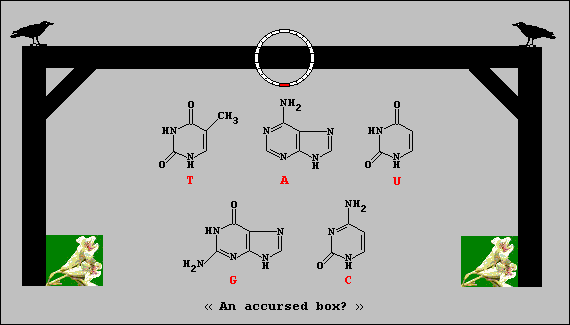
1. Canvas - « An accursed box? »
________________________________________________________________________________________
3.00 p.m. One afternoon during the 2nd week of term. In his bedroom, the Headmaster, Mr. Pond, is propped-up in bed; Dr. Krautmann enters ...
Dr. KRAUTMANN.
Good afternoon, Bassett.
Mr. POND.
Good afternoon, Gustav.
Dr. KRAUTMANN.
How are you feeling? (His tone is solicitous.)
Mr. POND.
Not too bad, all things considered; ... a bit fragile and, er, ... rather apprehensive, to tell the truth.
Dr. KRAUTMANN.
Mmm, ... Yes; Florence has been telling me as much.
Mr. POND.
Ah! The good Matron herself is very much an acquired taste; certainly on a thrice-daily basis!
Dr. KRAUTMANN.
So I can imagine. (He smiles.) Retribution, Bassett; just retribution. ...
Mr. POND.
Whatever do you mean!?
Dr. KRAUTMANN.
Your mild attack was your body's less than gentle warning to you to change your lifestyle; and, by fair means or foul, that is to be the modus vivendi of everyone involved in both your short-term rehabilitation and long-term welfare.
Mr. POND.
My lifestyle? I would admit to carrying a few extra pounds, (Dr. K. raises an eyebrow.) but I don't smoke, ... I drink in moderation, and ... I exercise regularly. (He shrugs.)
Dr. KRAUTMANN.
Exercise?! Shame on you! ... You can consider yourself very fortunate that Florence isn't here, otherwise I'd ask her to give you an enema. ... Exercise? Hmm! By no stretch of the imagination does swanning around the school in your academic gown constitute serious exercise!
Mr. POND.
Oh! (He sounds and looks contrite.)
Dr. KRAUTMANN.
"Oh!", indeed! (Then his tone softens.) Bassett, old chap, as with almost any disease, whether or not it affects any given individual is due in part to their «genetic make-up», and, in part to their «lifestyle». And, not surprisingly, these contributions will inevitably vary from one individual to another. ... With me so far? ...
Mr. POND.
Yes; I think so. ...
Dr. KRAUTMANN.
Now, ... you, yourself, may be genetically predisposed to cardio-vascular problems: but, bluntly stated, this is very cold comfort, particularly when you haven't done your system any favors with your lifestyle. Which, incidentally, if it
continued unchanged, might also promote «type 2 diabetes», also known as «adult-onset diabetes». ... ...
Mr. POND.
Mmm, ... Whilst I was in hospital, one of the doctors said something about a ... «cardiac rehabilitation programme»?
Dr. KRAUTMANN.
Yes; a British Heart Foundation nurse will be popping into see you about it tomorrow morning.
Mr. POND.
And, er, ... how long does this programme last?
Dr. KRAUTMANN.
It varies for the individual, of course; most people usually attend twice a week for about two months.
Mr. POND.
Attend? At the hospital?
Dr. KRAUTMANN.
No; not necessarily. For one reason or t'other, some people prefer to follow the program at home; not least because its main aim is «secondary prevention», by helping you and your family choose and maintain a healthier lifestyle. ...
Mr. POND.
I see.
Dr. KRAUTMANN.
Speaking of which, Bassett, has it never struck you as odd that I give every student a physical examination each and every term, yet rarely see any of your staff — the males, in particular — from one year to the next?
Mr. POND.
Mmm, ... To be honest, Gustav, I've never given the matter any thought; ... though I cannot imagine for a moment any of them relishing the prospect of lining up behind the students to see you and Matron Nightingale. (He smiles.)
Dr. KRAUTMANN.
Very droll, Bassett; I wasn't for a moment suggesting that they should! ... But I do have a serious point here: while our «better halves» rapidly acquire the habit of carefully listening to their bodies' rhythms, most male of the species either ignore or are unaware of their own biological clocks; ... as has been exemplified here, at Narkover, in the past few years by the health problems of Alec and yourself! (Mr. Pond hold up his hands.)
Mr. POND.
Enough, Gustav, please; I'm convinced! (He smiles.)
Dr. KRAUTMANN.
Good! Then, I think its high time I went off in search of more deserving patients. (He smiles.) Ciao! ...
11.30 a.m. One morning during the 3rd week of term. Fr. Richelieu takes his nephew out for a stroll in the grounds of Narkover College; throughout, he assumes that Newton cannot understand him and is unaware of Newton's interpolations ...
Fr. RICHELIEU.
Newton, c'est dommage que tu ne parles pas français...
NEWTON POND.
What a nerve ! Or, if you prefer : quel culot !
Fr. RICHELIEU.
Ah! A language like no other. (He sighs wistfully.) So, I will speak English — the language of Shakespeare; though, of course when you are older, you must find out what our divine Voltaire thought about the Bard of Avon. ...
NEWTON POND.
Who the devil are these Shakespeare and Voltaire chappies?
Fr. RICHELIEU.
Now, for our little tour around this rather «undistinguished establishment»; a fair description — I'm sure you'll agree — since, aside from the beautiful chapel, the architects down the years must have considered this mouldering pile to be an
ever-growing folly. ... But, I do apologize; doubtless you are wondering what my qualifications are to be your guide here. ...
NEWTON POND.
Eh!? I was wondering nothing of the sort. I was, however, wondering why there are yellow icicles on the fountain.
Fr. RICHELIEU.
Well, during the time I was a seminary student in Montréal, I used to come to Narkover — whenever possible — to pursue my personal passion. ...
NEWTON POND.
A lady?
Fr. RICHELIEU.
Ah yes ! (He sighs contentedly as he points in the direction of some bare trees.) ...
NEWTON POND.
"Yes"!? Good heavens, you were training to be a man of the cloth!
Fr. RICHELIEU.
Corvus corax; the common raven. ...
NEWTON POND.
Oh! I see. My humble apologies.
Fr. RICHELIEU.
Yes, indeed. ... And Euphémie — your lady mother — was so supportive; not only financially, but also in continuing to keep records of their behaviour in my absences. ... Which, I might add, your father considered to be below his dignity — this, from a man who collects stamps. Humph! ...
NEWTON POND.
I'd have you know that we Englishmen consider it damned bad form to talk about a chap behind his back!
Fr. RICHELIEU.
However, I have made sure he is aware of my disapproval. ...
NEWTON POND.
Oh! ... Well, even so, it's still not quite cricket; I mean, as you chaps would say: chacun ses goûts.
Fr. RICHELIEU.
Mmm! (He points to several shapes in the distance which are performing aerial gymnastics.) The casual observer, like your good self, Newton, would probably think those birds are indulging in mere frolicking: but no, that is their displays of courtship — and they should be roosting before the end of this term! ... Ravens not only mate for life, but both males and females bring up the young: so, one might say that they are good Catholic birds. Ho! Ho! Ho! ...
NEWTON POND.
Spare me, please! (He groans.)
Fr. RICHELIEU.
Mmm? ... Let me see. ... Perhaps I should first provide you with a little general background? ...
NEWTON POND.
Oh dear ! This sounds like a prelude to a lecture.
Fr. RICHELIEU.
The common raven is a member of a family of birds known as the Corvidae, which includes crows, jays, and magpies. ...
NEWTON POND.
Yes; I thought as much. I'm sorry, Uncle, but it's time for me to play the oldest trick in the book. (He starts crying vociferously.)
Fr. RICHELIEU.
Ô !... Mon pauvre Newton ; tu dois avoir froid, n'est-ce pas ? Je suis desolé... À la nursery douillette !...
11.45 p.m. Same night. In the Headmaster's bedroom, Mr. Pond and his lady wife are asleep; in the adjacent nursery are Newton (asleep) and Lily (awake) ...
LILY POND.
Gentle thespian, as you will have doubtless observed, this nursery is more than a mite unusual; indeed, were it not for the presence of our cots, one would be forgiven for thinking that one had strayed into a craft and science workshop. ... Admittedly, there are a few concessions befitting our tender ages: one doll — Newton would appear to have hidden the rest of my collection; a rocking horse; and several stuffed toys.
Nevertheless, such toddler-friendly trappings are positively dwarfed by the preponderance of paraphernalia donated by the members of one class, who are currently in Year 12, namely the «Remove». And the prime culprits, so to speak, of this largesse are Brown, East, Mumford, and Unman. Aside from various models — including one of a monastery! — they have donated to us two electronic mobiles: the one suspended over
Newton's cot, named «DNA», is based on the letters A, C, G and T, of which only three are lit at any given time — for example, ACC, TAG, TTT; whereas the one suspended over mine, named «RNA», is based on the letters A, C, G and U, of which similarly only three are lit at any one time — for example, ACC, UAG, UUU. ... Mmm? There would appear to be a direct correspondence here. Coincidental, or otherwise? ... But I mustn't digress! ... This afternoon, after paying a courtesy visit to Papa — whom they referred to, out of his hearing, as «Bassy» — the above mentioned quartet popped into the nursery with a picture. (She points in the direction of the one shown below.)

These flowers' prettiness and ostensible appropriateness — being, as we are, somewhere between Christmas and Easter — did serve to brighten up my otherwise dreary afternoon: but, since then, a dark cloud may have appeared on my particular horizon. ... Thus, Newton was not backward in coming forward with the information that this exemplar of the Pasque flower is known as the Red Cloak variety. ... Yet, apart from a
distinct sense of unease, engendered by his doom-laden tone of voice, I cannot, in truth, state that he has enlightened me at all; indeed, I cannot but wonder whether he is merely manifesting a precocious talent for dissimulation. ...
4.45 p.m. One afternoon during the 4th week of term. Pattullo, with a sheaf of notes in his hand, sees Salice a little ahead of him ...
PATTULLO.
Salice?! (She turns round.)
SALICE.
Oh! Hi, Spats.
PATTULLO.
Er, ... Do you happen to know who your uncle's guests are? (She looks surprised.)
SALICE.
No; I didn't know he had any. What makes you think he has?
PATTULLO.
Well, when I went to see him at his flat — to check up about a rehearsal time — and, er, ... there was a bed made-up on the sofa; that's all. (He shrugs.) ...
SALICE.
I see. Mmm, ... I'll pop over there now. Ciao, Spats.
PATTULLO.
Ciao! (They go their separate ways.) ...
10.30 p.m. One night during the 5th week of term. In the Headmaster's bedroom, Mr. Pond is browsing through his stamp collection; his lady wife is lying in bed reading ...
Mr. POND.
Euphémie ?
Mrs. POND.
Oui, Bassett ?
Mr. POND.
Heu,... Puis-je suggérer que nous partageons du chocolat, si tu veux bien ?
Mrs. Pond.
Mmm,... J'en suis pas sûr. Au lait, certainement pas ; la prudence s'impose. (He looks disappointed.) Mais, nous pourrions essayer notre «nombre favori» ?
Mr. POND.
Chut ! Chut !... Il est mieux vaut agir que parler...
________________________________________________________________________________________
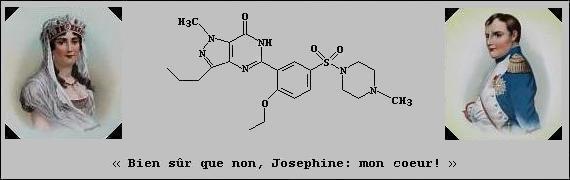
2. Canvas — « Bien sûr que non, Josephine: mon cœur! »
________________________________________________________________________________________
2.45 p.m. One afternoon during the 6th week of term. Dr. Bob Brummel takes the Lower 6th-Remove for their last lesson of General Studies before half-term ...
Dr. BRUMMEL.
Good afternoon, Class.
CLASS.
Afternoon, Sir. ...
Dr. BRUMMEL.
Although I can see that most of you appear to be somewhat surprised to see me at the helm this afternoon, I do assure that I have «commandeered» Dr. Stuart's class for a good reason. ... But, first things first. ... Pattullo, Sig. Sal. tells me that the final rehearsals for your divertissement have gone well?
PATTULLO.
Yes, Sir; on both sides of the Channel. Though, of course, we won't have had the opportunity of a full dress rehearsal with Lycée's orchestra; so, it may be «a wing and a prayer» stuff when we present the first performance, in French.
Dr. BRUMMEL.
Do you have any contingency plans?
PATTULLO.
Yes, Sir. If the worst should come to the worst — for the musical interludes — we'll play the appropriate CDs.
Dr. BRUMMEL.
Good thinking! (He smiles warmly at P.) Now, as you all know, neither Mlle Gossâge nor Dr. Stuart will be going to La Rochelle; the Headmaster felt both of them had deserved a «period of remission» — after the merry dance that some of you had led them a couple of years ago. (He gives, in turn, each boy a pointed look.) Be that as it may, in order to minimize the possibilities of you leading my lady wife and I a similar dance, we have decided to organize several field trips. (Merridew emits an audible groan.) Merridew, are you in pain? (His tone is solicitous.)
MERRIDEW.
Er, ... No, Sir. Sorry, Sir. ... I suddenly remembered the one we had to go on last time; ... to Hydragyrum Chapelier Vinaigrette.
Dr. BRUMMEL.
Their Museum of Hats?
MERRIDEW.
No, Sir; as far as I recall, it was a discussion about some industrial process or other.
Dr. BRUMMEL.
Yes, East?
EAST.
Sir, I'm pretty sure it concerned ethanoic acid ...?
Dr. BRUMMEL.
Yes; that's probably right. Do you have a more favorable impression than our friend Merridew here? (He smiles.)
EAST.
To be honest, Sir, no; it managed to be both surreal and boring at the same time. (All the boys nod their heads in affirmation.)
Dr. BRUMMEL.
Oh dear! Never mind. ... Yes, Wittering?
WITTERING.
Sir, these field trips you mentioned, um, ... they wouldn't happen to have been organized by Dr. Stuart, by any chance?
Dr. BRUMMEL.
No. (He looks puzzled.) Why do you ask?
WITTERING.
Well, both he and the Headmaster appear to be hell-bent on ensuring that no opportunity should be wasted in convincing us all to continue — in some way or t'other — our scientific education. ...
Dr. BRUMMEL.
For what it's worth, Wittering, I think you're doing both of them a massive injustice: for the simple reason that — even if their well-meaning decisions on your behalf, at present, are either misconceived or misguided, or both — these will be of no great moment because, in less than eighteen months time, you will leave Narkover and be able to determine your own choices in education. ... Wouldn't you agree? ...
WITTERING.
Suppose so, Sir; up to a point. (His tone is begrudging.)
Dr. BRUMMEL.
Mmm, ... In point of fact, these trips — which have been organized in the main by M. Rochefort of the Lycée Villiers, partly so that their students will be able to sit their mock examinations in peace — have no overtly scientific content. ... Yes, Trudi?
SALICE.
Are these trips around La Rochelle, or further afield, Sir, because Constance has told me that the history of the nearby islands is particularly rich?
Dr. BRUMMEL.
Oh! I'd completely forgotten that Constance went to the Lycée Villiers. ... Yes, Salice; most definitely the latter: but, which ones will be left as a surprise. (He smiles.) Now, in time-honored tradition, I will allow you to leave early, so that you may do some last-minute packing. ...
Day 1, afternoon: The Lower 6th-Remove, Mlle Backson, Dr. and Mrs. Brummel, and Fr. Richelieu travel to La Rochelle.
Day 2, morning: The Lower 6th-Remove spend the morning in the town.
Day 2, afternoon: The Lower 6th-Remove fine-tune the French version of their divertissement under the direction of Aramis and Pattullo.
Day 2, 7.00 p.m.: Seated in the audience of the Lycée's theatre are the staff and most of the students. The Lycée's orchestral players appear on stage, as appropriate; the parts of soloists and characters being distributed among the Lower 6th-Remove, ad libitum except for the two narrators. In front of the curtain: seated stage right is Salice, with her narrator's notes; seated stage left is Flora, with her white stick, guide dog, and narrator's notes in Braille; and standing centre stage is Fr. Richelieu ...
Fr. RICHELIEU.
Bienvenue... ... Il y a deux ans, un groupe d'étudiants du Lycée Villiers et de Narkover College s'est déshonoré ; d'une part, parce qu'ils ont simulé une scène d'exécution dans Les trois Mousquetaires de Milady qui était très dangereuse, et d'autre part, parce qu'ils ont joué une plaisanterie musicale qui était de mauvais goût. (His tone is disdainful.) Quoi qu'il en soit, exactement les mêmes étudiants, avec l'aide de leurs pairs, tenteront de se racheter ce soir... Alors, sans plus de cérémonie, permettez-moi de vous présenter un «divertissement musical» de Pierre Aramis et Ralph Pattullo. (Polite introductory applause from the theatre audience while Richelieu descends from the stage. ... Then:)
SALICE.
Bonsoir, mesdemoiselles et messieurs... Un avant-propos bref... Comme on pourrait s'attendre, notre divertissement musical inclut une petite mesure de la liberté de l'artiste : néanmoins, nous vous assurons de la vraisemblance de tous les personnalités réels et de la plupart des dates. Et la musique ? Ça va de soi, bien sûr !... Alors, nous présentons :
........................................................................................
MUSIQUE EN DOUBLE AVEUGLE
de Pierre Aramis du Lycée Villiers
et Ralph Pattullo de Narkover College.
[En anglais : Double-blind Music]
[Derrière le rideau, un claveciniste joue la sonate de Johann Schobert «Op.5 n°2» tout au long et au-delà les narrations suivantes.]
NARRATRICE [FLORA].
Leopold Mozart, le père de Wolfgang Amadeus, est mort le 28 mai 1787. Étant donné son rôle principal qu'il a joué dans le développement et la carrière de son fils, de l'enfance à la pleine maturité, c'est tout à fait curieux que Wolfgang n'a pas manifesté de signes extérieurs de chagrin lorsqu'il a appris de la mort de son père, le 31 mai ; seulement un post-scriptum à une lettre à Herr Gottfried von Jacquin, rédigé comme suit : ... «Je t'informe qu'en rentrant chez moi aujourd'hui, j'ai reçu des nouvelles tristes de la mort de mon père très bien-aimé. Tu peux imaginer l'état de mon esprit». ... C'est tout ! Dès lors, rien : pas de messe ; pas d'élégie ; pas de mémorial... Rien ? Pas nécessairement, parce qu'il y a une anomalie inexpliquée de cette période : à savoir, la première composition que Wolfgang a achevée, suite à la triste mort de son père, était Ein musikalischer Spass, ou, en français, Une Plaisanterie musicale.
NARRATRICE [SALICE].
Le docteur Stuart, professeur de science à Narkover, en Angleterre, a suggéré que cette composition pourrait être une lamentation inhabituelle, uniquement appropriée et
intensément personnelle pour son père bien-aimé ; In Memoriam, pour ainsi dire. ... En effet, une telle parodie plaisante a plusieurs précédents historiques ; par exemple, en 1747, Jean-Baptiste Forqueray a publié une pièce de clavecin, La
Forqueray, qui a pu être écrite comme un hommage aux talents exceptionnels de son père, Antoine, qui est mort en 1745... La suggestion du bon docteur est certainement plus crédible que «la sagesse reçue» — c'est-à-dire, une parodie caustique des œuvres et des usages des «petits-maîtres» — en partie parce que cette composition est parsemée de l'humour et des motifs de la musique de son père ; exemplifiés par la Sinfonia de chasse, la Sinfonia burlesque, le Voyage musical en traîneau, Le Mariage paysan et la Sinfonia pastorale... Néanmoins, il y a une mise en garde à la suggestion indiquée auparavant ; soit, Wolfgang a achevé le premier mouvement de cette composition vers la fin 1786, d'après une partition préliminaire qu'il a commencé probablement vers la fin 1785. Ceci dit, aucun de ces faits n'est accablant parce qu'il a souvent mis ses compositions «en cours» de côté. En effet, on aurait noté que ses œuvres existantes incluent beaucoup de partitions inachevées ; deux exemples sont la Grande Messe de 1782 et le Requiem de 1791, deux œuvres qui comportent plusieurs passages de la pièce liturgique la plus importante de son époque — c'est-à-dire, le Requiem de François-Joseph Gossec, écrit en 1760... Quoi qu'il en soit, à moins que le destin n'en décidât autrement, l'énigme resterait. Par la séréndipité, cette décision ne devrait jamais dépendre des caprices du destin.
NARRATRICE [FLORA].
Récemment, un collectionneur reclus d'antiquités a découvert quelques documents non catalogués de la fin du dix-huitième siècle dans un marché aux puces. Ces documents sembleraient provenir des archives de L'institution des Enfants Aveugles ; ce petit atelier, fondé par Valentin Haüy en 1786, était le premier du monde créé spécifiquement pour les aveugles. À ce jour, malheureusement, ce collectionneur n'a pas permis que ces documents soient examinés à fond pour établir leur authenticité. En conséquence, étant donné son attitude, que ce soit prudente ou philistine, nous vous conseillons de faire preuve d'une mesure de scepticisme sain à propos de nos reconstitutions partielles...
NARRATRICE [SALICE].
Alors,... une forme d'expression toute nouvelle prend son essor au milieu du dix-huitième siècle, destinée à dominer définitivement les mouvements de l'inspiration musicale et littéraire ; après l'Aufklärung — le «rationalisme» — c'était
l'Empfindsamkeit — la «sensibilité» — qui a entraîné les créateurs dans les profondeurs de l'âme et son irrépressible exaltation : voici bien l'embryon du «romantisme»... Mais, comme dit le proverbe : «on ne peut pas vivre d'amour et d'eau fraîche» ! Par conséquent en France, et ailleurs, les précurseurs et les pionniers de ces mouvements ont sollicité le mécénat qui était disponible seulement dans les salons les plus prestigieux des riches désœuvrées ; par exemple, celui du Grand-Prieur de France, Louis-François de Bourbon, le prince de Conti. Et, chez lui au Temple, vers le 27 juin 1766, on a des raisons de croire qu'une soirée a pu se dérouler avec les personnes suivantes :
NARRATRICE [FLORA].
Madame la comtesse de Boufflers et Mademoiselle la comtesse de Tessé, ses deux maîtresses. — M. Barthélémy Ollivier, son peintre officiel. — M. Michel Corrette, compositeur, auteur des 15 méthodes instrumentales, et organiste du Temple. — M. Valentin Haüy. — M. François-Joseph Gossec de Hainaut, le chef de l'orchestre du prince, compositeur aux talent divers et partisan infatigable de la musique de ses contemporains tout au long la deuxième moitié du dix-huitième siècle. — M. Jean-Claude Trial, violoniste, M. François-Joseph Haina de Prague et M. Jean Rodolphe de Strasbourg, deux cornistes, et Herr Johann Schobert de Silésie, claveciniste-compositeur de l'orchestre, qui est mort une année plus tard, dans la fleur de son âge, empoisonné par champignons de forêt. — Herr Leopold Mozart d'Augsburg, compositeur et l'auteur de la première méthode de violon qui a connu un succès mondial. — Enfin, M. Joseph Boulogne de la Guadeloupe, un mulâtre, plus connu comme M. le chevalier de Saint-George[s], séducteur, virtuose de l'épée et violoniste-compositeur ; à propos, au moins l'un des personnages principaux dans plusieurs romans historiques d'Alexandre Dumas est, en partie, un composite de tous les deux le bon chevalier et le père mulâtre du romancier.
[Rideau se lève. Un salon somptueusement meublé. Après que le soliste (Schobert) ait fini la sonate (environ 17 minutes au total), les invités applaudissent poliment ; puis ils déambulent. Disposition résultante ad libitum, sauf au devant côté cour, où Ollivier et Leopold Mozart sont debout et Mme de Boufflers est assise. Mme de B. est sur le point de s'adresser à Ollivier, qui n'a pas l'air dans son assiette.]
Mme de BOUFFLERS.
Cher Ollivier,... je sens que votre tempérament d'artiste délicat a été froissé ? [Son ton est taquin.]
OLLIVIER.
Non, Madame, pas exactement. [Son ton est un peu altier.] Néanmoins, Herr Mozart, ici présent, vient de m'informer que ses deux enfants ne seront pas chez nous ce soir ! [Son ton est un peu vexé.]
Mme de BOUFFLERS.
Euh !... Monsieur Mozart, c'est vrai ?
LEOPOLD MOZART.
Oui, Mme la comtesse.
Mme de BOUFFLERS.
Quel dommage, parce que mon cher Ollivier avait espéré faire une autre tableau de tous les deux, pour compléter celui qu'il vient de peindre... Ô ! Ma foi, je m'oubliais ; je suis désolée... Vos chers enfants ne sont pas malades ? [Son ton est vraiment inquiet.]
LEOPOLD MOZART.
Heureusement, non, Madame. Simplement tous les deux ont été fatigués. Comme vous savez, le petit Wolfgang a tendance à devenir surexcité...
Mme de BOUFFLERS.
Entre nous-mêmes, l'absence de Wolfgang est particulièrement décevante parce que M. Gossec m'a informé que, depuis votre dernière visite à Paris, il a écrit plusieurs œuvres pour orchestre ; des sinfonias et ce genre de choses.
LEOPOLD MOZART.
Oui, Madame, de tels morceaux sont nettement à la mode.
Mme de BOUFFLERS.
De qui par exemple ?
LEOPOLD MOZART.
Heu,... À part de moi-même, il y a Herr Michael Haydn, mon collègue à Salzbourg, Herr Josef Haydn, son frère aîné, Herr Christian Bach à Londres, le meilleur ami de mon fils, Herr Cannabich de Mannheim et, bien sûr, M. Gossec lui-même...
Mme de BOUFFLERS.
Eh bien voilà ! [Elle soupire d'une manière résignée.] Mais j'aurais aimé écouter l'une de ses compositions récentes.
LEOPOLD MOZART.
Ah ! Il y a pas de problème, Madame, parce que j'ai dans mes bagages un morceau qu'il a écrit en mars dernier à La Haye.
Mme de BOUFFLERS.
C'est splendide ! Il l'a composé tout par lui-même ?
LEOPOLD MOZART.
Non, Madame ; pas complètement. Comme de bien entendu, il fait quelques maladresses ; après tout, il apprend toujours.
Mme de BOUFFLERS.
Oui, je comprends... Monsieur, pour écouter ce morceau plus tard, auriez-vous l'obligeance d'aller le chercher ?
LEOPOLD MOZART.
Oui, Madame, mon plaisir. [Il salue gracieusement ; puis il avance vers une porte...]
Mme de BOUFFLERS.
Maintenant, mon cher Ollivier, dites-moi : savez-vous où sont M. le prince et Mlle de Tessé ?
OLLIVIER.
Ô !... ...
Mme de BOUFFLERS.
C'est tout !?... Un «Ô !» ?
OLLIVIER.
Madame, je suis la discrétion même.
Mme de BOUFFLERS.
Oui, et «la prudence est mère de sûreté» : je sais ! [Son ton est un peu impatient ; puis il adoucit.] Cependant, mon cher Ollivier, je veux seulement une réponse simple à une question simple.
OLLIVIER.
Oui, Madame, je vous prie de m'excuser. Je crois qu'ils prennent l'air dans le jardin.
Mme de BOUFFLERS.
Mmm ?... Et je sens qu'il y a de l'orage dans l'air !...
[Un orchestre et deux solistes (vielle ; musette) jouent la sinfonia de
Leopold Mozart «Le Mariage paysan» ; à l'achèvement, environ 13 minutes plus tard, les invités applaudissent poliment ; puis ils déambulent. Disposition résultante ad libitum, sauf au devant côté jardin, où Gossec et Saint-George sont debout et Mme de Boufflers est assise. Gossec est sur le point de s'adresser à Mme de B.]
GOSSEC.
Madame la comtesse, permettez-moi de vous présenter M. de Saint-George, gendarme de la garde du Roi.
Mme de BOUFFLERS.
Cher Gossec, enfin ! Vous m'avez obligé à attendre bien trop long avant de faire la connaissance de cet écuyer célèbre. [Son ton de reproche feint s'ajoutant d'un sourire gentil. Puis elle se tourne vers l'écuyer — qui deviendra, quelques années plus tard, «le Chevalier».] Bienvenue, Monsieur.
SAINT-GEORGE.
Merci mille fois, Madame ; tout le monde sait que M. le prince et vous sont deux mélomanes vrais. Mes hommages les plus profonds. [Il salue gracieusement.]
Mme de BOUFFLERS.
Charmant et galant ; quelle combinaison agréable, Monsieur. J'ai écouté plusieurs fois vos interprétations ravissantes au violon, chez La Popelinière et chez le duc d'Orléans, et je sais que votre premier maître au violon était le défunt M. Leclair : mais, j'aimerais savoir ce qui a suscité votre intérêt pour la musique...
SAINT-GEORGE.
Je crois qu'il a dû être la belle voix de ma mère, puis les encouragements de mon père ; mais, durant ces cinq dernières années, bien sûr, M. de la Boëssière m'avait soutenu.
Mme de BOUFFLERS.
Ô !... C'est un maître d'armes, sûrement ?
SAINT-GEORGE.
Vous avez tout à fait raison, Madame ; le meilleur en France, à mon avis. Quoi qu'il en soit, mon maître bien-aimé croit que l'étude de plusieurs sujets est indispensable au jeune gentilhomme.
Mme de BOUFFLERS.
Quoi par exemple ?
SAINT-GEORGE.
Heu,... Les mathématiques, la géographie, l'histoire, les langues vivantes, la danse, la musique,... [Il y a une toux discrète de Gossec...]
GOSSEC.
Excusez-moi l'interruption, Madame, mais le bon écuyer doit jouer bientôt l'un des premiers fruits de sa muse.
Mme de BOUFFLERS.
Et, je crois, aussi l'un des premiers de son instruction à l'art de composition par vous-même !? [Son ton est taquin et chaleureux à la fois.]
GOSSEC.
C'est juste, Madame. D'où, bien qu'un peu impertinent, mon impatience doit sembler compréhensible.
Mme de BOUFFLERS.
La mienne aussi ! [Tous les deux sourient. Puis elle se tourne vers l'écuyer.] Alors, Monsieur, voudriez-vous accorder, s'il vous plaît ?
SAINT-GEORGE.
Oui, Madame. [Il salue gracieusement ; puis il avance vers les trois autres membres d'un quatuor à cordes...]
Mme de BOUFFLERS.
Maintenant, mon cher Gossec, dites-moi : pensez-vous que cet écuyer soit assez talentueux pour gagner en matière de musique ?
GOSSEC.
Sans doute, Madame ; certainement, je crois que sa vocation vraie est la musique. [Son ton est énigmatique.]
Mme de BOUFFLERS.
Mmm !? Je sens un «mais» dans votre réponse. Peut-être vous pensez qu'il deviendra une victime de la jalousie ou de la couleur de sa peau ou... ?
GOSSEC.
Non, Madame, quoique les deux choses soient dans le domaine du possible... Il y a simplement plus d'exigences de son temps.
Mme de BOUFFLERS.
Quoi par exemple ?
GOSSEC.
Heu,... La chasse, la danse et, en particulier, l'escrime ; il est le meilleur escrimeur du royaume, comme vous savez. Bien, une telle renommée s'étend ; et, en effet, à ce moment, «la jeunesse dorée» est en train de lui conseiller vivement de se mesurer au meilleur escrimeur en Italie.
Mme de BOUFFLERS.
Le célèbre Signore Faldoni, n'est-ce pas ?
GOSSEC.
C'est bien cela, Madame...
Mme de BOUFFLERS.
Eh bien voilà ! [Elle soupire d'une manière résignée.] Seul l'avenir nous le dira...
[Un quatuor (Chevalier, 1e violon) joue le quatuor à cordes de Saint-George «Op.1a n°1» ; à l'achèvement, environ 7 minutes plus tard, les invités applaudissent poliment ; puis ils déambulent. Disposition résultante ad libitum, sauf au devant côté cour, où Corrette et Leopold Mozart sont debout et la comtesse de Tessé est assise. Mlle de T. est sur le point de s'adresser à Corrette.]
Mlle de TESSÉ.
Ah ! Monsieur Corrette et Herr Mozart, tout à l'heure j'ai observé que vous étiez plongés dans une discussion ; «un complot espiègle», sans doute ! [Son ton est taquin.]
CORRETTE.
Ô !? Mademoiselle la comtesse, à mon âge avancé ? Ça serait trop beau ! [Tous les trois prennent part aux rires.] Nous discutions seulement de l'usage des airs traditionnels et des instruments folkloriques en musique.
Mlle de TESSÉ.
Je vois... Quoi par exemple, M. Mozart, s'il vous plaît ?
LEOPOLD MOZART.
Comme vous avez écouté dans mon morceau de musique plus tôt, Mademoiselle, la vielle à roue et la musette.
Mlle de TESSÉ.
Heu,... Mais d'où vous vient cet intérêt spécial dans ces instruments, M. Corrette ?
CORRETTE.
Aucun intérêt particulier, en ce moment-ci, Mademoiselle. Mais, dans ma jeunesse, ils étaient à la mode ; et donc, pour les deux j'ai écrit des méthodes instrumentales et plusieurs compositions pour les amateurs.
Mlle de TESSÉ.
Vous composez toujours ?
CORRETTE.
Oui, Mademoiselle ; mais surtout pour l'orgue.
Mlle de TESSÉ.
Et vous-même, M. Mozart ?
LEOPOLD MOZART.
Un peu, oui, Mademoiselle ; mais, de plus en plus je me consacre à l'éducation de mon fils, Wolfgang.
Mlle de TESSÉ.
Ah ! À propos, il y a deux ans j'ai été vraiment honorée par sa dédicace de ces sonates pour clavecin avec accompagnement de violon. Vous le remercierez pour moi ?
LEOPOLD MOZART.
Bien sûr, Mademoiselle ; je sais qu'il sera très content. Et maintenant, hélas, je dois vous abandonner.
Mlle de TESSÉ.
Pourquoi, Monsieur, s'il vous plaît ?
LEOPOLD MOZART.
Parce que je viens de voir, Mademoiselle, du coin de l'œil, Mme de Boufflers m'indiquer son désir que je dirige le prochain morceau de musique ; qui, à propos, inclut quelques
airs traditionnels de néerlandais.
Mlle de TESSÉ.
C'est bien !... Et, le compositeur ?
LEOPOLD MOZART.
Ah ! Mon fils, Wolfgang... Votre serviteur, Mademoiselle. [Il salue gracieusement ; puis il avance vers l'orchestre.]
[Un orchestre joue la sérénade de Wolfgang Mozart «Galimathias musicum» ; à l'achèvement, environ 5 minutes plus tard, les invités applaudissent poliment ; puis ils déambulent. Disposition résultante ad libitum, sauf au devant côté jardin, où le prince de Conti et V. Haüy sont debout et la comtesse de Tessé est assise. Le prince est sur point de s'adresser à la comtesse.]
PRINCE DE CONTI.
Ma chère Mademoiselle, Mme de Boufflers a décidé d'élargir notre cercle de connaissances. Et, donc, il est mon plaisir de te présenter ce beau jeune homme,... heu,... [Il se tourne vers V. H.] M. Valentin Haüy, si ?
VALENTIN HAÜY.
C'est bon, Monsieur le prince. [Puis il se tourne vers Mlle de T.] Mademoiselle la comtesse, c'est vraiment un honneur pour moi de faire votre connaissance.
Mlle de TESSÉ.
Comme c'est charmant ! Merci, Monsieur... Et maintenant, parlez-moi un peu de vous-même, s'il vous plaît.
VALENTIN HAÜY.
Oui, Mademoiselle ; je suis né dans une famille de tisserands d'un petit bourg en Picardie... Heu,... Parce qu'ils sont assez aisés, ils m'ont permis de compléter mon éducation à Paris à l'université, comme René, mon frère aîné... ...
Mlle de TESSÉ.
Oui, Monsieur, et là ?
VALENTIN HAÜY.
Ah !... J'ai fait des études classiques ; et j'ai acquis la pratique du latin, du grec, de l'hébreu et de plusieurs langues vivantes... ...
Mlle de TESSÉ.
Alors, je présume que vous êtes expert en traductions ?
VALENTIN HAÜY.
Oui, Mademoiselle...
Mlle de TESSÉ.
De quoi ?
VALENTIN HAÜY.
Les documents des hommes d'affaires ; ce genre de choses...
Mlle de TESSÉ.
Monsieur, je vous loue sans réserve pour votre modestie très convenable — c'est un tel signe sûr d'un gentilhomme bien élevé — mais, essayer de obtenir votre vie,... eh bien, c'est comme essayer de faire parler un muet ! [Son ton de reproche léger s'ajoutant d'un encouragement.]
VALENTIN HAÜY.
Je suis désolé, Mademoiselle. Mais, comme on dit,... nous autres bourgeois simples... [Il pousse un soupir et il fait un geste d'innocence feinte ; puis il sourit.]
Mlle de TESSÉ.
Mais, je vois, pas d'esprit simple ! [Tous les deux rient doucement.] Alors, Monsieur, que faites-vous comme loisirs ?
VALENTIN HAÜY.
Inévitablement, je suppose, mes moments de loisir sont peu nombreux. Pourtant, je m'intéresse d'abord aux sourds-muets et à l'œuvre de M. l'abbé Michel de l'Épée, en particulier.
Mlle de TESSÉ.
Pourquoi ça, Monsieur ?
VALENTIN HAÜY.
Comme vous savez déjà, peut-être, il y a environ dix ans, ce philanthrope généreux a fondé la première école en France pour ces déshérités ; soit, L'institution des Sourds-Muets. Bien, j'aide... [Elle interrompt.]
Mlle de TESSÉ.
Pardonnez-moi l'interruption, Monsieur, mais tout d'un coup j'ai rendu compte que ma remarque sur les muets était de mauvais goût ; je m'excuse vraiment.
VALENTIN HAÜY.
Peu importe, Mademoiselle. [Son ton est bienveillant ; puis il soupire.] Malheureusement, chaque langue est libéralement parsemée d'expressions maladroites... ...
Mlle de TESSÉ.
Excusez-moi, vous disiez donc,... ça vous aidez là ?
VALENTIN HAÜY.
Ah ?... Oui ! En enseignant l'alphabet manuel aux élèves ; en les encourageant à parler ; et... [Il observe que le prince regarde sa montre de gousset.] Misère !... Monsieur, je vois que vous regardiez votre montre ; si je vous ai ennuyé, je me confonds en excuses. [Son ton est contrit.]
PRINCE DE CONTI.
Pas du tout, mon brave. [Son ton est enjoué.] Seulement, l'heure passe ; et je crois que Mlle la comtesse a un autre rendez-vous à une bergerie.
VALENTIN HAÜY.
Ô ! Alors, Mademoiselle, vous vous intéressez aux affaires pastorales ?
Mlle de TESSÉ.
Ma foi ! L'innocence simple de la jeunesse. [Elle sourit.]
PRINCE DE CONTI.
Mmm !?... Ou, peut-être, l'innocence feinte de la jeunesse ? [Puis il fait un signe de la tête au domestique, qui commence de souffler les bougies en scène. Rideau tombe.]
Entracte (obligato)
[Derrière le rideau, un fortepianiste joue la sonate de J. C. Bach «Op.17 n°5» tout au long et au-delà les narrations suivantes.]
NARRATRICE [SALICE].
Comme ce siècle s'est avancé, ces salons étaient l'hôte d'un mélange de plus en plus éclectique des «roues» molles, des dilettantes et des professionnels. Par exemple, vers le 20 août 1778, au château à Villers-Cotterêtes du duc d'Orléans et son épouse morganatique, la marquise de Montesson, on a des raisons de croire qu'une soirée a pu se dérouler avec les personnes suivantes :
NARRATRICE [FLORA].
M. Gossec. — M. Trial. — Herr Wolfgang Mozart. — Herr Baron Friedrich Grimm de Regensburg, le mécène le plus important de Wolfgang durant le premier deux tiers de sa courte vie. M. Valentin Haüy. — M. l'abbé René-Just Haüy, créateur de la cristallographie et savant. — M. de Saint-George[s]. — M. le capitaine Choderlos de Laclos, le co-librettiste du premier opéra du Chevalier ; et, un peu plus tard, en 1782, l'auteur des Liaisons dangereuses, écrit pendant qu'il supervisait la
construction des fortifications améliorées sur l'île d'Aix, près de La Rochelle,... contre les Anglais : qui d'autre !? — Signore Giuseppe Cambini de Livourne, l'un des compositeur-violonistes les plus appréciés de son temps ; à propos, comme de bien entendu, c'était Gossec qui a facilité son entrée dans la vie musicale parisienne. — Herr Johann Christian Bach de Leipzig, le plus jeune fils de Johann Sebastian, et
l'un des compositeur-clavecinistes les plus appréciés de son temps ; à propos, le jugement sur un procès, au éditeur non autorisé, en faveur de Chrétian, a établi la base des droits du compositeur dans la législation anglaise. — Dr Benjamin Franklin de Philadephie, le polymathe prééminent du Nouveau Monde du dix-huitième siècle, auteur et éditeur, séducteur, co-rédacteur de la Déclaration d'indépendance des États-Unis
d'Amerique en 1776, et l'inventeur du poêle, des lunettes à double foyer, du paratonnerre, de l'armonica de verre et tant de chose encore. — Mr John Adams de Massachusetts, un autre co-rédacteur de la Déclaration et, plus tard, le deuxième
président des États-Unis. — Herr Doktor Mesmer de Vienne, le médecin controversé ; à propos, un peu plus tard, en 1784, sa «théorie du magnétisme animal» serait repoussée par une commission royale d'enquête conduite par Franklin et dont les savants ont inclus Antoine Lavoisier, le chimiste, et Joseph Guillotin, le médecin. — Enfin, Miss Cecilia Davies et Miss Marianne Davies de Londres, deux nièces anglaises de Franklin ; la première, une chanteuse de talent et l'aide soignante pour Marianne, sa sœur aveugle ; et cette dernière, une claveciniste et une virtuose de l'armonica de verre.
[Rideau se lève. Un autre salon somptueusement meublé. Après que le soliste (J. C. Bach) ait fini la sonate (environ 9 minutes au total), les invités applaudissent poliment ; puis ils déambulent. Disposition
résultante ad libitum, sauf au devant côté cour, où V. Haüy et R. Haüy sont debout et Marianne Davies est assise. Marianne est sur le point de s'adresser à R. Haüy.]
MARIANNE DAVIES.
Monsieur l'abbé, dites-moi :... il est vrai que M. le docteur Mesmer est un invité ce soir ? [Son ton est énervé.]
RENÉ-JUST HAÜY.
Oui, Mlle Marianne... Heu,... Parce que votre si belle voix a quelque chose de tendu, aurais-je raison de croire que vous le tenez en basse estime ?...
MARIANNE DAVIES.
Entre nous-mêmes ? [Elle chuchote.]
RENÉ-JUST HAÜY.
Oui, Mademoiselle. [Son ton est entendu.] Je vous assure de la discrétion absolue de tous les deux mon frère et moi-même. [Puis il s'adresse à V. Haüy.] Valentin, d'accord ?
VALENTIN HAÜY.
Oui, René ; bien sûr... ... Mademoiselle,... alors ?
MARIANNE DAVIES.
Ah !... Eh bien, à mon avis, il est à peine un charlatan. [Son ton est acerbe et dédaigneux à la fois.]
RENÉ-JUST HAÜY.
C'est surprenant, parce que sa bonne réputation... [Elle coupe la parole à R. H.]
MARIANNE DAVIES.
Bôf !... Ô ! Je suis vraiment désolée, Monsieur. Pardonnez-moi l'interruption ?
RENÉ-JUST HAÜY.
Votre serviteur, Mademoiselle... Mais, ce n'était point la peine de s'excuser ; pour moi, je vois que vous tenez quelques intimes opinions au sujet du docteur, si ?
MARIANNE DAVIES.
C'est juste, Monsieur... Plus tôt cette année, à Vienne, il était nettement vain dans le traitement de ma bonne amie, Mlle Paradies... Certainement, il ne faut pas prendre sa «théorie du magnétisme animal» pour argent comptant !...
VALENTIN HAÜY.
Heu,... Mademoiselle, excusez mon indiscrétion, mais quelle maladie est-ce que votre amie souffre ?
MARIANNE DAVIES.
Pas une maladie : mais, comme moi, elle est aveugle.
VALENTIN HAÜY.
Et, depuis combien d'années la connaissez-vous ?
MARIANNE DAVIES.
Dès son plus jeune âge... Il y a environ neuf ans que nous avons joué du clavecin à quatre mains pour la première fois ; je suppose qu'elle aurait eu dix ans.
VALENTIN HAÜY.
Ah ! Vous étiez son enseignante alors ?
MARIANNE DAVIES.
Ma foi ! [Elle rit communicativement ; puis elle se reprend.] Pas du tout ; ça serait un cas vrai «des aveugles mènent les aveugles». [Les deux frères semblent un peu étonnés.] En fait, elle a eu plusieurs bons enseignants ; ceux-ci incluent le hautement apprécié Signore Salieri assez récemment...
RENÉ-JUST HAÜY.
Excusez-moi, Mademoiselle, mais, peu de temps avant, c'était un exemple du sens anglais d'humour bizarre ?
MARIANNE DAVIES.
Non, pas particulièrement ; bien que nous ayons tendance à se moquer de nous-mêmes. Et,... Chut !... Ah, oui ! Je crois que l'orchestre soit presque prêt ?
RENÉ-JUST HAÜY.
Hein ? [Il semble perplexe ; puis il regarde autour de lui.] Ah ! Vous avez complètement raison : bravo !... Vous devrez avoir l'oreille fine ; à ce moment, M. de Saint-George est en train de discuter la partition avec le chef d'orchestre.
MARIANNE DAVIES.
Ça doit être le fameux Chevalier ?
RENÉ-JUST HAÜY.
Oui, Mademoiselle ; exactement le même.
MARIANNE DAVIES.
C'est bien ! [Puis elle s'adresse à V. H.] Voudriez-vous le décrire pour moi, s'il vous plaît ?
VALENTIN HAÜY.
Mon plaisir, Mademoiselle. [Puis il regarde en direction de Saint-George près de l'orchestre.] Voyons un peu : ... il va avoir quarante ans ; il est grand, je dirais qu'il fait à peu près six pieds ; ... il est mince, mais il a la carrure
d'athlète ; et il est brun, comme un Créole... ...
MARIANNE DAVIES.
C'est tout ?
VALENTIN HAÜY.
Oui, Mademoiselle.
MARIANNE DAVIES.
Et, Monsieur, ça serait un exemple du sens français d'humour bizarre ? [Son ton est pince-sans-rire.] ...
VALENTIN HAÜY.
Ô !... Mademoiselle, qu'est ce que vous voulez dire par là, s'il vous plaît ? [Son ton est un peu mécontent.] Peut-être vous me moquez ou... [R. H. coupe la parole à V. H.]
RENÉ-JUST HAÜY.
Mon cher frère, où est ton sens d'humour !? [Cette question de reproche léger est suivie immédiatement par des rires chaleureux de R. H. et de Marianne.] ... Ou, peut-être, plus pertinemment, ton sens de la honte ! Tu as dessiné seulement une ébauche pour notre demoiselle charmante : tu n'as pas peint une image pour elle...
VALENTIN HAÜY.
Je me confonds en excuses, Mademoiselle. Néanmoins, d'après le prochain morceau de musique, je vous assure que je ferai une attention toute particulière à la description du bon chevalier par mon frère : avec ses dons d'observation, comme un savant, sans doute il peindra une image pour nous.
MARIANNE DAVIES.
Touché, Monsieur : bravo ! [Tous les trois prennent part aux rires.] ...
[Un orchestre et un soliste (Chevalier, violon) jouent le concerto pour violon de Saint-George «Op.3 n°1» ; à l'achèvement, environ 17 minutes plus tard, les invités applaudissent poliment ; puis ils déambulent. Disposition résultante ad libitum, sauf au devant côté jardin, où Laclos, Franklin et Adams sont debout ; Franklin porte sa toque de trappeur, selon sa coutume tout au long de son séjour en France. Laclos est sur le point de s'adresser à Franklin.]
LACLOS.
Mon cher Franklin, comme tu sais, il y a plusieurs ans, tes deux nièces charmantes — [D'une manière gracieuse, il agite son mouchoir de soie en direction de Cecilia et puis Marianne.] — se sont surpassées aux noces de duc de Parme et l'archiduchesse d'Autriche, avec leur interprétation d'une cantate de Signore Hasse ; L'Armonica, si ?
FRANKLIN.
Oui, mon cher Laclos, c'est ça.
LACLOS.
Eh bien, pendant... [Adams interrompt.]
ADAMS.
Pardonne-moi cette interruption, mon ami, mais ça aurait été à Schönbrunn, à Vienne... heu,... en 1769 ?
LACLOS.
Oui, mon cher Adams ; ça devrait aller. [Puis il s'adresse à Franklin ensuite.] Bien, pendant ce temps, parce que tu t'es été occupé des affaires d'état et... [Adams coupe la parole à Laclos.]
ADAMS.
Des liaisons passionnées ? [Son ton est espiègle.]
LACLOS.
Monsieur, non ! [Son ton est gêne.] Loin de moi cette idée. Donc, où en étais-je ?... ... Parbleu ! J'ai perdu le fil de mes pensées ! [Son ton est énervé.]
ADAMS.
Cher ami, je t'en prie de m'excuser. [Son ton est contrit.]
LACLOS.
Peu importe, mon ami ; je me souviens le vif du sujet. [Puis il s'adresse à Franklin ensuite.] Notre hôtesse gracieuse a persuadé tes nièces de donner une représentation ce soir de la même cantate ! [Franklin rougit de plaisir anticipé.]
FRANKLIN.
C'est merveilleuse !... Elle est très généreuse de nature.
LACLOS.
C'est juste. En effet, un peu de bonne heure ce soir, elle a été faite plaisir à écouter un quatrain simple qui j'avais composé pour elle...
FRANKLIN.
Heu,... Cher Laclos, voudrais-tu le répéter pour nous ?
LACLOS.
Je suis désolé ; mais, la modestie l'interdit.
FRANKLIN.
Par contre, mon ami, la fausse modestie est une telle vertu inconvenante, non ? [Son ton est encourageant.] ...
LACLOS.
Très bien. [Son ton est résigné.] Dans l'antre du lion !...
«Soit en son cœur, soit en l'amour :
Notre charmante hôtesse est l'esprit de finesse.
Sans la peur, tous les jours :
Elle distribue la bonne sagesse.» ...
FRANKLIN.
Cher ami, je t'accuse d'un faux pas ! [Son ton est taquin.]
LACLOS.
En écrivant des vers de mirliton ? [Il rit doucement.]
FRANKLIN.
Ça va de soi !... Non pas «en hongrant un étalon pur-sang» : mais «en dorant le Roi Soleil».
ADAMS.
Bôf !... L'autre chemin pour contourner, sûrement ?
FRANKLIN.
Absolument pas !... Mmm ?... Ça, c'est une idée,... ou... ça aurait été !
LACLOS.
Chut, Messieurs, chut !... Il y a des espions partout. [Il chuchote ; puis, d'une manière discrète, il regarde autour de lui.] ...
FRANKLIN.
Mais, mon cher Laclos, nous devons être debout ensemble ?
ADAMS.
Ou, sûrement, nous pendrons séparément ! [Franklin et Adams éclatent de rire simultanément.] ...
LACLOS.
Quoi !?... [Il produit un tss-tss de désapprobation.] ... Je ne comprendrai jamais vous autres Américains. [Il regarde autour de lui encore.] Ah ! [Il pousse un soupir profond de soulagement.] On s'est sauvé. [Il agite son mouchoir de soie en direction de l'orchestre.] L'orchestre est sur le point de jouer...
[Un orchestre et deux solistes (Cécilia, soprano ; Marianne, l'armonica
de verre) jouent la cantate de Hasse «L'Armonica» ; à l'achèvement,
environ 27 minutes plus tard, les invités applaudissent poliment ; puis ils déambulent. Disposition résultante ad libitum, sauf au devant côté cour, où W. Mozart, J. C. Bach et Saint-George sont debout. Wolfgang est sur le point de s'adresser à Saint-George.]
WOLFGANG MOZART.
M. de Saint-George, permets-moi de te présenter mon plus vieil ami, M. Chrétian Bach.
SAINT-GEORGE.
Enchanté. Heu,... On se tutoie ?
J.-C. BACH.
Oui, mon cher Monsieur.
SAINT-GEORGE.
J'ai entendu que tu étais ici, à Paris, pour vérifier les chanteurs et les chanteuses pour ton nouvel opéra, Amadis des Gauls, qui est destiné à l'Académie royale de musique ?
J.-C. BACH.
Soit l'Opéra, oui ; l'année prochaine... Maintenant, avant que je n'oublie complètement, Mr Henry Angelo à Londres m'a demandé de te transmettre ses meilleurs respects.
SAINT-GEORGE.
Mais c'est extraordinaire ! Tu es un escrimeur aussi ?
J.-C. BACH.
Non, pas du tout ! [Son ton est enjoué.] En effet, avec ma ligne ample, tu dois plaisanter ! [Tous les trois prennent part aux rires.] Non, cet homme généreux entretient «une table ouverte» chez lui ; et je suis un invité fréquent...
SAINT-GEORGE.
Tu restes à Paris pour longtemps ?
J.-C. BACH.
Tristement, non. J'ai besoin de revenir à Londres parce que j'ai plusieurs engagements pressants ; en particulier, mon frère bien-aimé, Johann-Christoph, a laissé à moi le soin d'enseigner son fils, Wilhelm-Friedrich...
WOLFGANG MOZART.
Mon cher Chevalier,... M. le baron Grimm m'a raconté que les autorités t'ont envisagé comme le directeur de l'Opéra, il y a environ trois ans ?
SAINT-GEORGE.
C'est juste ; en effet, j'ai eu le soutien de Sa Majesté la Reine, elle-même. [Son ton devient triste.] Je crois que les chanteuses de la vénérable Académie royale de musique ont invoqué «leur honneur» pour dissuader les autorités de confier à un mulâtre la responsabilité de les diriger. [Il hausse les épaules et il soupire d'une manière résignée.]
WOLFGANG MOZART.
Tu n'as pas de participation à l'opéra alors ?
SAINT-GEORGE.
Si ; dans le théâtre de notre hôtesse gracieuse, la marquise, je dirige beaucoup de représentations ; par exemple, en mars dernier, Le Jugement de Midas de M. Grétry.
J.-C. BACH.
As-tu composé des opéras ?
SAINT-GEORGE.
Oui ; juste l'un à ce jour, nommé Ernestine, l'année dernière. Mais, malheureusement, c'était un échec lamentable !
WOLFGANG MOZART.
Pourquoi donc ?
SAINT-GEORGE.
Je ne sais pas, exactement ; il a été suggéré que ces parties du livret qu'ont été écrites par M. Laclos peut-être ont été... comment dirais-je avec délicatesse ?... heu,... pas particulièrement convenable. Quoi qu'il en soit, pour mon prochain opéra, La Chasse, j'ai les services exclusifs de M. l'abbé Desfontaines. Et, naturellement, mon cher Mozart, j'espère que tu assisteras à sa première cet octobre.
WOLFGANG MOZART.
Je suis désolé, mais je doute si je serai toujours à Paris.
SAINT-GEORGE.
Quoi ? J'ai eu l'impression de notre ami commun, M. le comte de Guines, que le poste d'organiste à Versailles avait été offert à toi ?
WOLFGANG MOZART.
C'est bon ; mais, entre nous-mêmes, je ne veux pas travailler dans ce hameau des morts vivants. [Son ton est dédaigneux.]
SAINT-GEORGE.
Oui, je comprends. Néanmoins, je sais vraiment que tous les mélomanes à Paris ont été captivés par les représentations de ta musique exquise au Concert Spirituel. Sans doute, la lumière baissera sans toi.
WOLFGANG MOZART.
Merci, mon cher Chevalier ; tu es très gentil.
J.-C. BACH.
Ô ! Mon cher ami, j'ai eu une impression différente ; c'est-à-dire, tu cherchais un poste à Mannheim ou à Munich ?
WOLFGANG MOZART.
Oui ; tu as raison aussi. [Son ton devient amer.] Bien que l'Électeur fût «compatissant», il m'a informé qu'il y a «pas d'embauche» ! [Puis son ton devient chaleureux.] Toutefois, malgré mes déceptions, j'ai passé un bon séjour chez Herr
Cannabich à Mannheim ; et sa jolie fille, Rosa, était une élève très attentive.
SAINT-GEORGE.
Heu,... Que pense-tu de Herr Cannabich ?
WOLFGANG MOZART.
Ah ! Je ne taris pas d'éloges sur lui ! Il est le meilleur chef d'orchestre que j'ai jamais rencontré,... sauf votre respect, bien sûr,... et il... [J.C. Bach interrompt.]
J.-C. BACH.
Pardonne-moi l'interruption, mon ami, mais Signore Cambini est sur le point de jouer ton concerto pour violon...
[Un orchestre et un soliste (Cambini, violon) jouent le concerto pour
violon de Wolfgang Mozart «KV211» ; à l'achèvement, environ 21 minutes
plus tard, les invités applaudissent poliment ; puis ils déambulent. Disposition résultante ad libitum, sauf au devant côté jardin, où V. Haüy et R. Haüy sont debout et la marquise de Montasson est assise. Mme de M. est sur le point de s'adresser à V. Haüy.]
Mme de MONTASSON.
Monsieur Haüy, votre renommée comme un traducteur est bien méritée, naturellement, mais mon petit doigt aussi m'a dit que vous vous intéressez surtout aux déshérités ?
VALENTIN HAÜY.
Vous avez un mille fois raison, Marquise ; votre petit doigt est bien informé ! [Son ton est un peu espiègle. Elle rit doucement ; puis elle se reprend.] ...
Mme de MONTASSON.
Mais, toute plaisanterie mise à part, quand est-ce que vous vous êtes intéressé à leur détresse pour la première fois ?
VALENTIN HAÜY.
Je ne suis pas sûr ; je suppose... au début des années 60, d'après j'avais étudié quelques-unes des premières œuvres de M. Diderot. Pourtant, mon engagement plus profond a résulté d'une représentation singulière que j'ai assisté à la Foire Saint-Ovide, il y a environ sept ans ; en effet, laquelle m'a bouleversé et m'a indigné à la fois !
Mme de MONTASSON.
Qu'est-ce qui s'est passé ? [Son ton apaisant s'ajoutant d'un intérêt inquiet.]
VALENTIN HAÜY.
Bien, une dizaine de pensionnaires aveugles de l'Hospice des Quinze-Vingts — affublés de vêtements grotesques, et portant des lunettes opaques — ont exécuté au moyen d'instruments divers une musique discordante qui ont semblé exciter la
joie des spectateurs.
Mme de MONTASSON.
Quelle scandale ! [Sa voix tremblote.]
VALENTIN HAÜY.
C'est juste, Madame. Dès ce moment-là, je me jurai de faire lire et écrire les aveugles pour leur rendre leur dignité !
Mme de MONTASSON.
Cette passion !... Monsieur, je vous souhaite bien. [Elle reconnaît le salut gracieux de V. H., puis elle s'adresse à R. H.] Et maintenant, M. l'abbé, que faites-vous comme loisirs ?
RENÉ-JUST HAÜY.
Ma chère Madame, moi ? [Il fait un geste en horreur feinte.] Je suis quand même trop occupé avec mes ouailles ?
Mme de MONTASSON.
Monsieur, vous me taquinez ? [À travers son monocle, elle regarde R. H. d'un air interrogatoire.]
RENÉ-JUST HAÜY.
Juste un peu, Madame. [Son ton est chaleureux.] En fait, j'ai conduit quelques expériences en cristallographie et en électricité sur des cristaux qui ont été découverts par M. Seignette, apothicaire de La Rochelle ; en effet, j'espère pouvoir de discuter mes résultats les plus récentes avec le docteur Franklin.
Mme de MONTASSON.
Pour quelle raison, Monsieur ?
RENÉ-JUST HAÜY.
Heu,... Parce que cet homme très éminent est bien informé de telles affaires...
Mme de MONTASSON.
Et maintenant, Monsieur, vous me taquinez avec un petit jeu de mots ? [Elle sourit.]
RENÉ-JUST HAÜY.
C'est juste, Madame ; oui, un peu. [Elle rit doucement ; puis elle soupire.]
Mme de MONTASSON.
Eh bien voilà !... Peut-être je suis devenue une figure de risée ?
RENÉ-JUST HAÜY.
Pas du tout, chère Madame : périssez la pensée !... Tout le monde sait que votre jolie «risette» est comme une petite «risée» de plus bon parfum. [Il salue gracieusement.]
Mme de MONTASSON.
Ma foi, M. l'abbé, vous êtes très galant. Merci... Hélas, je crois que vos discussions devront attendre jusqu'à un autre jour.
RENÉ-JUST HAÜY.
Et pourquoi, Madame, s'il vous plaît !? [Son ton est sévère feint. Elle rit doucement ; puis elle indique son éventail en direction de Franklin.]
Mme de MONTASSON.
Parce que le bon docteur dort à poings fermés ! Ô !? Quelle heure ? [Elle jette un coup d'œil à une horloge.] Ah, oui ! L'heure passe. Et, comme dit le lord Bacon : «on ne peut pas arrêter le temps». [Puis elle fait un signe de la tête au domestique, qui commence de souffler les bougies en scène. Rideau tombe.]
Entracte (obligato)
[Derrière le rideau, un fortepianiste joue le rondo de Wolfgang Mozart «KV511» tout au long et au-delà les narrations suivantes.]
NARRATRICE [SALICE].
Quoique le but de notre divertissement ne soit pas de donner même une vue plongeante sur la musique de ce siècle, nous serions décidément négligents ne pas attirer votre attention sur les apartés notables suivantes...
NARRATRICE [FLORA].
Pendant le dix-huitième siècle, Georg Telemann, Johann Hasse et Josef Haydn étaient les compositeurs qui ont été tenus en la plus haute estime par leurs contemporains ; par ailleurs, l'appellation neutre de «petits-maîtres» a été limitée pour la plupart aux instituteurs du village. Par contre, tout au long des dix-neuvième et vingtième siècles, une succession constante des arbitres autonommés «de la haute culture et du
bon goût» ont affirmé que Johann Sebastian Bach et Wolfgang Mozart étaient les meilleurs compositeurs ; à quelques autres peuvent être accordés des mentions honorables ; et la grande majorité doit être désignée, avec une connotation péjorative,
comme «petits-maîtres». De telles affirmations, qu'ont été accompagnées souvent par l'expression «l'Histoire a jugé», sont philistins parce qu'elles sont fondées sur une prémisse erronée ; soit, le filtrage tendancieux des faits mène à l'acquisition de l'édification, de la perspective équilibrée ou des connaissances. Alors qu'une telle prémisse sûrement ne pourrait jamais étancher un «soif de connaissance», ou, comme on dit en allemande, Wissensdrang.
NARRATRICE [SALICE].
Parce qu'il y a vraiment un nombre incalculable d'exemples qu'on pourrait citer d'illustrer la nature inique de cette prémisse erronée, nous nous limiterons à l'une tout à fait extraordinaire. À savoir, par rapport à Mozart, peu de gens n'aient accordés jusqu'ici plus qu'une note de bas de page aux œuvres de Saint-George. Mais, pourquoi ça ? Est-ce que des tests en aveugle de leurs œuvres comparables dans les
mêmes genres — le quatuor à cordes, le concerto pour violon et la symphonie concertante — pendant la même période — de 1766 à 1778 — révéleraient Saint-George d'être réprouvé ou, peut-être, d'une manière beaucoup de plus inquiétante, tout le contraire ?...
NARRATRICE [FLORA].
Quoi qu'il en soit, en étant tellement plus jeune que Saint-George, Mozart a atteint inévitablement à sa pleine maturité artistique à une date plus tard. Certainement, suite à ses derniers séjours à Mannheim et à Paris, et coïncident avec le changement de la capitale culturelle de l'Europe de Paris à Vienne, la douzaine d'années dernières de sa courte vie étaient témoin d'une période d'intense créativité sans égal et de l'admiration sans réserve de ses pairs professionnels ; mais aussi, tristement, s'ajoutant des privations sévères et plusieurs tragédies personnelles... ...
[Rideau se lève. Un salon très pauvrement meublé. Après que le soliste (Wolfgang) ait fini le rondo (environ 10 minutes au total), Constanze, sa femme enceinte de sept ou huit mois, entre bruyamment d'une manière enthousiasmée ; elle tient une lettre cachetée à la cire. Puis : ]
CONSTANZE.
Wolfgang! [Elle s'arrête pour reprendre son souffle.] Der Postreiter hat ein Brief aus Paris zugestellt.
WOLFGANG MOZART.
Wie seltsam! Constanze, von wem ist dieser Brief?
CONSTANZE.
Ich weiss nicht. Ein Moment, bitte; ich schaue mal nach. [Elle enlève le cachet ; puis elle parcourt la lettre.] Ah! ... Der Brief ist auf Französisch geschrieben; von ... Herr Valentin Haüy!
WOLFGANG MOZART.
Bitte lese den Brief für mich vor, mein Liebling?
CONSTANZE.
Mit Vergnügen, meine Schatz. [Elle s'assied ; puis elle commence à lire à haute voix...]
|
L'institution des Enfants Aveugles, Paris. Le 21 août 1786. Mon cher Mozart, Valentin Haüy. P.-S. M. Gossec m'a demandé de te transmettre ses respects et ses meilleurs vœux. |
CONSTANZE.
Das ist alle, meine Schatz.
WOLFGANG MOZART.
Danke schön, mein Liebling. [Il a l'air de pensif ; puis, il commence de jouer quelques motifs sur le fortepiano qu'on se rappelle de «Ein musikalischer Spass» ; puis, il commence à improviser un peu de variations discordantes. Rideau tombe.]
NARRATRICE [SALICE].
Tristement, et très désespérément, les documents découverts récemment — à moins, ceux qu'ont été mis à la disposition de nous-mêmes — ne nous permettent pas de reconstituer plus loin, à dater de ce jour. Certes, le susnommé reclus a fait allusion à l'existence des fragments pertinents : mais, la prudence s'impose. Néanmoins, les preuves indirectes sont en accord avec cette hypothèse de travail : «Le morceau de musique nommé Une Plaisanterie musicale, en français, a été commandé à Herr Wolfgang Mozart par M. Valentin Haüy, à la mi-août 1786, pour la consécration de L'institution des Enfants Aveugles. Dès réception de la commande, Wolfgang a
développé un fragment de 1785 en premier mouvement complet, mais il l'a mis de côté, peu de après, probablement parce qu'il a eu quelques exigences plus pressantes ; en outre, son fils nouveau-né, Johann, est mort en novembre. Lorsqu'il a appris de la triste mort de son père, le 31 mai 1787, peut-être se rappeler les deux la commande de Valentin Haüy et des conversations entendues par hasard à Paris en 1778, il a
recommencé cette composition ; et il l'a achevé, le 14 juin.» Nous affirmons que cette hypothèse n'est pas controversée : mais, de même, nous acceptons que l'approbation répandue de son résumé implicite d'événements, réels ou non, dépendra de la découverte et de la diffusion de plus évidences de l'époque.
NARRATRICE [FLORA].
Quoi qu'il en soit, peu de gens ne seraient pas d'accord avec la convenance de cette composition «discordante» aux deux occasions ?... Ainsi, premièrement, Wolfgang honore et reflète aux réussites musicales de son père très bien-aimé pendant qu'il composait cette musique, et deuxièmement, six pensionnaires aveugles de L'institution — ont habillé comme quelques mendiants — honorent et s'identifient aux aveugles à la foire Saint-Ovide et ailleurs pendant qu'ils jouaient cette même musique devant la cour extravagante de Louis XVI : vraiment, les deux In Memoriam... ... Toutefois, «aimable écouteur», que pensez-vous de ce Sextuor pour musiciens de village ?...
[Rideau se lève. Un mobile électronique, qui est éteint, est suspendu du plafond de la scène. Sur la scène presque nue, il y a six chaises qui se sont occupées par six lycéens ont habillé comme quelques mendiants aveugles en France à la fin du dix-huitième siècle (deux violonistes, un altiste, un contrebassiste et deux cornistes) ; devant chaque lycéen est un pupitre à musique et une partition musicale qui est éclairée par une bougie électrique. Ils jouent «Ein musikalischer Spass» de Wolfgang Mozart ; à l'achèvement, environ 18 minutes plus tard, les bougies des
musiciens sont éteintes, une par une ; immédiatement la dernière bougie est éteinte, le mobile est allumé de révéler, de droite à gauche, les majuscules écarlates T A G ; puis, il y a le silence depuis une minute. Rideau tombe.]
NARRATRICE [SALICE].
Nous aimerions clôturer avec notre paraphrase des versets 8 à 10 au chapitre 7 du livre de Zacharie...
NARRATRICE [FLORA].
La parole de Notre Seigneur apparut à Zacharie : «Exécute le jugement vrai et montre la clémence et la compassion à chacun de tes pairs ; et, n'opprime pas l'étranger, ou une minorité, ou les déshérités ; et, ne laisse pas personne avoir une seule mauvaise pensée sur ses pairs».
........................................................................................
(A short pause. Polite concluding applause from the theatre audience while Fr. Richelieu ascends the stage. ... Then:)
Fr. RICHELIEU.
Fort évidemment, à mon avis, on doit consentir que le but de leur divertissement musical n'était pas seulement de plaire aux oreilles, mais aussi d'éveiller l'imagination et de toucher la pensée. Malheureusement, «l'heure ensorcelante de minuit» approche, et je crois très fermement qu'on ferait rarement aujourd'hui ce qu'on doit faire le demain. Alors, mes putatifs vautours de culture, c'est l'heure d'aller se coucher. Bonne nuit... À vos dortoirs !!...
Day 3: The Lower 6th-Remove and Dr. and Mrs. Brummel visit Île d'Aix and Île Madame.
________________________________________________________________________________________
3. Canvas - « Misbegotten or misunderstood or ...? »
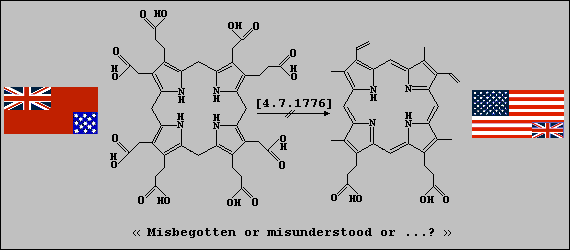
________________________________________________________________________________________
Day 4: The Lower 6th-Remove and Dr. and Mrs. Brummel visit Île de Ré.
Day 5, morning: The Lower 6th-Remove spend the morning in the town.
Day 5, afternoon: The Lower 6th-Remove fine-tune the English version of their divertissement under the direction of Aramis and Pattullo.
Day 5, 7.00 p.m.: Seated in the audience of the Lycée's theatre are the staff and most of the students. The Lycée's orchestral players appear on stage, as appropriate; the parts of soloists and characters being distributed among the Lower 6th-Remove, ad libitum except for the two narrators. In front of the curtain: seated stage right is Salice, with her narrator's notes; seated stage left is Flora, with her white stick, guide dog, and narrator's notes in Braille; and standing centre stage is Father Rochefort ...
M. ROCHEFORT.
Good evening, ladies and gentlemen. ... I have the greatest pleasure in introducing you to Ms. Salice Albero, who will introduce the English version of Musique en double aveugle, co-written by Pierre Aramis and Ralph Pattullo. (He smiles graciously at Salice.)
SALICE.
Thank you, Sir. ... ... Good evening. ... A brief foreword. ... As one might expect, our musical divertissement contains a slight measure of artistic licence: nevertheless, we do assure you of the verisimilitude of all the characters and most of the dates. ... And the music? That goes without saying, of course! ... ... We present:
........................................................................................
DOUBLE-BLIND MUSIC
by Pierre Aramis of the Lycée Villiers
and Ralph Pattullo of Narkover College.
[In French: Musique en double aveugle]
[Behind the curtain, a harpsichordist performs Johann Schobert's sonata
«Op.5 no.2» throughout (and beyond) the following narrations.]
NARRATOR [FLORA].
Leopold Mozart, the father of Wolfgang Amadeus, died on the 28th of May, 1787. Given the principal rôle which he played in his son's development and career — from childhood to full maturity — it is quite remarkable that Wolfgang showed no outward signs of grief when he learnt of his father's death on the 31st of May; merely a postscript to a letter to Herr Gottfried von Jacquin, which read as follows: ... "I inform you that on returning home today, I received the sad news of my father's death. You can imagine the state of my spirit." ... That's all! From then on, nothing: no mass; no elegy; no memorial. ... Nothing? Not necessarily, because there is an unexplained anomaly from this period: namely, the first composition that Wolfgang completed, following the sad death of his father, was Ein musikalischer Spass, or, in English,
A Musical Joke.
NARRATOR [SALICE].
Dr. Stuart, a science teacher at Narkover, in England, has proposed that this composition might be an unusual, uniquely appropriate, and intensely personal lament; In Memoriam, so to speak. ... Indeed, such an agreeable parody has several
historical precedents; for example, in 1747, Jean-Baptiste Forqueray published a harpsichord piece, La Forqueray, which appears to have been written as a homage to the exceptional talents of his father, Antoine, who died in 1745. ... The good doctor's suggestion is certainly more credible than the «received wisdom» — that is to say, a caustic parody of the works and the practices of the «minor-masters» — in part
because this composition is sprinkled with the humour and the motifs of his father's music; exemplified by The Peasant Wedding, the Musical Sleigh-ride, and the Burlesque, Hunting and Pastoral Sinfonias. ... Nevertheless, there is a caveat to the suggestion indicated previously; that is, Wolfgang completed the first movement of this composition towards the end of 1786, from a preliminary score that he had probably started towards the end of 1785. That said, neither fact is damning because he often set aside compositions «in progress». Indeed, one should note that his extant works include many incomplete scores; two examples are the Great
Mass of 1782 and the Requiem of 1791, both of which contain several passages from the most important liturgical work of its time — namely, the Requiem of François-Joseph Gossec, written in 1760. ... Be that as it may, unless fate decided otherwise, the enigma would remain. Serendipitously, this
decision would never depend on the whims of destiny.
NARRATOR [FLORA].
Recently, a reclusive antiques' collector discovered, in a flea-market, some uncataloged documents from the end of the 18th century. These documents would appear to have emanated from the archives of The Institution for Blind Children; this small workshop, founded by Valentin Haüy in 1786, was the world's first created specifically for the blind. To date, sadly, this collector has not allowed these documents to be examined thoroughly in order to establish their authenticity. As such, given his attitude — whether it be prudent or philistine — we counsel you to exercise a measure of healthy scepticism about our partial reconstructions. ...
NARRATOR [SALICE].
Now, ... in the middle of the 18th century, a completely new form of expression began to take shape, which was destined to dominate musical and literary inspiration; Aufklärung, or rationalism, was followed by Empfindsamkeit, or sensibility, which drove the creators towards the innermost reaches of the soul and its irrepressible elation: thus truly being Romanticism in embryonic form. ... But, as the proverb goes: «one cannot live on love and fresh air»! Consequently, in France, and elsewhere, the precursors and pioneers of these movements sought the patronage that was available only in the most prestigious salons of the idle rich; for example, that of the Grand Prior of France, Louis-François de Bourbon, the Prince de Conti. And, at his residence in the Temple, around the 27th of June, 1766, there are reasons to believe that a soirée may have taken place with the following persons:
NARRATOR [FLORA].
Madame la comtesse de Boufflers and Mademoiselle la comtesse de Tessé, his two mistresses. — M. Barthélémy Ollivier, his official painter. — M. Michel Corrette, composer, author of 15 instrumental tutors, and the organist of the Temple. — M.
Valentin Haüy. — M. François-Joseph Gossec of Hainaut, the conductor of the prince's orchestra, a composer of diverse talents, and tireless supporter of his contemporaries' music throughout the second half of the 18th century. — M. Jean-Claude Trial, violinist, M. François-Joseph Haina of Prague and M. Jean Rodolphe of Strasbourg, two horn players. — Herr Johann Schobert of Silesia, the composer-harpsichordist of the orchestra, who died a year later, in the prime of life, poisoned by forest mushrooms. — Herr Leopold Mozart of Augsburg, a composer and the author of the first tutor for the violin to achieve worldwide success. — And, finally, M. Joseph Boulogne of Guadaloupe, a mulatto, better known as the Chevalier de Saint-George[s], virtuoso swordsman, «lady-killer», and composer-violinist; incidentally, at least one of the main characters in several of the historical novels by Alexandre Dumas is a composite of the good chevalier and the author's mulatto father.
[Curtain rises. A lavishly furnished drawing room. After the soloist
(Schobert) completes the sonata (about 17 mins. in total), the guests
applaud politely and then circulate. Final arrangement ad lib., except front stage left, where Ollivier and Leopold Mozart stand and Mme de Boufflers is seated. Mme de B. is about to address Ollivier, who looks out of sorts.]
Mme de BOUFFLERS.
Dear Ollivier, ... do I sense that your delicate artistic temperament has been ruffled? [Her tone is teasing.]
OLLIVIER.
No, Madame; not exactly. [His tone is a touch haughty.] Nevertheless, Herr Mozart, here, has just informed me that his two children will not be with us this evening! [He sounds miffed.]
Mme de BOUFFLERS.
Oh! ... M. Mozart, is this true?
LEOPOLD MOZART.
Yes, Madame la comtesse.
Mme de BOUFFLERS.
What a pity, because my dear Ollivier had hoped to paint another picture of them both, so as to complement the one he has just painted. ... Oh! Upon my word, I was forgetting myself; I am sorry. ... Your dear children are not ill? [Her tone is one of genuine concern.]
LEOPOLD MOZART.
Happily, no, Madame. Merely that both of them are tired. As you know, little Wolfgang has a tendency to become over-excited. ...
Mme de BOUFFLERS.
Between ourselves, the absence of Wolfgang is particularly disappointing because M. Gossec has informed me that, since your last visit to Paris, he has written several orchestral works; sinfonias and that sort of thing.
LEOPOLD MOZART.
Yes, Madame; such pieces are very fashionable.
Mme de BOUFFLERS.
By whom, for example?
LEOPOLD MOZART.
Er, ... Aside from myself, there is: Herr Michael Haydn, my colleague in Salzburg; Herr Josef Haydn, his elder brother; Herr Christian Bach in London, my son's best friend; Herr Cannabich in Mannheim; and, of course, M. Gossec himself.
Mme de BOUFFLERS.
Ah well then, [She sighs in a resigned manner.] but I would have loved to hear to one of his recent compositions.
LEOPOLD MOZART.
Ah! That's no problem, Madame, because I have a piece in my luggage that he wrote last March in The Hague.
Mme de BOUFFLERS.
How splendid! ... Did he compose it all by himself?
LEOPOLD MOZART.
No, Madame; not completely. As one would expect, he makes a few infelicities; after all, he is still learning.
Mme de BOUFFLERS.
Yes, I understand. ... Monsieur, in order to listen to this morceau later, would you be so obliged as to fetch it?
LEOPOLD MOZART.
Yes, Madame; my pleasure. [He bows graciously; then moves towards a door.] ... ...
Mme de BOUFFLERS.
Now, my dear Ollivier, tell me: ... do you know where M. le prince and Mlle de Tessé are?
OLLIVIER.
Oh! ... ...
Mme de BOUFFLERS.
That's all!? ... An «Oh!»?
OLLIVIER.
Madame, I am the soul of discretion.
Mme de BOUFFLERS.
Yes, and «'tis better to be safe than sorry»: I know! [Her tone is slightly impatient; then it softens.] However, my dear Ollivier, I merely wish a simple answer to a simple question.
OLLIVIER.
Yes, Madame; pray forgive me. I believe they are taking the air in the garden.
Mme de BOUFFLERS.
Mmm? ... And I sense a storm is brewing! ...
[An orchestra and soloists (hurdy-gurdy; bagpipes) perform L. Mozart's
sinfonia «The Peasant Wedding»; on completion, about 13 min. later, the
guests applaud politely and then circulate. Final arrangement ad lib.,
except front stage right, where Gossec and Saint-George stand and Mme de Boufflers is seated. Gossec is about to address Mme de B.]
GOSSEC.
Madame la comtesse, allow me to present M. de Saint-George, one of the King's gendarmes.
Mme de BOUFFLERS.
Dear Gossec, at last! You have made me wait far too long to make the acquaintance of this celebrated equerry. [Her tone of mock reproach is coupled with a gentle smile. Then she turns to the equerry — who will become, a few years later, «le Chevalier».] Welcome, Monsieur.
SAINT-GEORGE.
Thank you so much, Madame; everyone knows that both Monsieur le prince and yourself are true music-lovers. My deepest respects. [He bows graciously.]
Mme de BOUFFLERS.
Charming and gallant; what an agreeable combination, Monsieur. ... I have heard your ravishing interpretations on the violin several times, chez the Duke of Orléans and La Popelinière, and I know that your first violin teacher was the late M. Leclair: but, I would like to know who aroused your interest in music. ...
SAINT-GEORGE.
I believe that it must have my mother's beautiful voice, then my father's encouragement; but, during these last five years, of course, M. de la Boëssière has supported me.
Mme de BOUFFLERS.
Oh! ... He is a Master of Arms, surely?
SAINT-GEORGE.
You are absolutely right, Madame; the best in France, in my opinion. Be that as it may, my beloved Master believes that the study of several subjects is indispensable to the young gentleman.
Mme de BOUFFLERS.
Such as ...?
SAINT-GEORGE.
Er, ... Mathematic, Geography, History, Modern Languages, Dance, Music, ... [Gossec coughs discreetly.] ...
GOSSEC.
Do please forgive the interruption, Madame, but the good equerry must soon play one of the first fruits of his muse.
Mme de BOUFFLERS.
And, I believe, also one of the first of his instruction in the art of composition by yourself. [Her tone is teasing but warm-hearted.]
GOSSEC.
That's true, Madame. Hence, although a mite impertinent, my impatience must seem understandable.
Mme de BOUFFLERS.
Mine too! [They both smile; then she turns to the equerry.] So, Monsieur, would you tune-up, please?
SAINT-GEORGE.
Yes, Madame. [He bows graciously; then he moves towards the other three members of a string quartet.] ... ...
Mme de BOUFFLERS.
Now, my dear Gossec, tell me: ... do you think that this equerry is talented enough to earn a living in music?
GOSSEC.
Without doubt, Madame; certainly, I do believe that his true vocation is music. [His tone is enigmatic.]
Mme de BOUFFLERS.
Mmm!? I sense a «but» in your reply. Perhaps you think that he will become a victim of jealously or of the colour of his skin or ...?
GOSSEC.
No, Madame, although both of these things are in the realms of possibility. ... There are simply too many demands on his time.
Mme de BOUFFLERS.
Such as ...?
GOSSEC.
Er, ... Hunting, dancing and, in particular, fencing; he is the finest blade in the kingdom, as you know. Well, such fame spreads; and indeed, at this moment, the «gilded youth» are strongly advising him to measure himself against the best swordsman in Italy.
Mme de BOUFFLERS.
The celebrated Signore Faldoni, yes?
GOSSEC.
That is so, Madame. ...
Mme de BOUFFLERS.
Ah well then, [She sighs resignedly.] we will have to see what the future holds. ...
[A string quartet (Chevalier, 1st violin) perform Saint-George's string
quartet «Op.1a no.1»; on completion, about 7 min. later, the guests applaud politely and then circulate. Final arrangement ad lib., except front stage left, where Corrette and Leopold Mozart stand and Mlle de Tessé is seated. Mlle de T. is about to address Corrette.]
Mlle de TESSÉ.
Ah! Monsieur Corrette and Herr Mozart, a little earlier I observed that you two were plunged in deep discussion: «a mischievous plot», no doubt! [Her tone is teasing.]
CORRETTE.
Oh!? Mademoiselle la comtesse, at my advanced age? Chance would be a fine thing! [All three share gentle laughter.] We were merely discussing the use of traditional tunes and folk instruments in music.
Mlle de TESSÉ.
I see. ... Such as, M. Mozart, if you please?
LEOPOLD MOZART.
As you heard in my piece of music a little earlier, Mademoiselle, the hurdy-gurdy and the bagpipes.
Mlle de TESSÉ.
Er,... But how is that you have this special interest in these instruments, M. Corrette?
CORRETTE.
No particular interest, at the present time, Mademoiselle. But, in my youth, they were fashionable; and so, for both of them, I wrote instrumental methods and several compositions for amateurs.
Mlle de TESSÉ.
Do you still compose?
CORRETTE.
Yes, Mademoiselle; but chiefly for the organ.
Mlle de TESSÉ.
And yourself, M. Mozart?
LEOPOLD MOZART.
A little, yes, Mademoiselle; but, increasingly, I dedicate myself to the education of my son, Wolfgang.
Mlle de TESSÉ.
Ah! By the way, two years ago, I was truly honoured by his dedication of those two sonatas for harpsichord and violin. You will thank him for me?
LEOPOLD MOZART.
But of course, Mademoiselle; I know he will be very happy. And now, sadly, I must abandon you.
Mlle de TESSÉ.
Why so, Monsieur, if you please?
LEOPOLD MOZART.
Because I have just seen, Mademoiselle, out of the corner of my eye, Mme de Boufflers indicate her desire that I direct the next piece of music; which, incidentally, includes some Dutch folk tunes.
Mlle de TESSÉ.
That's good! ... And, the composer?
LEOPOLD MOZART.
Ah! My son, Wolfgang. ... Your servant, Mademoiselle. [He bows graciously; then advances towards the orchestra.]
[An orchestra performs W. Mozart's serenade «Galimathias musicum»; on
completion, about 15 min. later, the guests applaud politely and then circulate. Final arrangement ad lib., except front stage right, where the Prince de Conti and V. Haüy stand and Mlle de Tessé is seated. The prince is about to address Mlle de T.]
PRINCE DE CONTI.
My dear Mademoiselle, Mme de Boufflers has decided to widen our circle of acquaintances. And so, it is my pleasure to present to you this fine young man, ... er, ... [He turns towards V. H.] ... M. Valentin Haüy, yes?
VALENTIN HAÜY.
That is correct, Monsieur le prince. [Then he turns towards Mlle de T.] Mademoiselle la comtesse, it is truly an honour for me to make your acquaintance.
Mlle de TESSÉ.
How charming! Thank you, Monsieur. ... And now, please tell me a little about yourself.
VALENTIN HAÜY.
Yes, Mademoiselle; I was born into a family of weavers in a small town in Picardy. ... Er, ... Because they were rather well off, they allowed me to complete my education in Paris at the university, like René, my older brother. ... ...
Mlle de TESSÉ.
Yes, Monsieur, and there?
VALENTIN HAÜY.
Ah! ... I studied Classics; and acquired fluency in Latin, Greek, Hebrew, and several modern languages. ... ...
Mlle de TESSÉ.
So, I presume you make a living as a translator?
VALENTIN HAÜY.
Yes, Mademoiselle. ...
Mlle de TESSÉ.
Such as?
VALENTIN HAÜY.
The documents of businessmen; that sort of thing. ...
Mlle de TESSÉ.
Monsieur, I praise you unreservedly for your most becoming modesty — it is such a sure sign of a well brought up gentleman — but, trying to obtain your life's story, ...
well, it's like trying to get a mute to speak! [Her tone of gentle reproach is coupled one with of encouragement.]
VALENTIN HAÜY.
I am sorry, Mademoiselle. But, as they say, ... we simple bourgeoisie ... [He breathes a sigh and makes a gesture of mock innocence; then he smiles.]
Mlle de TESSÉ.
But, I see, not a simple wit! [Both laugh softly.] Now, Monsieur, what do you for leisure?
VALENTIN HAÜY.
Inevitably, I suppose, my leisure time is somewhat limited. However, I'm interested above all in deaf-mutes and the work of M. l'abbé Michel de l'Épée, in particular.
Mlle de TESSÉ.
Why so, Monsieur?
VALENTIN HAÜY.
As you are perhaps aware, about ten years ago, this generous philanthropist founded the first school in France for these disadvantaged; namely, The Institution for Deaf-Mutes. ... Well, I help... [She interrupts.]
Mlle de TESSÉ.
Please forgive my interruption, Monsieur, but, all of a sudden, I have realized that my remark about the mutes was in poor taste; I do apologize.
VALENTIN HAÜY.
No matter, Mademoiselle. [His tone is benevolent; then he sighs.] Sadly, each language is liberally sprinkled with maladroit expressions. ... ...
Mlle de TESSÉ.
Excuse me, but you were saying, ... that you helped there?
VALENTIN HAÜY.
Ah! ... Yes! By teaching the hand alphabet to pupils; by encouraging them to speak; and ... [He observes the prince looking at his pocket-watch.] ... Oh dear! ... Monsieur, I see that you were looking at your watch; if I have bored you, I apologize profusely. [His tone is contrite.]
PRINCE DE CONTI.
Not at all, my good fellow. [His tone is jovial.] Merely that time passes; and I believe that Mlle la comtesse has another rendezvous in a shepherd's barn.
VALENTIN HAÜY.
Oh! So, Mademoiselle, you interest yourself in pastoral affairs?
Mlle de TESSÉ.
Upon my word! The simple innocence of youth. [She smiles.]
PRINCE DE CONTI.
Mmm!? ... Or, perhaps, the mock innocence of youth? [Then he nods to a servant, who
starts to extinguish the candles on stage. Curtain falls.]
Entracte (obligato)
[Behind the curtain, a fortepianist performs J. C. Bach's sonata «Op.17 no.5» throughout (and beyond) the following narrations.]
NARRATOR [SALICE].
As this century progressed, these salons were host to an increasingly eclectic mixture of libertines, dilettantes, and professionals. For example, around the 20th of August,
1778, at the Château Villers-Cotterêtes of the Duke of Orléans and his morganatic wife, the Marchioness of Montesson, there are reasons to believe that a soirée may
have taken place with the following persons:
NARRATOR [FLORA].
M. Gossec. — M. Trial. — Herr Wolfgang Mozart. — Herr Baron Friedrich Grimm of Regensburg, the most important patron of Wolfgang Mozart during the first two-thirds of his short life. — M. Valentin Haüy. — M. l'abbé René-Just Haüy, savant and founder of the science of crystallography. — M. de Saint George[s]. — M. le capitaine Choderlos de Laclos, the co-librettist of the Chevalier's first opera; and, later, in 1782, the author of Dangerous Liaisons, written whilst he supervised the construction of improved fortifications on the Île d'Aix, near La Rochelle, ... against the English:
who else!? — Signore Giuseppe Cambini of Livorno, one of the most highly appreciated composer-violinists of his time; as one would expect, it was Gossec who facilitated his entry into Parisian musical life. — Herr Johann Christian Bach of Leipzig, Johann Sebastian's youngest son, and one of the most highly appreciated composer-harpsichordists of his time; incidentally, the judgement in a law suit against an unauthorized publisher, in favour of Christian, established the concept of the composer's rights in English law. — Dr. Benjamin Franklin of Philadelphia, the pre-eminent polymath of the New World in the 18th century, author and editor, «lady's man», co-drafter of The Declaration of Independence of the United States of America in 1776, and the inventor of the stove, bifocal glasses, the lightening conductor, the
glass harmonica, and so much more besides. — Mr. John Adams of Massachusetts, another co-drafter of The Declaration and, later, in 1797, the second president of the United States. — Herr Doktor Mesmer of Vienna, the controversial physician; incidentally, a little later, in 1784, his «theory of animal magnetism» would be rejected by a royal commission headed by Franklin and whose savants included Antoine Lavoisier, the
chemist, and Joseph Guillotin, the physician. — And finally, Miss Cecilia Davies and Miss Marianne Davies of London, two English nieces of Franklin; the former, a talented singer and care-worker for Marianne, her blind sister; and this latter, a harpsichordist and a glass harmonica virtuoso.
[Curtain rises. Another lavishly furnished drawing room. After the soloist (J.C. Bach) completes the sonata (about 9 mins. in total), the guests applaud politely and then circulate. Final arrangement ad lib., except front stage left, where V. Haüy and R. Haüy stand and Marianne Davies is seated. Marianne is about to address R. Haüy.]
MARIANNE DAVIES.
Monsieur l'abbé, tell me: ... is it true that Doctor Mesmer is a guest here this evening? [Her tone is edgy.]
RENÉ-JUST HAÜY.
Yes, Mlle Marianne. Er, ... Because there's a catch in your otherwise beautiful voice, would I be correct in believing that you hold him in low regard? ...
MARIANNE DAVIES.
Between ourselves? [She whispers.]
RENÉ-JUST HAÜY.
Yes, Mademoiselle. [His tone is conspiratorial.] I assure you of the absolute discretion of both my brother and myself. [Then he addresses V.H.] Valentin, agreed?
VALENTIN HAÜY.
Yes, René; of course. ... ... Mademoiselle, ... and?
MARIANNE DAVIES.
Ah! Well, in my opinion, he's little more than a charlatan. [Her tone is both waspish and disdainful.]
RENÉ-JUST HAÜY.
That is surprising, because his excellent reputation... [She interjects.]
MARIANNE DAVIES.
Humph! ... Oh! I am so sorry, Monsieur. Please do forgive my interruption?
RENÉ-JUST HAÜY.
Your servant, Mademoiselle. ... However, there was no need for you to apologize; for myself, I see that you hold strong views about the doctor, yes?
MARIANNE DAVIES.
That's correct, Monsieur. ... Earlier this year, in Vienna, he was totally unsuccessful in treating my good friend, Mlle Paradies. ... Certainly, one can take his «theory of animal magnetism» with a pinch of salt. ...
VALENTIN HAÜY.
Er, ... Mademoiselle, please forgive my curiosity, but from what illness does your friend suffer?
MARIANNE DAVIES.
Not an illness: but, like myself, she is blind.
VALENTIN HAÜY.
And, how long have you known her?
MARIANNE DAVIES.
From a very young age. ... It was about nine years ago that we played harpsichord duets for the first time; I suppose that she would have been ten years old.
VALENTIN HAÜY.
Ah! You were her teacher, then?
MARIANNE DAVIES.
Upon my word! [She giggles; then composes herself.] No, not at all; that would be a true case of «the blind leading the blind». [Both brothers look mildly astonished.] In fact, she has had several good teachers; including, quite recently, the highly esteemed Signore Salieri. ...
RENÉ-JUST HAÜY.
Excuse me, Mademoiselle, but, shortly before, would that be an example of the English sense of whimsical humour?
MARIANNE DAVIES.
No, not particularly; although we do have a tendency to make fun of ourselves; and, ... Shush! ... Ah, yes! I do believe the orchestra is almost ready?
RENÉ-JUST HAÜY.
Eh? [He looks nonplussed; then he looks around him.] Ah! You are absolutely right: bravo! ... You must have very fine hearing; at this moment, M. de Saint-George is discussing the score with the leader of the orchestra.
MARIANNE DAVIES.
That must be the much talked-about Chevalier?
RENÉ-JUST HAÜY.
Yes, Mademosielle; the one and the same.
MARIANNE DAVIES.
Splendid! [Then she addresses V. H.] Would you describe him for me, please?
VALENTIN HAÜY.
My pleasure, Mademoiselle. [He looks in the direction of Saint-George near the orchestra.] Let me see now: ... he's going on forty; he's tall, I'd say close on six foot; ... he's slim, but has the bearing of an athlete; and ... he's brown, like a Creole. ... ...
MARIANNE DAVIES.
That's all?
VALENTIN HAÜY.
Yes, Mademoiselle.
MARIANNE DAVIES.
And, Monsieur, that would be an example of the French sense of whimsical humour? [Her tone is dead-pan.] ...
VALENTIN HAÜY.
Oh! Mademoiselle, what do you mean by that, if you please? [His tone is slightly aggrieved.] Perhaps you are making fun of me or... [R. H. interjects.]
RENÉ-JUST HAÜY.
My dear brother, ... where is your sense of humour!? [This gently reproving question is followed immediately by warm-spirited laughter from R. H. and Marianne.] ... Or, perhaps, more pertinently, your sense of shame. You've merely drawn a sketch for our charming young lady: you have not painted a picture for her. ...
VALENTIN HAÜY.
I apologize profusely, Mademoiselle. Nevertheless, after the next piece of music, I do assure you that I will be paying the closest attention to my brother's description of
the good chevalier: with his powers of observation, as a scientist, he will undoubtedly paint a picture for us.
MARIANNE DAVIES.
Touché, Monsieur: bravo! [All three share laughter.] ...
[An orchestra and soloist (Chevalier, violin) perform Saint-George's violin concerto «Op.3 no.1»; on completion, about 17 min. later, the guests applaud politely and then circulate. Final arrangement ad lib., except front stage right, where Laclos, Adams, and Franklin stand; the latter, as was his custom throughout his stay in France, is wearing a fur trapper's hat. Laclos is about to address Franklin.]
LACLOS.
My dear Franklin, as you know, several years ago, your two charming nieces — [In a graceful manner, he waves his silk handkerchief in the direction of Cecilia and then Marianne.] — excelled themselves at the wedding of the Duke of Parma and the Archduchess of Austria, with their interpretation of a cantata by Signore Hasse; L'Armonica, yes?
FRANKLIN.
Yes, my dear Laclos; that's so.
LACLOS.
Well, during... [Adams interrupts.]
ADAMS.
Forgive this interruption, my friend, but that would have been at Schönbrunn, in Vienna, ... er, ... in 1769?
LACLOS.
Yes, my dear Adams; that would be about right. ... [Then he addresses Franklin again.] Well, during this time, because you were occupied with affairs of state and... [Adams interjects.]
ADAMS.
Passionate liaisons? [His tone is mischievous.]
LACLOS.
Monsieur, no! [His tone is embarrassed.] Nothing could be further from my mind. Now, where was I? ... ... Good grief! I've lost my train of thought! [His tone is flustered.]
ADAMS.
Dear friend, pray forgive me. [His tone is contrite.]
LACLOS.
No matter, my friend; I remember the heart of the matter. [Then he addresses Franklin again.] Our gracious hostess has persuaded your nieces to give a performance tonight of this very same cantata. [Franklin looks chuffed.]
FRANKLIN.
How marvellous! ... She is very generous by nature.
LACLOS.
That's so true. ... Indeed, a little earlier this evening, she was pleased to listen to a simple quatrain which I had written for her. ...
FRANKLIN.
Er, ... Dear Laclos, would you repeat it for us?
LACLOS.
I am sorry; but, modesty forbids it.
FRANKLIN.
On the contrary, dear friend, false modesty is such an unbecoming virtue, no? [His tone is encouraging.] ...
LACLOS.
Very well. [His tone is resigned.] Into the lion's den! ...
«Be it in her heart, or be it in love:
Our charming hostess is the soul of finesse.
Without fear, every year:
She dispenses such acuteness.» ...
FRANKLIN.
Dear friend, I accuse you of a faux pas! [His tone is teasing.]
LACLOS.
By writing doggerel? [He laughs softly.]
FRANKLIN.
That goes without saying! ... Not «in gelding a thorough-bred»: but «in gilding the Sun King».
ADAMS.
Humph! ... The other way round, surely?
FRANKLIN.
Absolutely not! ... Mmm? ... Ah! There's a thought, ... or ... would have been!
LACLOS.
Shush, Messieurs, shush! ... There are spies everywhere. [He whispers; then, discreetly, he looks around him.]
FRANKLIN.
But, my dear Laclos, we must stand together?
ADAMS.
Or, surely, we will hang separately! [Franklin and Adams burst out laughing simultaneously.] ...
LACLOS.
What!? ... [He tut-tuts.] ... I will never understand you Americans. [Then, he looks around him again.] Ah! [He sighs with relief.] We are saved. [He waves his silk handkerchief in the orchestra's direction.] The orchestra
is about to play. ...
[An orchestra and two soloists (Marianne, glass harmonica; and Cecilia,
soprano) perform Hasse's cantata «L'Armonica»; on completion, about 27 min. later, the guests applaud politely and then circulate. Final arrangement ad lib., except front stage right, where Saint-George, J.C. Bach, and W. Mozart stand. Wolfgang is about to address Saint-George.]
WOLFGANG MOZART.
Monsieur de Saint-George, allow me to present my oldest friend, M. Chrétian Bach.
SAINT-GEORGE.
Delighted to me you. ... I'd heard you were here, in Paris, to confirm the soloists for your new opera, Amadis des Gauls, ... intended for the Royal Academy of Music?
J. C. BACH.
The Opéra, yes; next year. ... Now, before I completely forget, Mr. Henry Angelo in London has asked me to convey to you his very best respects.
SAINT-GEORGE.
But that's extraordinary! You're a fencer too?
J. C. BACH.
No, not at all! [His tone is jovial.] Indeed, with my ample figure, you must joking! [All three share audible laughter.] No, this generous gentleman man keeps «open house»; and I'm a frequent guest. ...
SAINT-GEORGE.
Are you staying long in Paris?
J. C. BACH.
Sadly, no. I must return to London because I have several pressing engagements; in particular, my beloved brother, Johann Christoph, has entrusted me with the tutoring of his son, Wilhelm Friedrich. ...
WOLFGANG MOZART.
My dear Chevalier, ... Baron Grimm has told me that, about three years ago, the authorities envisaged your good self as the Director of the Opéra.
SAINT-GEORGE.
That's correct; indeed, I had the support of Her Majesty the Queen, herself. [His tone becomes sad.] I believe that the lady singers of the venerable Royal Academy of Music invoked «their honour» to dissuade the authorities from conferring a mulatto to direct them. [He shrugs his shoulders and sighs in a resigned manner.]
WOLFGANG MOZART.
You're not involved in opera, then?
SAINT-GEORGE.
Oh, yes; I direct many performances in the theatre of our gracious hostess, the marchioness; for example, last March, M. Grétry's Le Jugement de Midas.
J. C. BACH.
Have you composed any operas?
SAINT-GEORGE.
Yes; just the one to date, Ernestine, last year: but, most unfortunately, it was a lamentable disaster!
WOLFGANG MOZART.
Why so?
SAINT-GEORGE.
I don't know, exactly; it's been suggested that those parts of the libretto which had been written by M. Laclos were, perhaps, ... How can I put this delicately? ... er, ... not particularly suitable. ... Be that as it may, for my next opera, La Chasse, I have the exclusive services of M. l'abbé Desfontaines. And, naturally, my dear Mozart, I hope you will be present as its première this October.
WOLFGANG MOZART.
I am sorry, but I doubt whether I'll still be in Paris.
SAINT-GEORGE.
What? I had the impression from our mutual friend, the Count de Guines, that the position of organist at Versailles had been offered to your good self?
WOLFGANG MOZART.
That's true; but, between ourselves, I've no wish to work in that hamlet of the living dead. [His tone is disdainful.]
SAINT-GEORGE.
Yes; I understand. Nevertheless, I do know that every music lover in Paris has been captivated by the performances of your exquisite music at the Concert Spirituel. Without doubt, the light will be dimmer without your good self.
WOLFGANG MOZART.
Thank you, my dear Chevalier; you are most kind.
J. C. BACH.
Oh! My dear friend, I had a different impression; that's to say, you were looking for a position in Mannheim or Munich?
WOLFGANG MOZART.
Yes; you're right too. [His tone becomes bitter.] Although the Elector was «sympathetic», he informed me that there was «no room»! [Then his tone becomes warm.] Yet, despite my disappointments, I spent a nice time in Mannheim, chez Herr Cannabich; and his pretty daughter, Rosa, was a most attentive pupil.
SAINT-GEORGE.
Er, ... What do you think of Herr Cannabich?
WOLFGANG MOZART.
Ah! I'm full of praise for him! He's the best conductor I that I've ever met, ... saving your presence, of course, ... and... [J.C. Bach interrupts.]
J. C. BACH.
Forgive the interruption, my friend, but Signore Cambini is about to play your violin concerto. ...
[An orchestra and soloist (Cambini, violin) perform W. Mozart's violin
concerto «no.2 ; KV218»; on completion, about 21 min. later, the guests applaud politely and then circulate. Final arrangement ad lib., except front stage right, where V. Haüy and R. Haüy stand and the Marchioness of Montasson is seated. Mme de M. is about to address V. Haüy.]
Mme de MONTASSON.
Monsieur Haüy, your reputation as a translator is well merited, naturally, but a little bird has told me that you interest yourself above all in the disadvantaged?
VALENTIN HAÜY.
You are absolutely correct, Madame de Montesson; your little bird is well informed! [His tone is mischievous. She laughs softly; then she composes herself.] ...
Mme de MONTASSON.
But, all pleasantries aside, when did you interest yourself in their predicament for the first time?
VALENTIN HAÜY.
I'm not sure; ... I suppose at the beginning of the '60s, after I had studied several of M. Diderot's early works. ... However, my deeper involvement resulted from a most singular performance that I witnessed about seven years ago at the Saint-Ovide Fair; one, indeed, which both saddened and outraged me!
Mme de MONTASSON.
What happened? [Her emollient tone is coupled with one of concerned interest.]
VALENTIN HAÜY.
Well, about a dozen blind pensioners from The Hospice for the Three Hundred — dressed in grotesque clothes and wearing opaque spectacles — were playing a discordant piece of music, with all manner of instruments, which appeared to excite the pleasure of the spectators.
Mme de MONTASSON.
What a disgrace! [Her voice quivers.]
VALENTIN HAÜY.
That's so true, Madame. From that moment, I swore to myself that I would teach the blind to read and write so as to give them back their dignity!
Mme de MONTASSON.
What passion ! Monsieur, I wish you well. [She acknowledges V. H.'s gracious bow, then she addresses R. H.] And now, M. l'abbé, how do you occupy your leisure time?
RENÉ-JUST HAÜY.
My dear Madame, me? [He gestures with his hands in mock horror.] I'm surely too occupied with my flock?
Mme de MONTASSON.
Monsieur, are you teasing me? [She looks quizzically at R. H. through her monocle.]
RENÉ-JUST HAÜY.
Just a little, Madame. [His tone is warm-hearted.] In fact, I have conducted several experiments on some crystals which have been discovered by M. Seignette, an apothecary in La Rochelle; indeed, I hope to be able to discuss my most recent results with Dr. Franklin.
Mme de MONTASSON.
For what reason, Monsieur?
RENÉ-JUST HAÜY.
Er, ... Because this very eminent man is well informed of such affairs. ...
Mme de MONTASSON.
And now, Monsieur, are you teasing me with a play on words? [She smiles.]
RENÉ-JUST HAÜY.
Just so, Madame; a little, yes. [She laughs softly; then she sighs.]
Mme de MONTASSON.
Ah well then, ... perhaps I have become a figure of fun?
RENÉ-JUST HAÜY.
Not at all, dear Madame: perish the thought! ... Everybody knows that your pretty smile is akin to a waft of the finest perfume. [He bows graciously.]
Mme de MONTASSON.
Upon my word, M. l'abbé, you are very gallant. Thank you. ... Alas, I do believe you discussions must await until another day.
RENÉ-JUST HAÜY.
And why so, Madame, if you please!? [His tone is mock severe. She laughs softly; then she points her fan in the direction of Franklin.]
Mme de MONTASSON.
Because the good doctor is fast asleep! Oh!? What time is it? [She glances at a clock.] Ah, yes! It's late. And, as Lord Bacon once said: «one cannot stop time». [Then she nods to a servant, who starts to extinguish the candles on stage. Curtain falls.]
Entracte (obligato)
[From behind the curtain, a fortepianist performs W. Mozart's Rondo «KV511» throughout (and beyond) the following narrations.]
NARRATOR [SALICE].
Although the purpose of our divertissement is not to give even a bird's-eye-view of this century's music, we would be being decidedly negligent not to draw your attention to the following notable asides. ...
NARRATOR [FLORA].
During the 18th century, Georg Telemann, Johann Hasse, and Josef Haydn were the composers who were held in the greatest esteem by their contemporaries; furthermore, the neutral appellation of «minor masters» was limited — for the most part — to village schoolmasters. By contrast, throughout the 19th and 20th centuries, a constant succession of self-appointed arbiters of «high culture» and «good taste» have asserted Johann Sebastian Bach and Wolfgang Mozart were the best composers; some others could be accorded an honourable mention; and the vast majority must be designated, with pejorative overtones, as «minor masters». Such assertions, which have oft been accompanied by the expression «History has judged», are philistine because they are founded on an erroneous premise; namely, that the tendentious selection of facts leads to a balanced perspective, or the acquisition of enlightenment, or knowledge. Whereas, such a premise surely could never lead to quenching a «thirst for knowledge», or, as one says in German, Wissensdrang.
NARRATOR [SALICE].
Because there are truly an incalculable number of examples that one could cite to illustrate the iniquitous nature of this erroneous premise, we will limit ourselves to a quite extraordinary one. To wit, in comparison with Mozart, few people have accorded more than a footnote to the works of Saint-George. But, why is this so? Is it that blind tests of their comparable works in the same genre — the string quartet, the violin concerto, and the sinfonia concertante — during the same period — from 1766 to 1778 — would reveal Saint-George to be found wanting or, perhaps, in a much more
disconcerting manner, quite the reverse?
NARRATOR [FLORA].
Be that as it may, being that much younger than Saint-George, Mozart inevitably reached his full artistic maturity at a later date. Certainly, following his last stays in
Mannheim and in Paris — and coincident with the change of Europe's cultural capital from Paris to Vienna — the last dozen or so years of his brief life were witness to an
unparalleled period of intense creativity, as well as the unreserved admiration of his professional peers; but also, sadly, coupled with severe financial hardship and several
personal tragedies. ... ...
[Curtain rises. A barely furnished drawing room. After the soloist
(Wolfgang) completes the rondo (about 10 min. in total), Constanze, his wife (about 7 or 8 months pregnant), enters noisily and excitedly; she is holding a letter sealed with wax.]
CONSTANZE.
Wolfgang! [She pauses for breath. ...] The post rider has brought a letter from Paris.
WOLFGANG MOZART.
How extraordinary! Constanze, who's the letter from?
CONSTANZE.
I don't know. A moment, please; I'll have a quick look. [She removes the seal, and scans the letter.] Ah! ... The letter is written in French; from ... M. Valentin Haüy!
WOLFGANG MOZART.
Please read the letter out loud to me, my darling?
CONSTANZE.
With pleasure, my beloved. [She sits down; then starts to read aloud. ...]
|
The Institution for Blind Children, Paris. 21st August, 1786. My dear Mozart, Valentin Haüy. P.-S. M. Gossec has asked me to forward his respects and his best wishes. |
CONSTANZE.
That's all, my beloved.
WOLFGANG MOZART.
Thank you, my darling. [He looks pensive; ... then, on the fortepiano, starts to play some motifs reminiscent of Ein musikalischer Spass; then he improvises a few discordant variations. Curtain falls.]
NARRATOR [SALICE].
Sadly, and most disappointingly, the documents discovered recently — at least those that were placed at our disposal — do not allow us to reconstruct any further, from this date forward. Admittedly, the aforementioned recluse has alluded to the existence of pertinent fragments: but, prudence is called for. Nevertheless, the indirect evidence is in agreement with this working hypothesis: «The piece of music called A Musical Joke, in English, was commissioned from Wolfgang Mozart by Valentin Haüy, in mid-August, 1786, for the consecration of The Institution for Blind Students. On receiving this commission, Wolfgang developed a fragment from 1785 into a complete first movement, but set it aside, shortly thereafter, probably because he had more pressing engagements; moreover, his new-born son, Johann, died that November. When he learnt of the sad death of his father, on the 31st of May, 1787, perhaps remembering Valentin Haüy's commission, as well as conservations overheard in Paris in 1778, he restarted this composition; and he completed it on the 28th of June.» We assert that this hypothesis is not controversial: though, equally, we do accept that widespread
acceptance of its implicit summary of events, real or otherwise, will depend on the discovery and dissemination of further evidence from the period.
NARRATOR [FLORA].
Be that as it may, few people would disagree as to the suitability of this «discordant» composition to both occasions? Thus: firstly, Wolfgang honouring and reflecting upon the musical achievements of his most beloved father whilst he composed this music; and secondly, six blind pensioners of The Institution — dressed like some beggars — honouring and identifying themselves with the blind at the Saint-Ovide Fair and elsewhere whilst they played this same music in front of King Louis XVI's extravagant court: truly, both In Memoriam. ... ... However, «gentle listener», what do you think of this Sextet for village musicians? ...
[Curtain rises. Suspended from the stage ceiling is an electronically operated mobile, which is switched off. On the bare stage are chairs, occupied by Year 12 students (i.e., two horn players, two violinists, one viola player, one double bassist) dressed as blind beggars in late 18th century France; before each student is a music stand and a musical score illuminated by an electric candle. They perform Wolfgang Mozart's «Ein musikalischer Spass»; on its completion, about 18 min. later, the candles of the musicians are extinguished, one by one; immediately the final one is extinguished, the mobile is switched on, to reveal, from right to left, the scarlet letters T A G; then there is total silence for one minute. Curtain falls.]
NARRATOR [SALICE].
We would like to close with our paraphrase of verses 8 to 10 of chapter 7 in the Book of Zechariah. ...
NARRATOR [FLORA].
The word of Our Lord appeared to Zechariah: «Execute true judgement, and show clemency and compassion to each one of your peers; and, do not oppress the stranger, or a minority, or the disadvantaged; and, allow nobody to have a single ill thought about their peers».
........................................................................................
(A short pause. Polite concluding applause from the theatre audience while Rochefort ascends the stage. ... Then:)
M. ROCHEFORT.
On behalf of the Lycée, I thank everyone concerned for that performance — particularly as it was produced at such short notice. (He looks at his watch.) Now, ... the time is very late: so, please go straight to your dormitories. ... Good night! ...
Day 6, morning: The Lower 6th-Remove, Mlle Backson, Dr. and Mrs. Brummel, and Fr. Richelieu travel back to Narkover.
2.45 p.m. One afternoon during the 7th week of term. Mrs. Chandeleur Brummel takes the Lower 6th-Remove for their first lesson of General Studies after half-term ...
Mrs. BRUMMEL.
Good afternoon, Class.
CLASS.
Afternoon, Miss. ...
Mrs. BRUMMEL.
Dr. Brummel and I thought it might be a good idea to have some feedback on your trips over half-term. (The class look rather blank.) Mmm? Perhaps not! (She smiles.) Methinks a little «pump-priming» is in order! ... Brown, you and your
confrères appeared to be much excited to learn something about the British fireships in the Île d'Aix road, in 1809?
BROWN.
Oh yes, Miss! Er, ... Me and the others have decided that a reconstruction of their attack will be our exclusive project in Sig. Sal.'s hobby club next year. (He looks at East, Mumford, and Unman, all of whom look equally enthusiastic.)
Mrs. BRUMMEL.
To scale, presumably? (Her face is dead-pan.)
BROWN.
Yes, Miss; and wha... (He does a double-take.) Eh! ... Very witty, Miss! (Mrs. B. smiles warmly while the rest of the class laugh gently.)
Mrs. BRUMMEL.
My apologies, Brown. Do go on, please. ...
BROWN.
Well, Miss, I was just going to say that, er, since then, we found out that this attack only missed out by a whisker on being the first example of chemical warfare. So we plan to do simulation of that as well, ... with the records of the winds and currents. (Affirmatory nods from E., M., and U.)
Mrs. BRUMMEL.
Mmm, ... I don't want to dampen your enthusiasm, but I do feel you might be engaging in a somewhat ... How might I say it, tactfully? ... «hollow» exercise. ... ... ...
BROWN.
And, Miss? ... I mean, in what way, please? ...
Mrs. BRUMMEL.
Firstly, there was some public discussion — prior to the attack itself — as to the moral implications of introducing chemical warfare; not least its possible consequence of forcing other states to imitate or surpass such methods. ... And secondly, both the procedures and the very different outcomes of the subsequent British and French court martials proved to be particularly disquieting exemplars of a moral question posed by the Latin philosopher Juvenal, over 2,000 years ago: "Sed quis custodiet ipsos custodes?" — or "Who will guard the guards?" ... ... Yes, East?
EAST.
Miss, would you hunt down some references for us, please?
Mrs. BRUMMEL.
My pleasure, East. ... And, er, ... Trudi, you seemed to be particularly affected by the memorial on Île Madame to the priests who didn't survive those truly appalling conditions on the prison hulks off Rochefort, in 1794?
TRUDI.
Yes, Miss. I mean, what was it? Only 228 survivors out of 829; the rest dying in barely three months. ... It reminded me of Andersonville — on a smaller scale, of course.
Mrs. BRUMMEL.
And, Trudi, your referring here to ...?
TRUDI.
Sorry, Miss. The Union prisoners at that camp in 1864 ...?
Mrs. BRUMMEL.
Ah! I'm with you now, Trudi. Yes, I do see the parallel; most definitely. Er, ... When did you come across that?
TRUDI.
We had to do it as a project in the 8th grade, back in the States, Miss.
Mrs. BRUMMEL.
I see. (She observes Flashman smiling quietly to himself.) Flashman, may we share the joke? (Her tone is censorious.)
FLASHMAN.
No, Miss; ... I mean I wasn't being irreverent or anything. No; I was just thinking what absolutely frightful rubbish those Pimpernel novels are. (He shrugs his shoulders.)
Mrs. BRUMMEL.
I'm afraid you've lost me completely; and everybody else by the looks on their faces.
FLASHMAN.
Well, Miss, really it amounts to little more than something you said last term; except it's «juxtaposition» rather than «appropriation». ...
Mrs. BRUMMEL.
That's as maybe: but I'm still none the wiser! (She smiles encouragingly at Flashman.)
FLASHMAN.
Well, Miss, those novels will probably have given countless people their only perspective on the French Revolution: yet, in the entire cycle, the Scarlet Pimpernel — and his band of derring-doers — rescue probably no more than a few score of fictional characters — most of whom are aristocrats, by the way — compared to six hundred or so real people who died on those hulks. ...
Mrs. BRUMMEL.
Yes, Trudi?
TRUDI.
Miss, so, is Flashy trying to say that historical fact is, say, always more appropriate than fiction?
Mrs. BRUMMEL.
Are you, Flashman?
FLASHMAN.
No, Miss; I mean, Trudi ... Oh! Whoever. (He smiles.) I wasn't trying to say anything general, being one swallow and a summer and all that. ... Although, Miss, as you sort of implied indirectly last term, the juxtaposition of fictional scenario with a real one may occasionally offer a different perspective? ...
Mrs. BRUMMEL.
Yes; food for thought, there. Mmm, ... In that connection, Flashman, you might consider reading Gilbert Prouteau's La Nuit de l'île d'Aix, where he has attempted to reconstruct Napoleon's last days in France — before his exile to Saint
Helena ...?
FLASHMAN.
Yes, Miss; I'll give it a go. (His tone is indifferent.)
Mrs. BRUMMEL.
Good. ... Any other comments? ... ... Yes, Salice?
SALICE.
Miss, was there any particular reason why we didn't go to the Île d'Oléron?
Mrs. BRUMMEL.
Not as such, Salice; no. We felt that it would be better to allow you the opportunity to potter about, rather than make a probably doomed attempt to squeeze too much in. (Salice nods her head.) Right, I think we might as well call it a day there. ...
________________________________________________________________________________________
4. Canvas - « Bien sûr que non, Josephine: mon esprit! »
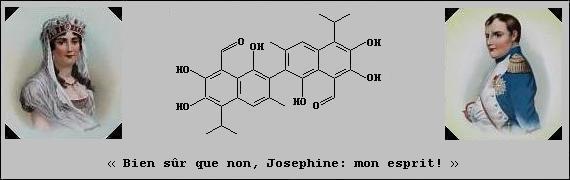
________________________________________________________________________________________
10.30 p.m. One night during the 8th week of term. In the Headmaster's bedroom, Mr. Pond is browsing through his stamp collection; his lady wife is lying in bed reading ...
Mr. POND.
Euphémie ?
Mrs. POND.
Oui, Bassett ?
Mr. POND.
Heu,... Ma chouette, puis-je suggérer que nous partageons du chocolat... au lait ?
Mrs. POND.
Absolument pas !
Mr. POND.
Euh ! Pourquoi pas ? Gustav m'a donné le feu vert.
Mrs. POND.
Peut-être bien, mais toujours est-il que nous ne voulons plus d'enfant : et pourtant nous n'employons plus un moyen de contraception.
Mr. POND.
Ô !... Tu as arrêté la pilule ?
Mrs. POND.
Bien sûr que oui... (Mr. Pond looks gloomy.)
Mr. POND.
Que faire ?...
Mrs. POND.
Bien,... tu pourrais utiliser un préservatif ?
Mr. POND.
Comment !? Jamais ! C'est comme porter les chaussettes dans le bain !
Mrs. POND.
Bôf! ... Eh bien : tant pis !... Alors, je crois que tu dois avoir une vasectomie ; c'est la seule solution à long terme.
Mr. POND.
Aïe ! Ma même masculinité !
Mrs. POND.
Ne dis pas de bêtises !... Vous autres hommes avez un tel sens mal fondé et singulier de la masculinité. (Her tone is withering.) Mmm ?... Eh bien, en attendant,... on pourrait satisfaire nos besoins à la fois par notre «nombre favori» ?
Mr. POND.
Non ! C'est pas le même.
Mrs. POND.
Quoi ? Fais comme tu veux. (She turns over in a deliberate manner.) Alors, éteins la lumière !
Mr. POND.
Oui, Euphémie chérie. (He switches off the light.) ...
4.15 p.m. One afternoon during the 9th week of term. In their study-dorm, sprawled out on bean bags, Constance and Trudi are idly chatting as they are drinking cups of tea ...
TRUDI.
Conny, ... have you ever been to the States?
CONSTANCE.
What, apart from Drummond Island, you mean?
TRUDI.
Yes.
CONSTANCE.
No, Trudi. ... Why do you ask?
TRUDI.
Well, ... I know it's a bit short notice and that, but I was wondering whether you might like to spend this vacation with me and my folks ...?
CONSTANCE.
Ooh! That's sounds a great idea! Let's see if my parents are at home. (They go on-line, very enthusiastically.) ...
11.30 a.m. One morning during the 10th week of term. Fr. Richelieu takes his nephew out for a stroll in the grounds of Narkover College; throughout, Richelieu assumes that Newton cannot understand him and is unaware of Newton's interpolations ...
Fr. RICHELIEU.
Newton, une petite histoire...
NEWTON POND.
"Petite"? Chance would be a fine thing!
Fr. RICHELIEU.
When your lady mother and I were growing up, we listened to a radio serial called The Archers — set in this county of Borsetshire. So, one summer vacation, we decided to explore south-west England in the expectation of finding places like Ambridge, Borchester, Felpersham, and Waterley Cross, which had become very familiar to us. ...
NEWTON POND.
The south-west!? My dear uncle, that would be Barsetshire — as in the novels of Thomas Hardy.
Fr. RICHELIEU.
However, the local peasants soon directed us towards middle England. ...
NEWTON POND.
Peasants they may have been: but clearly their knowledge of geography was much superior to your own!
Fr. RICHELIEU.
Whilst Borchester proved relatively easy to find, being the county town, the other towns and villages proved otherwise — and we got hopelessly lost. ... We found ourselves, in fact, over there; (He points in the direction of an expanse of
water.) yes, the other side of that lake. ... ...
NEWTON POND.
And!?
Fr. RICHELIEU.
And, (He sighs in a regretful manner.) fate stepped into the breach, so to speak, in the portly shape of Bassett. ... For my dear sister, he proved to be «love at first sight»; and, within a few weeks, Euphémie had become the wife of the recently appointed Headmaster of Narkover College. ...
NEWTON POND.
How charming!
Fr. RICHELIEU.
And this less than felicitous occasion — quite naturally — rekindled my interest in ravens. ...
NEWTON POND.
Eh? I'm afraid the connection escapes me.
Fr. RICHELIEU.
Though monstrously unfair to their beauty and intelligence, ravens have been considered by most cultures — since time immemorial — to be harbingers of doom and death. ...
NEWTON POND.
What an ungracious connection!
Fr. RICHELIEU.
Furthermore, although Narkover had become a raven sanctuary in the 1840s — as an incidental consequence of Borsetshire's major landowner, Lord Netherbourne, developing his pheasant shooting rights — I found out that there had been no studies on this particular habitat in the intervening years. ...
NEWTON POND.
I sense The Ravens of Narkover looming here.
Fr. RICHELIEU.
And so I initiated my field studies, which were to lead to Corvorum Narkoverae. ...
NEWTON POND.
Oh dear! (He yawns vociferously.)
Fr. RICHELIEU.
Ô ! Je suis desolé, Newton ; je me tais... Tu fais un petit somme...
11.45 p.m. Same night. In the Headmaster's bedroom, Mr. Pond and his lady wife are asleep; in the adjacent nursery are Newton (asleep) and Lily (awake) ...
LILY POND.
Gentle thespian, to inculcate you with a suitably rounded portrait of life chez the nursery would, strictly speaking, require me to present a long litany of my tribulations; and that, I fear, would try your patience as much as my brother does mine: accordingly, I will limit myself to a mere two. Firstly, whereas Newton's christening at the Lycée Villiers had been followed by a performance of Jan Dismas Zelenka's Missa Circumcisionis, my one — with the apparently «out of sorts» Signore and Signora Salieri standing as godparents — was a most lacklustre affair at Narkover's parish church; and, believe you me, the voices of their boys' choir were
neither broken nor unbroken: just broke. Whilst initially I attributed this «fobbing off» to my apparently second-class status as a female of the species, after mature reflection, I have since attributed same to Papa's current indisposition to travel. That said, and secondly, there can be no doubt that Newton is being overly favoured; as exemplified by his innumerable trips with the gentleman in the black cassock — who, I gather, is none other than my uncle. ... Curiously — or so it seems to me — their absences invariably coincide with the appearance of two or more Year 12 students; and, more often than not, these will be Brown et al. Quite why our nursery should be treated as some sort of laboratory is most baffling: but their activities certainly entertain me! Last week they did something to both our electronic mobiles, with the result that a musical chord resounds when a triplet appears. Intuitively, I suppose, I had expected that each musical chord would be unique to a triplet: but, apart from ATG on Newton's mobile, which corresponds to AUG on mine, this is not so; moreover, Newton's mobile stops temporarily whenever TAA or TGA or TAG are illuminated, as does mine whenever UAA or UGA or UAG are. ... Mmm? Perhaps these are teething problems? ... No matter, because — this afternoon — the quartet popped into the nursery with this picture. (She points in the direction of the one shown below.)
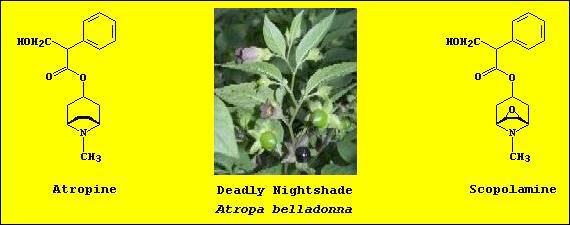
Between you, me, and this cot, I was none too enamoured with their latest offering; this flower is dull, no: plain ugly! However, its effect on Newton was a sight for my sore eyes: not only did he become positively wide-eyed, but his visage turned a dull shade of grey-green — not unlike these leaves, in fact. His signs of distress were followed by mutterings in French; for example, "Pas de carte de visite; je vous en
prie!" Sadly, I have not the vaguest idea what this means: on the other hand, his stricken tone of voice was certainly music to my ears. ...
3.00 p.m. One afternoon during the 11th week of term. In his lounge,
the Headmaster is browsing through a philatelic tome in a desultory
manner; Dr. Krautmann enters ...
Dr. KRAUTMANN.
Good afternoon, Bassett! (His tone is breezy.)
Mr. POND.
Afternoon, Gustav. (His tone is very muted. He waves in the direction of a chair: so Dr. K. sits himself down.)
Dr. KRAUTMANN.
Oh dear! Do I sense that my patient is champing at the bit to be back in harness? ...
Mr. POND.
No. No; not especially so.
Dr. KRAUTMANN.
Well, then, what's the problem? (His tone is concerned.)
Mr. POND.
Er, ... It's a rather personal matter. ...
Dr. KRAUTMANN.
Come on, Bassett, out with it! In the confessional stakes, I don't play second fiddle — even to the parish priest! ...
Mr. POND.
I wouldn't doubt that for a moment, no. But, um, ... I feel most uncomfortable talking about such things.
Dr. KRAUTMANN.
Ah! ... Are you alluding to the nether regions, in some way?
Mr. POND.
That's a mite prescient of you, Gustav.
Dr. KRAUTMANN.
No; not at all. But that's by the by. ... Now, yourself!?
Mr. POND.
Er, ... Well, ever since you gave me the all-clear, Euphémie has not so much put me on short rations as a «fasting». ...
Dr. KRAUTMANN.
That's no cause for concern, Bassett; no, true to form, your lady wife is merely being her usual considerate self.
Mr. POND.
No, no; you don't understand. She has issued — what is, for all intents and purposes — an ultimatum: my conjugal rights, so to speak, are well and truly behind me ... unless I agree to a ... a ... vasectomy.
Dr. KRAUTMANN.
Ah! Because Euphémie has no wish to add to her brood ...?
Mr. POND.
Yes; and I am — I hasten to add — at one with her there.
Dr. KRAUTMANN.
And so, ... what is your precise problem, then? ... ...
Mr. POND.
Well, ... I mean to say, ... a vasectomy! (Dr. K. initially looks puzzled; then he begins to smile.)
Dr. KRAUTMANN.
Bassett, surely you are not worried that you might be snowed under with invitations to sing «castrato» at the Royal Opera House? (He laughs indecorously.)
Mr. POND.
Gustav, this is no time for levity; no time at all! (Dr. K. continues to laugh.)
Dr. KRAUTMANN.
Forgive me, Bassett, but it is! I, for one, have never had so much as a single invitation. ...
Mr. POND.
Eh!? ... Are you telling me that you've had, er, ... ...?
Dr. KRAUTMANN.
The «snip»; yes, indeed I have.
Mr. POND.
Oh! I didn't know.
Dr. KRAUTMANN.
Well, that's hardly surprising; I really didn't see the need to take out a full-page advertisement in The Times! ...
Mr. POND.
So, like Euphémie, you must think I'm being foolish?
Dr. KRAUTMANN.
No; not in the least. ... Mmm? ... May I be so bold as to suggest that you and Euphémie come into my surgery for a detailed consultation?
Mr. POND.
Thank you, Gustav: but that won't be necessary. However, I would be grateful for some hard and fast information? ...
Dr. KRAUTMANN.
Well, Bassett, first and foremost you should appreciate that a vasectomy is not the male equivalent of a hysterectomy, be it from a physiological, a psychological, or a surgical perspective. ... In the medium- to long-term, neither one's sense of «masculinity» nor one's desire for sexual pleasure is diminished, because they are few if any hormonal changes; one's ability to father sprogs is maintained, providing, of
course, that one ensures a sperm sample is stored; and, finally, the operation itself — via the «Li technique» — is brief, painless, and safe. ... There's even a rumor floating around which suggests that sterilizing the «nut-crackers» is
most definitely de rigueur these days. (He smiles.)
Mr. POND.
Gustav!! (He winces.)
Dr. KRAUTMANN.
My apologies, Bassett; that was in poor taste, I must agree. Mmm, ... I suspect that you will find that the only mildly distressing aspect of the whole business is producing one or or two sperm samples. (He briefly adopts an expression of slight distaste.) However, this minor inconvenience is more than compensated by the realization that — after a period of three or four months, to allow your remaining sperm to clear from the vasa — all considerations of contraception become a thing of the past, ... providing, of course, neither you nor Euphémie stray, so to speak.
Mr. POND.
Gustav!!
Dr. KRAUTMANN.
Yes, Bassett?
Mr. POND.
That last comment was most uncalled for!
Dr. KRAUTMANN.
On the contrary, my dear Bassett. ... I would accept that my choice of euphemism was not particularly felicitous: but its substance cannot be gainsaid, and would not be by any self-respecting doctor. ... I'm well aware that your marriage is rock-solid, but the future is surely an unpredictable beast?
Mr. POND.
Er, ... Yes, ... I suppose it is. (His tone is distracted.)
Dr. KRAUTMANN.
Bassett, are you still brooding about my infelicity?
Mr. POND.
No, no. ... I was just reflecting on how my students might react, if they were to get wind of my anticipated «status». (He looks quite disconcerted.)
Dr. KRAUTMANN.
Ah! ... With respect, Bassett, there you are being foolish. In so far as information on your vasectomy will be limited to «a need to know basis», they should be none the wiser as to your status, whatever that be. And, on a lighter note, I'd contend that you were flattering yourself to an uncommon degree to suppose that they would be overly interested! ... Now, may I suggest that you and Euphémie have another natter before the pair of you fix up an appointment to come into my surgery?
Mr. POND.
That won't be necessary, Gustav. Please be a good fellow and arrange to have me pencilled in for this vacation.
Dr. KRAUTMANN.
No, Bassett; that is not the procedure. While the venue is not set in stone, it is essential that I discuss the matter with both of you, together. ...
Mr. POND.
Fair enough, Gustav; I'll have a word with Euphémie.
Dr. KRAUTMANN.
Splendid! (He rises from his chair.) I will leave you in peace to ponder over this, that ... and, indeed, the other. (He smiles.) Ciao! ...
________________________________________________________________________________________
5. Canvas - « An accursed harvest? »
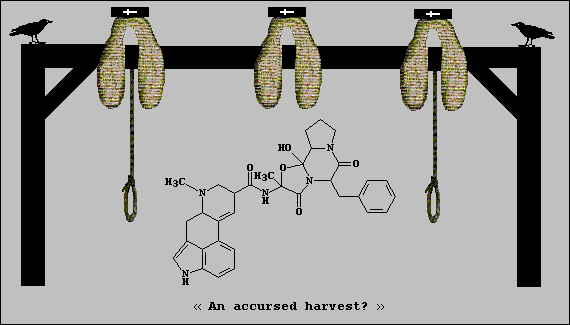
________________________________________________________________________________________
2.45 p.m. One afternoon during the 12th week of term. Fr. Richelieu takes the Lower 6th-Remove for their last lesson of General Studies ...
Fr. RICHELIEU.
Bonjour, mesdemoiselles et messieurs.
CLASS.
Bonjour, Monsieur le proviseur...
Fr. RICHELIEU.
Tout d'abord, je fais l'appel... Mlle Salice Albero.
SALICE.
Présent, Monsieur.
Fr. RICHELIEU.
Mlle Constance Bonacieux.
CONSTANTCE.
Présent, Monsieur.
Fr. RICHELIEU.
Brow... Non ! C'est impoli... Hamish Brown.
BROWN.
Présent, Monsieur.
Fr. RICHELIEU.
Mlle Shandy Drynck.
SHANDY.
Présent, Monsieur.
Fr. RICHELIEU.
Scudamore East.
EAST.
Présent, Monsieur.
Fr. RICHELIEU.
Rudolph Flashman.
FLASHMAN.
Présent, Monsieur.
Fr. RICHELIEU.
Mlle Malice A. Forthort.
MALICE.
Présent, Monsieur.
Fr. RICHELIEU.
Ah ! Dr Stuart m'a dit qu'une gerbe de belladones est «la carte de visite» de quelque-unes des filles, y compris vous-même, Malice ?
MALICE.
Heu,... Oui, Monsieur, (She, Alice, and Salice exchange brief nervous looks.) mais cette trimestre, du moins, nous n'en avons pas envoyées,... vraiment! (Both Alice and Salice nod their heads; which, in turn, prompts looks of a dawning
realization on the part of F., Me., McK., W., and Z.)
Fr. RICHELIEU.
Ô !?... Vous n'êtes pas donc responsable du tableau de la belladone chez la nursery de mon neveu ?
MALICE.
Je suis désolée, Monsieur, mais je n'en sais rien...
Fr. RICHELIEU.
Très bien... Mlle Alice Lidell-Lonsdale.
ALICE.
Présent, Monsieur.
Fr. RICHELIEU.
Duncan McKechnie.
McKECHNIE.
Présent, Monsieur.
Fr. RICHELIEU.
Eh bien !! Duncan, j'ai entendu dire que vous êtes chef des «sans-culottes» ?
McKECHNIE.
Non, Monsieur ; sauf votre respect, vous avez été mal renseigné... D'abord, je ne suis point le chef du rien ; et, enfin, le sobriquet des «sans-culottes» était l'un des
plaisanteries du docteur Stuart, heu,... Comment dirais-je avec délicatesse ?... pas particulièrement convenable.
Fr. RICHELIEU.
Bôf ! Nous savons tous les deux qu'il y n'a pas de fumée sans feu !...
McKECHNIE.
Peut-être bien, Monsieur, mais tout le monde peut tourner une nouvelle feuille. (He sounds innocent cum defensive.)
Fr. RICHELIEU.
C'est bien cela... Et, «le jour où les poules auront des dents» !?... Mmm,... On s'écarte du essentiel. Je sais de source sûr que — soit qu'on vous appelle les «sans-culottes» ou que vous appeliez vous-mêmes «La Jeunesse dorée» — votre «carte de visite», pour ainsi dire, est le manteau rouge ?
McKECHNIE.
Heu,... Oui, Monsieur, nous devons le reconnaître ; dans le passé, bien sûr.
Fr. RICHELIEU.
Vraiment !?... Vous n'êtes pas donc responsable du tableau de la variété «Red Cloak» de la fleur de Paques,... chez la nursery? (McK. looks completely bemused.)
McKECHNIE.
Non, Monsieur ; absolument pas.
Fr. RICHELIEU.
Alors,... heu,... oui, Shandy ?
SHANDY.
Excusez-moi l'interruption, Monsieur, mais,... peu de temps avant,... quel est le sens de l'expression «le jour où les poules auront des dents», s'il vous plaît ? (McK. gives her a look of gratitude cum relief.)
Fr. RICHELIEU.
Voyons un peu... Ah ! En anglais : Pigs might fly!
SHANDY.
Merci, Monsieur. (She and several others smile.)
Fr. RICHELIEU.
Heu,... Où en étais-je ? (He looks down at the register.) Jack Merridew.
MERRIDEW.
Présent, Monsieur.
Fr. RICHELIEU.
Toby Mumford.
MUMFORD.
Présent, Monsieur.
Fr. RICHELIEU.
Ralph Pattullo.
PATTULLO.
Présent, Monsieur.
Fr. RICHELIEU.
Pig... Non ! (He looks irritated; then sotto voce.) C'est pas nécessaire... Mlle Chalice Poison.
CHALICE.
Présent, Monsieur.
Fr. RICHELIEU.
Mlle Popsy Rice.
POPSY.
Présent, Monsieur.
Fr. RICHELIEU.
Mlle Flora Stuart.
FLORA.
Présent, Monsieur.
Fr. RICHELIEU.
Mlle Lolli Stich.
LOLLI.
Présent, Monsieur.
Fr. RICHELIEU.
Mlle Trudi Taplow.
TRUDI.
Présent, Monsieur.
Fr. RICHELIEU.
James Unman.
UNMAN.
Présent, Monsieur ; heu,... Jock, Scud, Mumsy et moi étaient responsables des tableaux chez la nursery, Monsieur...
Fr. RICHELIEU.
Je vois... C'est vrai, Toby ? (No reply; Mumford is gazing out of the window.) Mumford !!?
MUMFORD.
Oui, Monsieur ?
Fr. RICHELIEU.
Êtes-vous sourd !?
MUMFORD.
Heu,... En fait je suis malentendant, Monsieur ; mais j'ai égaré ma prosthèse auditive. (He looks rather sheepish, whereas Richlieu looks embarrassed.) Désolé, Monsieur ; vous m'avez posé une question ?
Fr. RICHELIEU.
Non, non ; cela importe peu... George Wittering.
WITTERING.
Présent, Monsieur.
Fr. RICHELIEU.
Frederick Zigo.
ZIGO.
Présent, Monsieur.
Fr. RICHELIEU.
Bon ; tous présents à l'appel... Maintenant : la nursery ! Je dois dire que j'étais en colère de trouver cette pièce étant utilisée comme un dépotoir pour vos bric-à-brac ; et, pour être tout à fait franc avec vous, ma colère ne s'est pas calmé lorsque votre proviseur, M. Pond, (His tone is distinctly acerbic here.) m'a suggéré ce bric-à-brac peut être une partie des expériences avec un but pédagogique... C'était vrai, Toby ?... ...
MUMFORD.
Pas exactement, Monsieur. Bien qu'il ait pu circuler dans les derrières de nos têtes, heu,... je suis presque sûr que nous n'en avons pas formulé exactement de ce point de vue. (He glances at several of the other students, who shrug and nod their heads in an uncertain manner.) ...
Fr. RICHELIEU.
Je vois... Et pourtant, à ma grande surprise, tous les deux le docteur Stuart et ma sœur — heu,... Mme Pond — ont pensé que des «expériences» ont pu être un tentative de
suivre un aspect du «cheval bataille» actuel du proviseur ; soit le consiliens, ou, en français, «l'unicité du savoir»... Bien intentionnées mais mal fondées ? Seul l'avenir nous le dira... Quoi qu'il en soit, de fil en aiguille, et j'ai avancé la suggestion qu'une piste plus avantageuse peut être par un «Questionnaire anthropomorphique de Proust» ; et, heureusement, le bon docteur était d'accord avec moi... Oui, Flora ?
FLORA.
Excusez-moi, Monsieur, qu'est-ce que ce questionnaire, s'il vous plaît ?
Fr. RICHELIEU.
Ah ! D'abord, une petite histoire... Au XIXe siècle, une mode importée d’Angleterre en France faisait fureur chez les jeunes filles de bonne famille : «l’album de confidences», soit keepsake, en anglais ; et, elles priaient leurs proches de répondre par écrit à des séries de questions portant sur leurs goûts et leurs traits de caractère... Voyons un peu, George et Frederick, soyez l'amabilité, faites les honneurs ? (He holds two sheafs of blank questionnaires; one in French and the other in English, with Braille versions for Flora.)
WITTERING & ZIGO.
Oui, Monsieur. (They hand out a copy of each questionnaire to each student; then a couple of minutes later ...)
Fr. RICHELIEU.
Merci... Un tel questionnaire est appelé le «Questionnaire de Proust» — par pur hasard — parce que Marcel Proust, le fameux philosophe français, se prêta au moins deux fois à «ce jeu de société» ; soit vers 1886 et vers 1893, à l'âge de vingt et un ans... Maintenant, comme vous êtes en train de prévoir, ma modification doit être différente à cause du mot anthropomorphique : ... vous n'auriez pas tort ! (He smiles.) Nous vous aimerions utiliser un tel questionnaire pour des choses, par opposition aux personnes ; et, spécifiquement à un aspect scientifique de vos propres drames. (Merridew utters an audible groan.) Jack, qu'est-ce qu'il y a? (His tone is solicitous.)
MERRIDEW.
Heu,... Je vous prie de m'excuser, Monsieur ; ... je viens d'avoir un chat dans la gorge. (His tone and expression are of studied innocence.)
Fr. RICHELIEU.
C'est mourait ? (His tone and expression are dead-pan.) ...
MERRIDEW.
Heu, ... Comment, Monsieur ?
Fr. RICHELIEU.
Non ; peu importe. (He looks at his watch.) Pour conclure cette leçon, je vous voudrais enlever vos bric-à-brac de la nursery. (None of the class move.) Hmph ! Il ne faut que jamais remettre au lendemain ce que l'on peut faire le jour même ! (Every member of the class mutters "Oui, Monsieur.", then makes a bee-line for the door.) ...
9.00 p.m. Last evening of term. In his study, Dr. S. is reading while listening to Wolgang Mozart's fortepiano concerto K456; the telephone rings, with his ex-wife Diana on t'other end ...
Dr. STUART.
Narkover, double two, four; Dr. Stuart speaking.
DIANA.
Good evening, Desmond! (He utters a groans of irritation.)
Dr. STUART.
Evening, Diana. And to what do I owe this dubious pleasure?
DIANA.
Desmond! Don't sound so peevish; it doesn't suit.
Dr. STUART.
That's as maybe. ... Well!?
DIANA.
I've just rung up to tell you that Philip and I'll be there at the crack of dawn to collect Flora, Constance, and Trudi.
Dr. STUART.
Constance and Trudi? Why those two?
DIANA.
Desmond, do you ever pay attention to what goes on beyond those gray walls of Narkover? Obviously not! The Taplows live only a few blocks away: so it makes sense for us to escort Trudi safely home.
Dr. STUART.
I see. And has Flora invited Constance over to Boston for the Easter vacation?
DIANA.
No! (She sounds surprised.) Constance will be staying with Trudi; she's never been to the States before; and the pair of them want to check out aspects of colonial Massachusetts for some play they are writing together.
Dr. STUART.
Oh! ... How splendid!
DIANA.
Now, I must love you and leave you... (He interrupts.)
Dr. STUART.
Just the latter, please! Good night, Diana. (He places the receiver down.) ...
11.45 p.m. Same night. In the Headmaster's bedroom, the Mr. Pond and his lady wife are asleep; in the adjacent nursery are Newton (asleep) and Lily (awake) ...
LILY POND.
Gentle thespian, this final week of term has been witness to a sense of «demobilization» throughout the school, and, as you will have observed already, chez the nursery. And, the catalyst for the sea change in our abode — which, for better or worse, no longer houses any of the paraphernalia donated by the «Remove» — was Newton, or, to be strictly accurate, the picture of Atropa belladonna. Ever since its arrival, a few week ago, my brother had been unusually quiet; withdrawn
might be le mot juste. However, Uncle Benoît appeared to be blissfully unaware of Newton's atypical behaviour until the latter poked one of his chubby fingers at the picture to the accompaniment of torrents of tears. ... Well, the immediate consequence of this most undignified scene was that my uncle surveyed the nursery with fresh eyes; and, as he did so, his mood rapidly approached the colour of his cassock. And, two days later, the members of said Remove trooped in to remove their bonnes bouches, bag and baggage. ... Needless to say, perhaps, but these recent events have had the undesirable effect of restoring the status quo; that is, Newton being an insufferable blot. ... Nevertheless, my horizon would appear to have a silver lining, because we're going on holiday next week, en famille, to La Rochelle. No. No; that's not quite true. Papa will be staying here at Narkover, so that he can
have une opération délicate — whatever that is. Mmm, ... I wonder what next term will bring? ...
Playlet 9 (Summer Term 3) and Epilogue (Speech Day 3):
La Capricciosa and Magnificat
References
Anon.: Recueils des documents non catalogués (2e tome), Éditions du Lycée Villiers, La Rochelle, n.d.
Bach, J. C. (1735-1782): 6 Symphonies (Op.3, London 1765); CPO 999268.
Bach, J. C.: Sonata for Fpn. in A major (Op.17 no.5, London, 1774); Chandos CHAN0543.
Bach, J. C.: Amadis des Gaules (opera; 1st performance in Paris on the 14th of December, 1779); Hänssler-Verlag CD98963.
Bauer, W. A., et al. (Eds.): Wolfgang Amadeus Mozart: Briefe [no. 547] und Aufzeichnungen (Gesamtaugabe), Kassel, 1962-75.
Bottin, M. P. B.: Récit abrégé des souffrances de près de huit cents
ecclésiastiques [dans la rade de l'île d'Aix, 1794-1795...], Crapart,
Paris, 1796 [Transcription].
Boulogne, J. (1739-1799): Quartet for 2Vn., Va., and Vc. in C major (1765-6?, à M. ... Robecq; Op.1a no.1, Paris, 1773); Arion ARN55425.
Boulogne, J.: Concerto for Vn., 2Fl., 2Ob., 2Hn., and Str. in D major (Op.3 no.1, Paris, 1774/5); Arion ARN68093.
Boulogne, J.: Ernestine & La Chasse (operas; 1st performances in Paris
on the 18th of July, 1777, & the 12th of October, 1778, respectively); the overture to La Chasse maybe the sinfonia in D major, Op.9 no.2 (recorded by Arion; ARN55434).
Cannabich, J. C. (1731-1798): 24 Symphonies and Orchestral Trios (Op.1, 2, 3, and 4), Paris, 1766.
Collodi (né Lorenzini), C. (1826-1890): Le avventure di Pinocchio, Paggi, Florence, 1883.
Corrette, M. (1709-1795): 6 Concertos (musette/vielle; Op.7), Paris, 1731.
Corrette, M.: 6 Concertos comiques (Paris, 1733-56); Adès 205432.
Corrette, M.: L'école d'Orphée ... (Op.18), Paris, 1738.
Dumas, A. (1802-1870): Les trois Mousquetaires and Le Comte de Monte
Cristo, Paris, 1844 and 1845.
Forqueray, J. (1699-1782): La Forqueray for Hpd. in D minor (ex. Livre
de Clavecin de Madame Forqueray, Paris, 1747); Globe 6027.
Futch, O. L.: History of Andersonville Prison, University Press of Florida, Gainsville, 1968.
Fraser, G. M.: Flashman, Jenkins, London, 1969; et seq.
Gossec, F.-J. (1734-1829): 6 Symphonies (RH1-6; Op.3), Paris, 1756.
Gossec, F.-J.: Mass for SSTB, 2Fl., 2Ob., 2Cl., 2Hn., 2Bn., 2Tpt., 3Trbn., Timp., and Str. (RH501, Requiem; Paris, 1760); Erato ECD75359.
Grétry, A.-M. (1741-1813): Le Jugement de Midas (opera; 1st performance in Paris on the 28th of March, 1778); Ricercar RIC06033 (extracts).
Hasse, J. A. (1699-1783): Cantata for Soprano, Glass Harmonica, 2Ob., 2Hn., Str., and B.c. (L'Armonica; Vienna, 1769); Adda 581147.
Haüy, R.-J. (1743-1822): Exposition abrégé de la théorie sur la structure des Crystaux, Paris, 1792.
Haüy, V. (1745-1822): Essai sur l'éducation des aveugles, Paris, 1786.
Haydn, J. (1732-1809): 21 Symphonies (H1:1-5,10,11,14,15,17-20,25,27,
32,33,36,37,107,108; ‹1764); Decca 436428-2 and 436592-2.
Haydn, M. (1737-1806): 6 Symphonies (S.:1-6; 1761-1764); CPO 999591.
Laclos, P. A. C. de (1741-1803): Les Liaisons dangereuses, Paris, 1782.
Landon, H. (Ed.): The Mozart Compendium, Thames & Hudson, London, 1990.
Maier, P.: American Scripture, A. Knopf, New York, 1997.
Mason, E. J. & Webb, G. A.: The Archers of Ambridge, Newnes, London,
1954; B.B.C. radio serial 1951-.
Mozart, L. (1719-1787): Sinfonia for Hurdy-gurdy, Bagpipes, 2Ob., 2Bn., 2Hn., Str., and B.c. in D major (Die Bauernhochzeit; 1755), Suite for 2Ob., 2Bn., 2Hn., 4Tpt., Timp., Str., Sleigh bells, and B.c. in D major (Musikalische Schlittenfahrt; 1755), and Sinfonia for 2Va., 2Vc., and B.c. in G major (Burlesca); Deutsche Grammophon 427122-2.
Mozart, L.: Sinfonia for Shepherd Horn, 2Vn., Va., and B.c. in G major (Pastorella; ‹1756), and Sinfonia for 4Hn., Shotgun, Str., and B.c. in
G major (Caccia; ‹1756); Dabringhaus und Grimm MDGL3085.
Mozart, L.: Versuch einer gründlich Violinschule, Augsburg, 1756.
Mozart, L.: 6 Symphonies (E.:D18,D26,F2,F6,G5,G7; ‹1761); CPO 999142.
Mozart, W. (1756-1791): 2 Sonatas for Hpd. with Vn. (KV8 and KV9; Op.2, à la comtesse de Tessé, Paris, 1764); Philips 438803-2.
Mozart, W.: Serenade for Hpd., 2Ob., 2Hn., 2Bn., and Str. in D major (KV32, Galimathias Musicum; 1766); Decca 452496-2.
Mozart, W.: Concerto for Vn., 2Ob., 2Hn., and Str. in D major (KV211; 1774/5); Decca 455721-2.
Mozart, W.: Symphony for 2Fl., 2Ob., 2Cl., 2Hn., 2Tpt., Timp., and Str. in D major (KV297, Paris; 1778); Decca 452496-2.
Mozart, W.: Sonata for Fpn. in C major (KV309, für Rosa Cannabich;
1777); BIS CD837.
Mozart, W.: Mass for SSTB, Fl., 2Ob., 2Bn., 2Hn., 2Tpt., 3Trbn., Timp., Str., and Org. in C minor (KV427, Great Mass; 1782); Philips 420210-2.
Mozart, W.: Concerto for Fpn., Fl., 2Ob., 2Bn., 2Hn., and Str. in B flat major (KV456, für Maria Theresia Paradies; 1784); Archiv 463111-2.
Mozart, W.: Rondo for Fpn. in a minor (KV511; 1787); BIS CD894.
Mozart, W.: Sextet for 2Vn., Va., Bs. and 2Hn. in F major (KV522, Ein
musikalischer Spass; 1787); Sony SK46702.
Mozart, W.: Il Don Giovanni (KV527, opera; 1786/7; 1st performance in Prague on the 29th of November, 1787); Decca 425943-2.
Mozart, W.: Adagio for Glass Harmonica in C Major (K617a, für Marianne
Kirchgessner; 1791); Ricercar 240672.
Mozart, W.: Mass for SATB, 2Bt.-Hn., 2Bn., 2Tpt., 3Tpt., Timp., Str., and Org. in D minor (KV626, Requiem; 1791); Philips 420197-2.
Ollivier, M.-B. (1712-1784): Le Thé à L'Anglais ... du Temple à Paris, May-June 1766; La Réunion des Musées Nationaux, Paris.
Peters, R.: An Overview of Period Instrument CDs (1580-1830) [Br.].
Peters, R.: Aufbau1 (a teaching resource for Year 10-11 chemistry students, which contains no falsehoods, no half-truths, and no non sequiturs: Student's Version & Teacher's Notes), unpublished Mss., 1996.
Peters, R.: Hat Wissensdrang die Katze getötet? (a suite of multidisciplinary resources for Year 10 and 11 students; including Playlets 1, 2, & 3), unpublished Mss., 1996.
Peters, R.: Eine Spinnwebe von Wissen? (a suite of multidisciplinary resources for Year 10 and 11 students; including Playlets 4, 5, & 6), unpublished Mss., 1998/99.
Peters, R.: Konsilienz: Die Kunst für die wissende Katze? (a suite of multidisciplinary resources for Year 12 students; including Playlet 7, unpublished Ms., 2000/02.
Prouteau, G. (1917-2000): La Nuit de l'île d'Aix, Albin Michel, Paris, 1985.
Schobert, J. (1735-1767): Sonata for Hpd. in F major (Op.5 no.2, Paris, 1764); ASV Gaudeamus CDGAU172.
Silvestre, J. (1841-1913): Les Brûlots anglais en rade de l'île d'Aix -
1809, Savaète, Paris, 1912 [Transcription].
Smidak, E.: Joseph Boulogne, nommé chevalier de Saint-Georges, Avenira
Foundation, Lucerne, 1995.
Terry, C. S. (1864-1928): John Christian Bach, Oxford University Press, 2nd Edition, 1967.
The Holy Bible, (Authorized) King James' Version, 1611: Zec. 7:8-10.
Trollope, A. (1840-1928): The Warden, Longman, London, 1855; et seq.
MM. Jean Claude Halley et Michael Donnan avaient la patience de lire la pièce close, Musique en double aveugle, et de corriger mes maladresses. Je les en remercie ici, tout en précisant qu'ils ne sont en aucune manière responsable du contenu, que j'assume entièrement.
Dr. R. Peters' Home Page