ORGANIC CHEMISTRY: MALE CONTRACEPTIVES
A research chemist executed studies on the synthesis of chemicals which
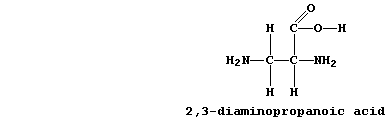
might have potential as male contraceptives. The 'lead' compound chosen
was 2,3-diaminopropanoic acid (DAP):
The scientist's reasoning for choosing this particular compound was
complicated, though pivotal to the choice were biological and chemical
similarities of the following four compounds.
Indolyl-3-ethanoic acid, "T", was the first plant growth regulator to
be identified and characterized (1934-1936); its effects are observed
in the familiar tropic activities of plants (e.g., the phototropism
first noted by Charles Darwin in 1880), and it is known to be directly
involved in both protein and RNA synthesis.
Ethene, "U", perhaps surprisingly, is also a plant growth regulator; in
this context, it is used commercially as a method of ripening fruit.
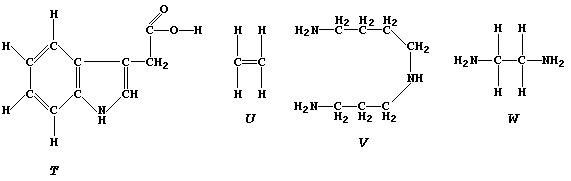
Spermidine, "V", is a natural tri-amine present in the seminal fluid
secreted by mammals.
1,2-Diaminoethane, "W", forms numerous platinum(II) compounds; some of
these show anti-cancer activity and, therefore, most probably affect
the DNA of cancerous cells.

1.  Suggest one reason why the exponential increase in human population
is causing concern. ___________________________________________________
                                                                    [1]
2.  Naturally occurring female hormones, which prevent follicle growth
and ovulation, are produced synthetically and incorporated into several
contraceptives. Name two such hormones. _______________________________
                                                                    [2]
3.  State two functional groups which are shared between DAP and one or
more of the compounds "T" to "W". _____________________________________
                                                                    [2]
4.  What do the abbreviations RNA and DNA stand for? __________________
_______________________________________________________________________
                                                                    [2]
5.  Compounds "T" to "W" are directly or indirectly involved with which
two characteristics of living organisms? ______________________________
                                                                    [2]
6.  Plants biosynthesize acid "T" in response to the stimulus of light.
Name two other tropisms and their corresponding stimuli. ______________
_______________________________________________________________________
                                                                    [4]
7.  Ripening fruit requires only a small quantity of ethene, "U"; this
is obtained by the catalytic dehydration of ethanol. Construct the
symbol equation for this reversible reaction. _________________________
_______________________________________________________________________
_______________________________________________________________________
                                                                    [2]
8.  Suggest the reason why spermidine, "V", is called a 'tri-amine'.
_______________________________________________________________________
                                                                    [1]
9.  Noting that certain platinum(II) compounds of "W" show anti-cancer
activity, suggest one other metal ion which might also be effective.
_______________________________________________________________________
                                                                    [1]
10. The synthetic route chosen by the scientist to 2,3-diaminopropanoic
acid, a known compound, is shown below: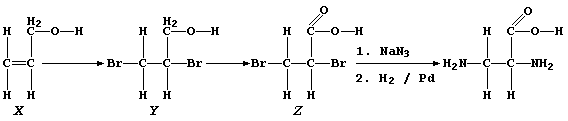
(a) State the colour change observed during the course of the addition
reaction of bromine with alcohol "X". _________________________________
(b) Alcohols "X" and "Y" are liquids at room temperature, with similar
boiling points. What physical technique could be used to separate a
mixture of "X" and "Y"? _______________________________________________
(c) Name a reagent which could oxidize alcohol "Y" to dibromo-acid "Z".
_______________________________________________________________________
(d) Name the gas evolved when a mixture of dibromo-acid "Z" and aqueous
sodium hydrogencarbonate was warmed. __________________________________
(e) The conversion of dibromo-acid "Z" to DAP involves a substitution
reaction and a reduction (step 2). Suggest the purpose of the palladium
in this second step. __________________________________________________
(f) Suggest one physical test used to confirm that DAP, a crystalline
substance, had been obtained. _________________________________________
                                                                    [6]
(g) The scientist considered an alternative to the synthetic route to
DAP; specifically, a fermentation process using propene as the starting
material. Suggest two potential advantages of this process. ___________
_______________________________________________________________________
                                                                    [2]
(h) Tests on laboratory rats showed that DAP was partially successful;
thus, rats injected with DAP were less fertile than the controls (i.e.,
those used to isolate the independent variable; these were not injected
with DAP). Accordingly, more compounds were synthesized - including two
isomers obtained by the hydration of compound "X". Draw the structural
formula of each isomer. _______________________________________________
_______________________________________________________________________
_______________________________________________________________________
_______________________________________________________________________
_______________________________________________________________________
_______________________________________________________________________
_______________________________________________________________________
                                                                    [3]
(i) This research was shelved as soon as some potentially devastating
news began to circulate in the early 1980s. Suggest one disadvantage in
using chemical contraceptives. ________________________________________
_______________________________________________________________________
                                                                    [1]


Dr. R. Peters                                            Contents' List

                        Metals - Introduction (1)